


S3 charges you for six different things simultaneously. Most teams only think about the first one — storage. But a 10TB dataset accessed daily through Athena queries can generate more in request costs than in storage costs. A lifecycle policy transitioning 100 million small objects to Glacier costs $5,000 in transition fees alone before you save a single dollar on storage. And routing 5TB monthly directly to users instead of through CloudFront wastes $450 in completely avoidable egress charges.
Amazon S3 consistently ranks among the top three AWS cost drivers for data-intensive organizations, yet remains one of the most misunderstood services from a pricing perspective. According to a September 2025 Crayon study, 94% of IT leaders report ongoing struggles optimizing cloud storage costs despite years of cloud adoption. The complexity stems from S3’s multi-dimensional pricing model: storage rates vary 23× between the cheapest and most expensive classes, request charges change based on operation type and storage class, retrieval fees can exceed storage costs for infrequently accessed data, and data transfer pricing follows Byzantine tiered structures with special cases and exceptions.
How Amazon S3 Pricing Works — The 3 Billing Pillars
Amazon S3 billing operates across six independent dimensions that accumulate simultaneously, making cost estimation deceptively complex. Most teams focus exclusively on storage rates while ignoring the five additional cost sources that often represent 30-50% of total S3 spending.
Pillar 1 — Storage costs bill per GB-month based on the storage class you select when uploading objects or through lifecycle policy transitions. Rates span from $0.00099/GB-month for Glacier Deep Archive (the absolute cheapest option requiring 12-48 hour retrieval) to $0.16/GB-month for S3 Express One Zone (ultra-high-performance single-AZ storage delivering single-digit millisecond latency). Standard S3 storage — the default choice — costs $0.023/GB-month for the first 50TB with volume discounts applying beyond that threshold. Storage billing calculates daily average usage and bills monthly, meaning 100GB stored for 15 days costs approximately $0.345 (100GB × $0.023 ÷ 30 days × 15 days).
Pillar 2 — Requests and data retrievals charge per API call regardless of success or failure. PUT, COPY, POST, and LIST operations cost $0.005 per 1,000 requests for Standard storage, while GET and SELECT operations cost $0.0004 per 1,000 requests. These rates multiply 2-10× for Infrequent Access and Glacier classes. Additionally, retrieving data from Glacier classes incurs separate per-GB retrieval fees ranging from $0.01/GB (Standard-IA) to $0.03/GB (Glacier Instant Retrieval) — fees that can dwarf storage costs if you retrieve bulk archived data. A million GET requests against Standard storage costs $0.40; the same million GETs against Glacier Instant Retrieval cost $10 plus $0.03/GB for every gigabyte returned.
Pillar 3 — Data transfer (egress) charges for data leaving S3 while inbound transfer remains free. The first 100GB monthly egress to the internet is free (aggregated across all AWS services), then tiers begin: $0.09/GB for the next 9.9TB, $0.085/GB for the next 40TB, $0.07/GB for the next 100TB, and $0.05/GB beyond 150TB. Critical exception: S3-to-CloudFront data transfer in the same region is completely free. Transferring 10TB monthly directly from S3 to internet users costs approximately $922; routing through CloudFront eliminates the S3 egress charge entirely and typically costs $850 in CloudFront egress instead, while adding global edge caching that reduces origin requests by 80-95%.
All 5 S3 Storage Classes — Pricing & Use Cases
Amazon S3 offers nine distinct storage classes, each optimized for specific access patterns, performance requirements, and cost priorities. Selecting the appropriate class based on actual usage determines whether S3 costs represent 2% or 15% of your AWS bill for the same dataset.
Complete storage class comparison (us-east-1 pricing):
| Storage Class | $/GB/Month | Min Duration | Retrieval Fee | Latency | Best For |
| S3 Standard | $0.023 | None | None | Milliseconds | Frequently accessed data |
| S3 Standard-IA | $0.0125 | 30 days | $0.01/GB | Milliseconds | Monthly backups, DR files |
| S3 One Zone-IA | $0.01 | 30 days | $0.01/GB | Milliseconds | Reproducible infrequent data |
| S3 Express One Zone | $0.16 | None | None | Single-digit ms | ML training, real-time analytics |
| S3 Intelligent-Tiering | Varies | None | None | Milliseconds | Unknown/changing access patterns |
| S3 Glacier Instant Retrieval | $0.004 | 90 days | $0.03/GB | Milliseconds | Quarterly archives, media |
| S3 Glacier Flexible Retrieval | $0.0036 | 90 days | $0.01/GB+ | Minutes–12 hrs | Annual archives, compliance |
| S3 Glacier Deep Archive | $0.00099 | 180 days | $0.0065/GB+ | 12–48 hrs | 7–10 yr retention |
| S3 Tables | $0.0265 | None | None | Milliseconds | Analytics (Athena, Redshift, EMR) |
S3 Standard — The Default Choice
S3 Standard represents AWS’s foundational object storage with the highest performance, availability, and durability guarantees. Storage pricing follows volume tiers: $0.023/GB-month for the first 50TB monthly, $0.022/GB-month for the next 450TB (50-500TB total), and $0.021/GB-month beyond 500TB. These tiers apply per AWS account per region per month, meaning 600TB stored in us-east-1 costs (50TB × $0.023) + (450TB × $0.022) + (100TB × $0.021) = $1,150 + $9,900 + $2,100 = $13,150 monthly.
Standard storage enforces no minimum storage duration — delete an object one hour after upload and pay for exactly one hour at the monthly rate divided by 720 hours. No retrieval fees apply regardless of access frequency or volume. Objects replicate across a minimum of three physically separated Availability Zones within the selected region, delivering 99.999999999% (11 nines) durability and 99.99% availability SLA.
Request pricing for Standard: PUT, COPY, POST, and LIST operations cost $0.005 per 1,000 requests; GET, SELECT, and all other requests cost $0.0004 per 1,000 requests. DELETE and CANCEL operations are always free across all storage classes, encouraging aggressive cleanup of unnecessary data.
When to use S3 Standard: Any actively accessed data including application assets, user-uploaded content, streaming media, website files, frequently queried datasets, and operational logs. If access patterns are uncertain, start with Standard and analyze usage with Storage Class Analysis after 30 days. The absence of retrieval fees and minimum duration charges makes Standard the safest choice when costs are unpredictable. Learn more about optimizing S3 costs for production workloads.
S3 Standard-IA — Infrequent Access
Standard-IA (Infrequent Access) targets data accessed less than monthly but requiring millisecond retrieval latency when needed. Storage costs $0.0125/GB-month — 46% cheaper than Standard — but adds $0.01/GB retrieval charges and higher request costs. PUT operations cost $0.010 per 1,000 requests (2× Standard), while GET requests cost $0.001 per 1,000 (2.5× Standard).
Standard-IA enforces a 30-day minimum storage duration — objects deleted before 30 days bill for the full 30 days regardless of actual duration. A 128KB minimum object size applies; objects smaller than 128KB bill as 128KB. Ten 10KB files consume 10KB actual storage but bill as 1,280KB (10 × 128KB), making Standard-IA economically unsuitable for small objects. Objects replicate across three AZs with identical durability (11 nines) and slightly reduced availability (99.9% vs 99.99%) compared to Standard.
Cost breakeven analysis: Standard-IA becomes cheaper than Standard when monthly access (retrieval + increased request costs) remains below the storage savings. For 100GB stored one year:
- Standard: 100GB × $0.023 × 12 = $27.60
- Standard-IA: (100GB × $0.0125 × 12) + retrieval costs
If you retrieve the entire 100GB once: Standard-IA = $15 storage + $1 retrieval = $16 total — still $11.60 cheaper than Standard annually. Retrieve twice: $15 + $2 = $17 — still cheaper. Retrieve three times or more: Standard-IA costs exceed Standard, negating the storage discount.
When to use Standard-IA: Monthly or quarterly backups, disaster recovery datasets you hope never to access, compliance documentation retrieved annually, user data from churned customers kept for contractual periods, and infrequently accessed logs. Avoid Standard-IA for data accessed weekly or more frequently; the retrieval fees negate storage savings.
S3 One Zone-IA — Single AZ Storage
One Zone-IA provides 20% additional savings compared to Standard-IA by storing data in a single Availability Zone rather than replicating across three AZs. Storage costs $0.01/GB-month with identical retrieval fees ($0.01/GB), request pricing, and minimum duration (30 days) as Standard-IA. Durability remains 99.999999999% within the selected AZ, but availability drops to 99.5% due to single-AZ architecture.
The critical trade-off: if the selected Availability Zone experiences an outage or physical damage, data becomes unavailable until AWS restores the AZ. Unlike multi-AZ storage classes that remain accessible during single-AZ failures, One Zone-IA data is inaccessible until that specific AZ recovers. Permanent AZ loss (extremely rare but theoretically possible) results in permanent data loss.
When to use One Zone-IA: Reproducible data where loss doesn’t create business impact — thumbnail images regenerated from master files, transcoded video outputs recreated from original recordings, derived analytics datasets recalculated from source data, and intermediate processing results. One Zone-IA suits data with easy recovery paths and tolerance for temporary unavailability during AZ incidents.
Do NOT use One Zone-IA for: Primary datasets, source-of-truth records, compliance archives, databases, or any data where loss requires significant effort or cost to recover. The 20% storage savings ($0.0025/GB-month difference from Standard-IA) rarely justifies the durability risk for critical data.
S3 Express One Zone — High-Performance Storage
S3 Express One Zone, launched at AWS re:Invent 2023 and generally available throughout 2024, delivers request latencies measured in single-digit milliseconds — up to 10× faster than Standard S3’s typical 20-100ms first-byte latency. Storage costs $0.16/GB-month (7× Standard pricing), making Express economically viable only for workloads where performance directly translates to substantial cost savings elsewhere in the architecture.
Express One Zone uses fundamentally different infrastructure called “directory buckets” with modified APIs and different request patterns compared to standard S3 buckets. Request costs run approximately 50% cheaper per operation than Standard: PUT operations cost roughly $0.0025 per 1,000 requests and GET operations approximately $0.0002 per 1,000 requests (exact pricing varies by region). The architecture stores data in a single Availability Zone you select, providing locality advantages when colocated with compute resources.
AWS optimizes Express One Zone for integration with analytical and ML services. Amazon Athena queries against Express buckets complete 2-3× faster than equivalent Standard S3 queries. SageMaker training jobs reading from Express-colocated storage experience 40-60% reduced training times due to eliminated I/O wait. Amazon EMR and AWS Glue jobs benefit from single-digit millisecond latencies when reading source data repeatedly.
When to use S3 Express One Zone: Machine learning training datasets read hundreds of times during hyperparameter tuning and multiple training runs, real-time analytics requiring sub-10ms query latencies, high-frequency trading data accessed thousands of times per second, and caching layers serving ultra-low-latency applications. Express makes sense when the 7× storage premium pays back through reduced compute time (faster Athena/EMR jobs cost less) or business value (millisecond latency enables new use cases).
NOT suitable for: Archival data, cold storage, infrequently accessed backups, or any data accessed fewer than 10-50 times daily. At $163.84/TB-month (vs $23.55/TB-month for Standard), Express requires extreme access frequency to justify costs. Most ML training workloads operate cost-effectively on Standard storage; reserve Express for proven bottlenecks where I/O latency demonstrably limits throughput.
S3 Intelligent-Tiering — Automatic Cost Optimization
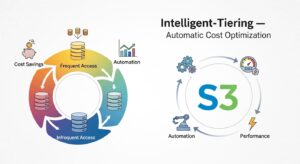
Intelligent-Tiering isn’t a traditional storage class but rather an automated lifecycle management system monitoring access patterns and moving objects between internal tiers without manual intervention. Objects transition automatically based purely on access frequency with no retrieval fees for the primary tiers, making Intelligent-Tiering ideal for unpredictable or changing access patterns.
The system maintains up to five internal tiers:
- Frequent Access tier: $0.023/GB-month (identical to S3 Standard) for objects accessed within the past 30 consecutive days
- Infrequent Access tier: $0.0125/GB-month for objects unaccessed for 30+ consecutive days
- Archive Instant Access tier: $0.004/GB-month for objects unaccessed for 90+ consecutive days (optional, must be enabled)
- Archive Access tier: $0.0036/GB-month for objects unaccessed for 90-270+ consecutive days (optional, configurable)
- Deep Archive Access tier: $0.00099/GB-month for objects unaccessed for 180-730+ consecutive days (optional, configurable)
Intelligent-Tiering charges a $0.0025 per 1,000 objects monthly monitoring fee to track access patterns and automate transitions. Objects smaller than 128KB don’t transition to lower tiers, remaining in Frequent Access permanently to avoid inefficient small-object management overhead. The monitoring fee applies to all objects regardless of size, making Intelligent-Tiering expensive for billions of tiny objects (logs, thumbnails) but economical for millions of medium-to-large objects with variable access.
Transitions between the Frequent, Infrequent, and Archive Instant Access tiers occur automatically with no retrieval fees — objects move freely based on access patterns without penalty. The optional Archive Access and Deep Archive Access tiers function similarly to Glacier classes, incurring retrieval fees when objects return to higher tiers.
When to use Intelligent-Tiering: User-generated content with unpredictable popularity (viral posts remain hot, then go cold), application logs with unknown future query needs, media libraries with sporadic access patterns, data lake repositories where analysts access different datasets irregularly, and any scenario where manual lifecycle policy configuration requires ongoing maintenance as access patterns shift. The monitoring fee ($2.50 per million objects monthly) typically pays back within 30-60 days through automatic optimization.
S3 Glacier Instant Retrieval
S3 Glacier Instant Retrieval provides millisecond-latency access to archived data at $0.004/GB-month — 83% cheaper than Standard storage. Unlike legacy Glacier classes requiring minutes-to-hours retrieval, Instant Retrieval delivers the same sub-100ms first-byte latency as Standard while charging $0.03/GB retrieval fees and higher request costs ($0.010 per 1,000 GET requests).
Glacier Instant enforces a 90-day minimum storage duration — objects deleted before 90 days bill for the full 90 days regardless of actual duration. A 128KB minimum object size charges smaller objects as 128KB, identical to Standard-IA. Objects replicate across three Availability Zones with 11-nines durability and 99.9% availability.
Cost breakeven calculation: For 1TB stored 12 months with quarterly retrieval (4 retrievals annually of complete dataset):
- Standard: 1,024GB × $0.023 × 12 = $282.62
- Glacier Instant: (1,024GB × $0.004 × 12) + (1,024GB × $0.03 × 4) = $49.15 + $122.88 = $172.03
Savings: $110.59 annually (39% reduction). Retrieve monthly instead of quarterly: storage + 12 retrievals = $49.15 + $368.64 = $417.79 — now 48% more expensive than Standard.
When to use Glacier Instant Retrieval: Medical imaging archives accessed 2-4 times yearly for patient care, news media assets retrieved occasionally for retrospectives, genomics data queried quarterly for research, regulatory compliance documents requiring instant access for audits, and backup data accessed infrequently but demanding zero restore delay. Glacier Instant suits “just-in-case” data where retrieval probability is low but speed requirements prevent traditional Glacier usage. Learn more about analytics cost optimization when querying archived datasets.
S3 Glacier Flexible Retrieval
Glacier Flexible Retrieval (formerly Glacier Standard) costs $0.0036/GB-month — 84% cheaper than Standard — with retrieval times ranging from 1 minute to 12 hours depending on selected retrieval tier. This class targets data accessed annually or less with tolerance for retrieval delays.
Three retrieval tiers balance speed against cost:
- Expedited retrieval: 1-5 minutes, $0.03/GB + $10.00 per 1,000 requests
- Standard retrieval: 3-5 hours, $0.01/GB + $0.05 per 1,000 requests
- Bulk retrieval: 5-12 hours, $0.0025/GB + $0.025 per 1,000 requests
Glacier Flexible enforces a 90-day minimum storage duration with pro-rated early deletion charges. Transitioning 1TB to Glacier Flexible then retrieving it entirely one week later costs: (1,024GB × $0.0036 ÷ 30 × 7 days) + (1,024GB × $0.01 standard retrieval) = $0.86 storage + $10.24 retrieval = $11.10 — cheaper than one week of Standard storage ($5.52) due to retrieval fees.
When to use Glacier Flexible Retrieval: Annual compliance data retrievals, disaster recovery archives expected to never restore, quarterly financial statement backups, media master files for content no longer in distribution, and long-term database backups retained for regulatory periods. Glacier Flexible suits data where multi-hour retrieval delay is acceptable and access frequency remains below 1-2 times yearly. For data accessed quarterly or more, Glacier Instant Retrieval typically provides better total cost despite higher storage rates.
S3 Glacier Deep Archive — The Cheapest Option
Glacier Deep Archive delivers the absolute lowest storage cost in AWS at $0.00099/GB-month — 96% cheaper than Standard and 1/23rd the price. This class targets data retained for 7-10+ years with near-zero expected retrieval probability, accepting 12-48 hour restore times as the trade-off for extreme cost efficiency.
Two retrieval tiers:
- Standard retrieval: 12 hours, $0.0065/GB + $0.10 per 1,000 requests
- Bulk retrieval: 48 hours, $0.002/GB + $0.025 per 1,000 requests
Deep Archive enforces the longest minimum storage duration at 180 days (6 months). Objects deleted before 180 days bill for the full period regardless of actual storage time. This minimum makes Deep Archive unsuitable for short-term cost experiments; commit only data truly intended for multi-year retention.
S3 Request & Data Retrieval Costs
Request charges accumulate per API operation regardless of payload size or success status. A failed PUT request costs the same as a successful PUT. A GET request returning 1KB bills identically to a GET returning 1GB — the per-GB retrieval fees apply separately from per-request charges.
Complete request and retrieval pricing matrix (us-east-1):
| Operation | Standard | Standard-IA | One Zone-IA | Glacier Instant | Glacier Flexible | Deep Archive |
| PUT/COPY/POST/LIST per 1K | $0.005 | $0.010 | $0.010 | $0.020 | $0.030 | $0.050 |
| GET/SELECT per 1K | $0.0004 | $0.001 | $0.001 | $0.010 | $0.0004 | $0.0004 |
| DELETE/CANCEL | Free | Free | Free | Free | Free | Free |
| Lifecycle transition per 1K | $0.010 | $0.010 | $0.010 | $0.050 | $0.050 | $0.050 |
| Retrieval fee (per GB) | None | $0.01 | $0.01 | $0.03 | $0.01 (std) | $0.0065 (std) |
Key insights about request costs:
- Batch small files before upload. Uploading 1,000 individual 1KB files as separate objects costs $0.005 in PUT requests plus storage for 1MB total data. Combining those 1,000 files into a single 1MB archive before upload costs $0.000005 — a 1,000× reduction in request charges. For write-heavy workloads with millions of small objects, batching can reduce monthly request costs from thousands of dollars to single-digit dollars.
- DELETE and CANCEL operations are always free. Aggressively clean up test data, failed multipart uploads, outdated versions, and temporary processing artifacts without cost concern. Many organizations leave garbage data in S3 for years paying ongoing storage charges because teams incorrectly assume deletion costs money.
- Lifecycle transitions are NOT free. Moving objects between storage classes via lifecycle policies generates transition request charges. Transitioning 1 billion objects from Standard to Glacier Flexible costs 1,000,000 (thousands of objects) × $0.050 = $50,000 in transition fees alone before capturing any storage savings. For datasets with billions of tiny objects, transition costs can exceed first-year storage savings, making lifecycle policies economically counterproductive without object consolidation.
S3 Data Transfer Pricing
Data transfer pricing follows complex tiered structures with critical exceptions and special cases that dramatically affect total costs. The most impactful optimization — routing delivery through CloudFront — eliminates the largest egress charges entirely.
Complete data transfer pricing matrix (us-east-1):
| Transfer Type | Cost |
| Internet → S3 (inbound) | FREE |
| S3 → Internet (first 100GB/month) | FREE |
| S3 → Internet (next 9.9TB/month) | $0.09/GB |
| S3 → Internet (next 40TB/month) | $0.085/GB |
| S3 → Internet (next 100TB/month) | $0.07/GB |
| S3 → Internet (>150TB/month) | $0.05/GB |
| S3 → CloudFront (same region) | FREE ← Critical optimization |
| S3 → EC2 (same region, same account) | FREE |
| S3 → Lambda (same region) | FREE |
| S3 → S3 (same region, different account) | FREE |
| S3 → S3 (cross-region, same account) | ~$0.02/GB (varies by region pair) |
| S3 → other AWS services (cross-region) | ~$0.02/GB |
| S3 Transfer Acceleration (upload) | +$0.04/GB over standard transfer |
| S3 Transfer Acceleration (download) | +$0.04/GB over standard transfer |
| Same-region data transfer (cross-AZ) | $0.01/GB each direction |
| Multi-Region Access Point routing | +$0.0033/GB per request routing |
Management, Analytics & Replication Costs
Management & Analytics Costs
S3 provides several built-in tools for monitoring, analyzing, and optimizing storage usage. Each tool adds per-object or per-request charges that accumulate into significant line items for large-scale deployments.
Management and analytics pricing (us-east-1):
| Feature | Cost |
| S3 Storage Lens (free tier) | Free (limited metrics) |
| S3 Storage Lens (advanced metrics) | $0.20 per million objects/month |
| Storage Class Analysis | $0.10 per million objects monitored/month |
| S3 Inventory | $0.0025 per million objects listed |
| S3 Object Tagging | $0.01 per 10,000 tags/month |
| S3 Batch Operations | $0.25 per job + $1.00 per million objects |
| S3 Access Grants | $0.03 per 1,000 requests |
2 Real-World S3 Cost Scenarios
Scenario 1 — 1TB SaaS Application Media Storage
A SaaS platform stores user-uploaded images, videos, and documents with mixed access patterns. Recently uploaded content receives heavy traffic; older content sees declining access over time.
Workload characteristics:
- Total storage: 1TB (1,024GB)
- Breakdown: 600GB actively accessed content (Standard), 400GB older content accessed monthly (Standard-IA)
- Monthly GET requests: 2,000,000 (1,500,000 against Standard; 500,000 against Standard-IA)
- Monthly PUT requests: 100,000 (new uploads)
- Egress via CloudFront: 500GB (free S3-to-CloudFront transfer)
- Egress directly to internet: 50GB
Cost calculation:
Storage costs:
- Standard: 600GB × $0.023 = $13.80
- Standard-IA: 400GB × $0.0125 = $5.00
Request costs:
- GET (Standard): 1,500 (thousands) × $0.0004 = $0.60
- GET (Standard-IA): 500 (thousands) × $0.001 = $0.50
- PUT (Standard): 100 (thousands) × $0.005 = $0.50
Data transfer:
- S3 → CloudFront (500GB): $0.00 (free)
- S3 → Internet (50GB): First 100GB free = $0.00
Total monthly cost: $13.80 + $5.00 + $0.60 + $0.50 + $0.50 + $0.00 = $20.40
Comparison with all-Standard storage:
- Storage: 1,024GB × $0.023 = $23.55
- Requests: (2,000 GET + 100 PUT thousands) × respective Standard rates = $1.30
- Transfer: $0.00
- Total: $24.85
Savings from lifecycle optimization: $4.45 monthly ($53.40 annually) — an 18% reduction achieved by migrating infrequently accessed content to Standard-IA. For organizations managing 100TB+ with similar patterns, this optimization scales to $5,000+ annual savings. Learn more about comprehensive S3 cost optimization strategies.
Scenario 2 — 50TB Compliance Archive (7-Year Retention)
A financial services firm archives transaction records for regulatory compliance, storing 50TB new data monthly with 7-year retention requirements. Data retrieval is extremely rare (disaster recovery or legal discovery only).
Workload characteristics:
- New data rate: 50TB monthly
- Retention period: 7 years (84 months)
- Total archived after 12 months: 600TB (50TB × 12)
- Storage class: Glacier Deep Archive
- Expected retrievals: Never under normal operations; disaster scenario retrieval modeled
Cost calculation at month 12 (600TB archived):
Storage cost:
- Deep Archive: 600TB × 1,024GB/TB × $0.00099/GB = $608.26 monthly
Comparison with S3 Standard:
- Standard: 600TB × 1,024GB × $0.023/GB = $14,131.20 monthly
Annual cost comparison:
- Deep Archive: $608.26 × 12 = $7,299.12
- Standard: $14,131.20 × 12 = $169,574.40
Savings vs Standard: $162,275.28 annually (95.7% reduction)
7-year total cost:
- Deep Archive: $7,299.12 × 7 = $51,093.84
- Standard: $169,574.40 × 7 = $1,187,020.80
Total savings over retention period: $1,135,926.96
Retrieval cost analysis (disaster scenario): If legal discovery requires restoring 10TB from Deep Archive:
- Standard retrieval (12 hours): 10,240GB × $0.0065/GB = $66.56
- Bulk retrieval (48 hours): 10,240GB × $0.002/GB = $20.48
- GET requests: 10,000 (thousands, assuming 1GB avg object size) × $0.0004 = $4.00
Total disaster retrieval cost: $24.48 to $70.56 depending on urgency — negligible compared to $1.1+ million savings over the retention lifecycle. Even retrieving the entire 600TB archive costs approximately $1,350 (bulk) to $4,000 (standard), a fraction of one month’s Standard storage costs.
Recommendation: Glacier Deep Archive represents the optimal choice for long-term compliance data with near-zero expected access. The 96% storage discount dwarfs retrieval costs even in disaster scenarios requiring full restoration.
Lifecycle Policy Cost Model — 12 Months
Lifecycle policies represent the single most impactful S3 cost optimization technique, automatically transitioning objects to cheaper storage classes as access frequency declines. However, poorly designed lifecycle policies can increase costs through excessive transition charges and premature archival of still-active data.
This model demonstrates progressive cost evolution for a 1TB bucket with a well-designed lifecycle policy: Standard → Standard-IA (30 days) → Glacier Instant Retrieval (90 days) → Deep Archive (365 days).
Assumptions:
- Initial dataset: 1TB (1,024GB)
- 30% of data accessed regularly and remains in Standard
- 40% of data transitions to Standard-IA after 30 days
- 20% progresses to Glacier Instant after 90 days
- 10% progresses to Deep Archive after 365 days
- Transition costs included in calculations
12-month cost progression:
| Month | Storage Distribution | Storage Cost | Transition Costs | Total Monthly Cost | Notes |
| 1 | 100% Standard (1,024GB) | $23.55 | $0.00 | $23.55 | Baseline: all new data in Standard |
| 2 | 70% Std (716GB) + 30% IA (308GB) | $20.32 | $0.31 | $20.63 | First transition to IA; 300K objects × $0.01/1K |
| 3 | 60% Std (614GB) + 40% IA (410GB) | $19.25 | $0.10 | $19.35 | Additional 10% transitions to IA |
| 4 | 50% Std (512GB) + 45% IA (461GB) + 5% Glacier Instant (51GB) | $17.74 | $0.51 | $18.25 | First Glacier Instant transition; $0.05/1K objects |
| 5 | 45% Std (461GB) + 40% IA (410GB) + 15% Glacier (153GB) | $16.83 | $0.50 | $17.33 | Continued Glacier migration |
| 6 | 40% Std (410GB) + 35% IA (358GB) + 25% Glacier (256GB) | $15.92 | $0.50 | $16.42 | Increasing Glacier share |
| 7 | 35% Std (358GB) + 30% IA (308GB) + 35% Glacier (358GB) | $14.86 | $0.50 | $15.36 | Majority now in Glacier Instant |
| 8-11 (avg) | 30% Std + 25% IA + 45% Glacier | $13.80 | $0.20 | $14.00 | Stabilization period |
| 12 | 30% Std (308GB) + 20% IA (205GB) + 45% Glacier (461GB) + 5% Deep Archive (51GB) | $12.74 | $0.26 | $13.00 | First Deep Archive transition |
| Year 2+ | 20% Std + 10% IA + 50% Glacier + 20% Deep Archive | $8.12 | $0.10 | $8.22 | Long-term steady state |
3 S3 Cost Optimization Strategies
Deploy lifecycle policies immediately, not after cost accumulation.
Create lifecycle transition rules before data accumulates. Retroactively applying policies to petabyte-scale datasets generates massive transition charges. Establish policies at bucket creation: Standard → Standard-IA (30 days) → Glacier Instant (90 days) as a baseline for most workloads. Even a simple 30-day transition to Standard-IA cuts storage costs 46% without impacting frequently accessed data. Organizations establishing lifecycle policies proactively save 25-40% on S3 costs compared to those remediating after years of accumulation.
Enable Intelligent-Tiering for unpredictable access patterns.
Datasets with variable or unknown access patterns — user uploads, application logs, data lake repositories — benefit from Intelligent-Tiering’s automatic optimization. The $0.0025 per 1,000 objects monitoring fee typically pays back within 30-60 days through storage savings, and zero retrieval fees for main tiers eliminate the cost risk of premature archival. Intelligent-Tiering outperforms manual lifecycle policies when access patterns shift unpredictably over time. Avoid Intelligent-Tiering only for datasets with billions of tiny objects (<128KB) where monitoring fees exceed potential savings.
Delete incomplete multipart uploads within 7 days.
Failed or interrupted multipart uploads leave fragments stored permanently in Standard storage until manually deleted. These orphaned fragments consume storage without appearing in standard object listings, silently accumulating costs for years. Set a lifecycle rule aborting incomplete multipart uploads after 7 days (adjustable based on typical upload duration). Organizations implementing this rule discover 5-15% of S3 spending ties to forgotten upload fragments — costs eliminated immediately by automated cleanup.
Amazon S3 Pricing FAQs
How much does Amazon S3 cost per GB?
Prices range from $0.00099/GB-month (Glacier Deep Archive) to $0.16/GB-month (S3 Express One Zone), depending on storage class.
Which is the cheapest S3 storage class?
Glacier Deep Archive at $0.00099/GB-month, best for long-term archival data.
Does S3 charge for inbound data transfer?
No, uploading data to S3 from any source is free.
What is S3 Intelligent-Tiering?
It automatically moves objects between tiers based on access patterns, optimizing cost without retrieval fees.
When should I use S3 Standard vs Standard-IA?
Standard for frequently accessed data; Standard-IA for infrequent access, considering retrieval fees.
Conclusion
Understanding Amazon S3 pricing requires more than just looking at per-GB rates — storage class selection, requests, data transfer, and other factors all impact your final bill. By carefully analyzing access patterns and using features like Intelligent-Tiering, organizations can optimize costs and avoid expensive surprises. For teams seeking broader AWS cost optimization strategies, learning about AWS Lambda Pricing can provide additional insights into managing serverless workloads efficiently. At GoCloud, we help businesses navigate complex cloud pricing, ensuring smarter, predictable, and cost-effective storage and compute decisions.