

The average company overpays AWS by 35% — not because cloud is expensive, but because most teams don’t know these 20 simple tricks. If you are a startup founder, CTO, or DevOps engineer staring at a monthly invoice that seems to only go up, you are not alone.
AWS pricing is notoriously complex. With over 200 services and thousands of pricing dimensions, it is easy to provision resources that drain your budget silently. However, significant savings are very much achievable with the right strategy. In fact, simply knowing how to save money on AWS can transform your cloud bill from a liability into a competitive advantage.
In this guide, we will cover everything from quick wins you can implement this afternoon to long-term architectural changes that yield massive ROI. According to AWS Trusted Advisor data, millions of dollars in cloud waste occur simply due to idle resources and poor configuration. Whether you are looking to trim a few hundred dollars or cut your enterprise spend by millions, these strategies work.
Quick-Reference: 20 Strategies to Save Money on AWS
| Tip # | Strategy | Effort | Time to Implement | Potential Savings |
| 1 | Terminate Idle EC2 Instances | Low | < 1 Hour | 10–100% per instance |
| 2 | Delete Unattached EBS Volumes | Low | < 1 Hour | 100% of storage cost |
| 3 | Release Unused Elastic IPs | Low | 15 Mins | $3.60/mo per IP |
| 4 | Clean Up Old AMIs/Snapshots | Medium | 2–4 Hours | 15–30% of storage |
| 5 | Set Up AWS Budgets | Low | 30 Mins | Prevents 100% of surprise overages |
| 6 | Right-Size Instances | Medium | Days | 20–50% |
| 7 | AWS Savings Plans | Low | 1 Hour | Up to 72% |
| 8 | Use Spot Instances | High | Days/Weeks | Up to 90% |
| Tip # | Strategy | Effort | Time to Implement | Potential Savings |
| 9 | Schedule Dev Resources | Medium | 1 Day | ~65% (Nights/Weekends) |
| 10 | S3 Lifecycle Policies | Medium | Hours | 30–50% |
| 11 | Migrate to Graviton (ARM) | High | Weeks | Up to 40% price-performance |
| 12 | Move to Serverless | High | Months | Variable (Pay-per-use) |
| 13 | Optimize Data Transfer | High | Weeks | 20–40% |
| 14 | VPC Endpoints (Reduce NAT) | Medium | Days | Up to 80% vs NAT Gateway |
| 15 | S3 Intelligent-Tiering | Low | 1 Hour | Up to 40% |
| 16 | Reserved Instances (RDS/Elasticache) | Low | 1 Hour | Up to 72% |
| 17 | Cost Allocation Tags | Medium | Ongoing | Visibility (Indirect Savings) |
| 18 | AWS Organizations Consolidation | Medium | Days | Volume Discounts (5–10%) |
| 19 | Cost Anomaly Detection | Low | 30 Mins | Prevents Spikes |
| 20 | Well-Architected Review | High | Monthly | Strategic Optimization |
Why AWS Bills Keep Growing (And How to Stop It)

The Cloud Cost Paradox: Scaling Up Without Spiraling Spend
The flexibility of the cloud is a double-edged sword. It allows engineers to spin up powerful infrastructure in seconds, but often lacks the friction that prevents overspending. This is the “Cloud Cost Paradox”: you need to scale to grow, but scaling often leads to inefficient spending patterns that eat into margins.
Where Most AWS Waste Hides (And You’d Never Guess)
Research indicates that 30-40% of cloud spend is wasted. This isn’t usually malicious; it’s negligence. Waste hides in “zombie” resources—infrastructure that was spun up for a test, forgotten, and left running. It hides in over-provisioned databases that are 95% idle. It hides in data transfer fees between regions that could be routed internally.
Quick Wins — Save Money on AWS This Week
Tip 1: Identify and Terminate Idle EC2 Instances
The fastest way to save money on AWS is to stop paying for what you aren’t using. Developers often spin up instances for testing and forget to terminate them.
Tip 2: Delete Unattached EBS Volumes and Old Snapshots
When you terminate an EC2 instance, the attached EBS root volume is usually deleted, but additional attached volumes are not. These “orphaned” volumes sit there costing money while doing nothing.
Tip 3: Release Unused Elastic IPs
AWS charges for Elastic IP addresses (EIPs) when they are not attached to a running instance. This is a penalty for wasting a scarce IPv4 resources
Tip 4: Clean Up Old AMIs and Associated Snapshots
Every time you create an Amazon Machine Image (AMI), AWS creates a snapshot of the underlying volume. Deregistering the AMI does not automatically delete the snapshot. You must manually delete the snapshots to stop storage charges.
Tip 5: Set Up AWS Budgets and Alerts
You cannot save money on AWS if you don’t know you are spending it. AWS Budgets allows you to set a custom cost budget and alerts you via email or SNS when you exceed your threshold.
Medium-Term Strategies — Save Money on AWS This Month
Tip 6: Right-Size Your EC2 and RDS Instances
Right-sizing involves matching your instance types and sizes to your workload performance requirements. If you have an instance using only 4GB of its 16GB RAM, you are overpaying.
For more details, check out this aws cost optimization best practices guide.
Tip 7: Switch to AWS Savings Plans (Save Up to 72%)
AWS Savings Plans are the modern, flexible successor to Reserved Instances. By committing to a consistent amount of usage (e.g., $10/hour) for a 1 or 3-year term, you can save up to 72% compared to On-Demand prices.
Tip 8: Use Spot Instances for Non-Critical Workloads
Spot Instances allow you to take advantage of unused EC2 capacity in the AWS cloud. They are available at up to a 90% discount compared to On-Demand prices. The catch? AWS can interrupt them with a 2-minute warning.
Tip 9: Schedule Dev/Test Resources to Turn Off at Night
If your developers work 40 hours a week, leaving dev servers running 24/7 (168 hours) means you are paying for 128 hours of waste every week. That’s 76% waste.
Tip 10: Implement S3 Lifecycle Policies
Data stored in S3 Standard is expensive ($0.023/GB). Data that is rarely accessed should be moved to S3 Standard-IA or S3 Glacier Deep Archive (as low as
$0.00099/GB). Use Lifecycle Policies to automate this movement.
Long-Term Strategies — Save Money on AWS Sustainably
Tip 11: Migrate to AWS Graviton (ARM) Instances
AWS Graviton processors are custom-built by Amazon using 64-bit Arm Neoverse cores. They deliver up to 40% better price-performance over comparable x86-based instances.
Tip 12: Move to Serverless Where Possible
Serverless services like AWS Lambda and Fargate allow you to pay only for the compute time you consume. There is no charge when your code is not running, eliminating the cost of idle servers entirely.
Tip 13: Optimize Data Transfer and Egress with CloudFront
Data transfer out to the internet (egress) is expensive. Routing traffic through Amazon CloudFront can often be cheaper than serving it directly from S3 or EC2, as CloudFront has lower data transfer rates and a generous free tier.
Tip 14: Reduce NAT Gateway Costs with VPC Endpoints
NAT Gateways are notoriously expensive ($0.045/hr + processing fees). If your private instances need to access AWS services like S3 or DynamoDB, use Gateway VPC Endpoints. They are free and keep traffic entirely within the AWS network.
Tip 15: Enable S3 Intelligent-Tiering
If you don’t know your data access patterns, use S3 Intelligent-Tiering. It automatically moves objects between frequent and infrequent access tiers based on usage, saving you money without performance impact or operational overhead.
Advanced AWS Money-Saving Tips for Growing Teams
Tip 16: Use Reserved Instances for Steady-State Workloads
While Savings Plans are great for compute, Reserved Instances (RIs) are still the standard for saving money on Amazon RDS, ElastiCache, Redshift, and DynamoDB. Standard RIs offer the deepest discounts.
Tip 17: Implement Cost Allocation Tags for Visibility
You can’t manage what you can’t measure. Tag every resource with `CostCenter`,
`Environment` (Dev/Prod), and `Owner`. Activate these tags in the Billing Console to see exactly which team is driving up costs.
Tip 18: Consolidate Accounts with AWS Organizations
AWS Organizations allows you to consolidate billing for multiple AWS accounts. This combines usage across accounts, helping you reach volume discount tiers for S3 and data transfer faster.
Tip 19: Enable Cost Anomaly Detection
AWS Cost Anomaly Detection uses machine learning to identify unexpected spend. It can alert you if a Lambda function enters an infinite loop or if an API key is compromised and used for mining crypto.
Tip 20: Run a Monthly AWS Well-Architected Review
Adopt a FinOps culture. Dedicate time each month to review your architecture against the Cost Optimization pillar of the AWS Well-Architected Framework.
AWS Money-Saving Tips by Service
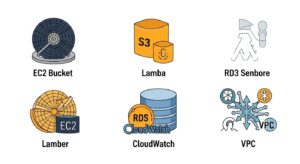
Save Money on EC2
- Use Spot Instances for fault-tolerant workloads.
- Adopt ARM-based Graviton instances (m6g, c6g, r6g).
- Stop instances when not in use.
Save Money on S3
- Use Intelligent-Tiering for unknown access patterns.
- Delete incomplete multi-part uploads via Lifecycle policies.
- Compress data before uploading to reduce storage usage.
Save Money on RDS
- Purchase Reserved Instances for production databases.
- Stop development databases on nights and weekends.
- Delete old manual snapshots.
Save Money on Lambda
- Optimize code execution time (cost is proportional to duration).
- Right-size memory allocation (Compute Optimizer can help).
- Use Compute Savings Plans for Lambda usage.
Save Money on Data Transfer
- Avoid using public IPs for internal communication.
- Keep traffic within the same Availability Zone (AZ) where possible.
- Use CloudFront to cache content and reduce egress fees.
Savings Calculator Example
How Much Can You Save? Real-World Examples
Case Study 1: A SaaS company reduced their AWS bill by 40% simply by purchasing Compute Savings Plans and migrating their staging environment to Spot instances.
Case Study 2: A data analytics firm saved $12,000 annually by setting up S3 Lifecycle policies to move logs to Glacier after 30 days.
Frequently Asked Questions (FAQ)
What AWS services cost the most?
Typically, Amazon EC2 (Compute), Amazon RDS (Databases), and Amazon EBS (Storage) account for the majority of a bill. Data Transfer is often a hidden high cost.
Is AWS Graviton really cheaper?
Yes. Graviton instances generally cost ~20% less per hour than their Intel x86 equivalents and offer up to 40% better performance, providing excellent price-performance value.
How do I prevent unexpected AWS cost spikes?
Set up AWS Budgets with email alerts. Enable AWS Cost Anomaly Detection to catch unusual behavior early.
What is the AWS Free Tier?
The AWS Free Tier offers limited usage of certain services (like 750 hours of t2.micro EC2 usage) for free for the first 12 months, plus some “always free” allowances like 25GB of DynamoDB storage.
How do startups save money on AWS?
Startups should leverage AWS Activate credits, use the Free Tier extensively, adopt serverless architectures to avoid paying for idle time, and enforce strict tagging policies early on.
Conclusion — Start Saving Money on AWS Today
Saving money on AWS isn’t a one-time event; it is a continuous process of monitoring, analyzing, and optimizing. By combining immediate cleanup tasks with smart financial commitments like Savings Plans and long-term architectural shifts to Serverless or Graviton, you can drastically reduce your cloud spend.
At GoCloud, we recommend taking a holistic approach — not just cleaning up idle resources, but also optimizing query patterns, storage strategies, and compute usage. To understand how these practices impact your analytics workloads specifically, see our detailed guide on AWS Athena Costs Explained. Applying these strategies together ensures your AWS environment remains efficient, cost-effective, and
Don’t wait for the next billing cycle shock. Follow this simple 3-step starter plan today:
- Run AWS Trusted Advisor to identify immediate waste (it’s free).
- Set up AWS Budgets and Cost Anomaly Detection to prevent future surprises.
- Analyze your steady-state usage and purchase Savings Plans for eligible workloads.
The best time to start saving money on AWS was last month. The second best time is right now. With the introduction of even more efficient hardware like Graviton and AI-powered tools in the AWS Compute Optimizer in 2026, the potential for savings has never been greater—you just need to take action.