

Federal grants for small businesses are non-dilutive funding awards from U.S. government agencies that do notrequire repayment or equity transfer. Most are competitive, tied to specific missions (R&D, innovation, community development, export), and carry strict compliance requirements. They are not startup capital — they are performance-based investments in public-interest outcomes.

What Counts as “Federal Grants for Small Businesses”? (Set Expectations)
This is where founders most commonly get misled. The term “federal grants for small businesses” covers a narrower universe than most people assume — and a different one than most Google results suggest.
Here is the accurate picture:
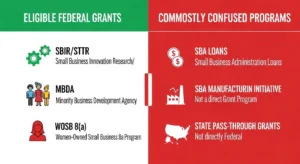
What ISa federal grant for small businesses:
SBIR/STTR awards: Competitive R&D grants from agencies including NIH, NSF, DOE, DHS, USDA, and 8 others — these are genuine cash grants to small businesses
- MBDA cooperative agreements: Grants to organizations supporting minority-owned businesses and entrepreneurs
- SBA Manufacturing Initiative grants: Targeted awards under the Made in America Manufacturing Initiative
- Agency-specific NOFOs (Notices of Funding Opportunity): Published on Grants.gov by federal departments for specific programmatic purposes
What is NOT a federal grant but is often confused as one:
- SBA loans (these are debt products — see our startup loan guide)
- Federal contracting set-asides like 8(a), HUBZone, and WOSB (these are contract revenues, not grants)
- State-administered programs funded by federal pass-through dollars (technically state grants)
Critical fact: The U.S. Small Business Administration (SBA) explicitly states: “SBA does not provide grants for starting and expanding a business.” Founders searching for “SBA grants to start a business” will not find what they expect.
Types of Small Business Grants (Federal vs State vs Corporate)
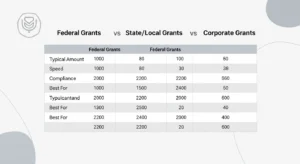
Federal Grants :
Federal grants are issued directly by U.S. government agencies. They are the largest in amount, the most competitive, and the most compliance-intensive. Most require SAM.gov registration, a UEI number, a detailed narrative, a budget justification, and ongoing performance reporting post-award.
Who they’re best for: Businesses with R&D components, specific sector focus (agriculture, energy, health, defense), or mission alignment with a federal agency’s priorities. Not designed for general business growth or working capital.
State and Local Programs (Brief + Why They Matter)
State grants are funded by state legislatures and — in many cases — by federal pass-through dollars (e.g., STEP export grants flow from the federal SBA to state agencies, which then re-grant to small businesses). Local economic development grants come from city or county programs, CDFIs, and regional foundations.
Why they matter:
- Smaller pools of applicants — significantly less competition than federal programs
- Community-focused priorities (job creation, retail development, underserved areas) that align well with early-stage businesses
- Faster decision timelines — often 4–8 weeks versus 3–6 months for federal awards
- Many states maintain portals mirroring Grants.gov for state-level opportunities
Start with your state’s Small Business Development Center — use the SBA SBDC locator — for a curated list of programs in your region.
Corporate and Nonprofit Grants (Brief)
Corporate grants are funded by companies’ community relations or marketing budgets. Think FedEx Small Business Grant, Visa Everywhere Initiative, or Amazon Small Business Accelerator. They are faster to apply for, less compliance-heavy, but often tied to visibility commitments (social sharing, brand association, content participation).
Nonprofit grants come from foundations (local community foundations, industry associations) and philanthropic organizations. These are often the most founder-friendly but smallest in size.
Bottom line: Layer all three types — federal, state, and corporate — rather than pursuing any one exclusively.
Best Places to Find Federal Grants
Grants.gov (How to Search + Filter)
Grants.gov is the U.S. government’s official, centralized portal for federal funding opportunities. Every NOFO (Notice of Funding Opportunity) from every federal agency must be posted here. This is where your search starts — and where your application is submitted.
How to search effectively:
- Go to Grants.gov → Search Grants
- Use the Eligibility filter — select “Small Businesses” to eliminate grants only available to nonprofits and universities
- Filter by Category (e.g., Science and Technology, Agriculture, Health)
- Filter by Agency (NIH, NSF, USDA, DOE, etc.) if you know which agencies align with your sector
- Read the full NOFO for every opportunity — especially Section C (eligibility), Section D (deadlines + requirements), and Section E (selection criteria)
- Bookmark and return frequently — NOFOs open and close on their own schedules
Registration requirement: Before you can submit any application through Grants.gov, you must register with SAM.gov to obtain a Unique Entity Identifier (UEI) — a free 12-character alphanumeric ID assigned to all federal grant applicants. Registration is free and takes up to 10 business days. Do not wait until a deadline approaches to register.
SBIR/STTR (Who It’s For)
The SBIR/STTR portal hosts the federal government’s primary direct grant mechanism for small businesses. If your company has any R&D, technology, or innovation component, this is the most important program to understand.
SBIR (Small Business Innovation Research):
- Phase I: Up to ~$305K (NSF) / ~$306,872 (NIH) for feasibility research
- Phase II: Up to $1.25M–$2M+ for full R&D and prototype development
- Phase III: Follow-on federal procurement (no SBIR funds; agency contracts the commercialized product)
- 11 federal agencies participate, including NIH, NSF, DOE, DHS, USDA, DoD, and NASA
STTR (Small Business Technology Transfer):
- Structured identically to SBIR in phases and funding levels
- Key difference: Requires a formal research partnership with a U.S. university or nonprofit research institution
Eligibility: For-profit U.S. company; under 500 employees; primarily U.S.-owned and controlled; principal researcher must be employed by the small business (for SBIR)
SBIR/STTR applications are submitted directly through each participating agency’s portal (not Grants.gov), but all open solicitations are listed at sbir.gov.
SBA + SBDC Support (How Counseling Helps)
The SBA’s network of Small Business Development Centers (SBDCs) provides free one-on-one consulting for grant readiness — including help with SAM.gov registration, SBIR proposal preparation, and identifying state and local grant opportunities. There are nearly 1,000 SBDC locations nationwide.
SBDCs also help with SBIR Phase 0 programs — state matching funds designed to help new applicants prepare their first federal Phase I proposal. Several states offer $10K–$40K in Phase 0 awards to offset proposal preparation costs .
Eligibility: How to Know If You Qualify (Before You Apply)
Business Status, Tax Status, Registrations
Before investing time in any application, verify these baseline requirements:
- Legal entity: Most federal grants require a registered legal entity (LLC, corporation, partnership) — not a sole proprietorship
- SAM.gov registration with active UEI: Mandatory for all federal grant applications
- EIN (Employer Identification Number): Required for SAM registration and Grants.gov account creation
- Tax compliance: Federal grantors check IRS compliance. Delinquent filings are disqualifying.
- For SBIR/STTR: Under 500 employees; primarily U.S.-owned; for-profit structure
- Size standards: Most federal programs follow SBA size standards — check your NAICS code
Common Disqualifiers (Save Time)
These are the most frequent eligibility failures — catching them before submission saves weeks of wasted work:
- Not registered in SAM.gov — no registration, no application accepted
- Sole proprietor applying for programs requiring a legal entity
- Applying as a nonprofit for small-business-only grants (and vice versa)
- Exceeding employee or revenue size standards for the specific program
- Applying to an agency whose mission doesn’t match your business
- Expired SAM.gov registration — renewals must happen annually; a lapse disqualifies pending applications
- Delinquent federal taxes or outstanding federal debt
How to Apply for Federal Small Business Grants (Step-by-Step)
The five-step grant application process from research to post-award compliance.
Step 1 — Build a Target List (Fit > Volume)
Research 5–10 grant opportunities. Narrow to 2–3 where the agency’s stated goals directly match your business’s actual work — not a stretch interpretation. Read the NOFO’s evaluation criteria section first. If you can’t score 80%+ on paper before writing a word, move on.
Use Grants.gov, sbir.gov, and your SBDC counselor to identify which programs are currently open and relevant to your sector.
Step 2 — Translate Your Business into the Grant’s Goals :
Federal reviewers do not evaluate your business on its own merits — they evaluate how well your proposed project serves the agency’s mission and stated funding priorities. Your proposal narrative must speak the agency’s language.
Reframe your work in terms of the NOFO’s stated objectives. Use the exact terminology from the solicitation — reviewers are scored on specific criteria, and matching language signals alignment. This is not manipulation; it is the professional standard for grant writing. A business plan template is the right foundation to adapt from.
Step 3 — Assemble the Documentation Package :
Most federal grant applications require:
- Project narrative — describing the problem, your approach, expected outcomes, and impact (typically 10–25 pages, strictly formatted)
- Detailed budget and budget justification — every line item must be explained and tied to allowable expenses under the program
- Organizational information — legal name, EIN, UEI, entity type, DUNS/SAM registration status
- Key personnel bios and resumes
- Letters of support or partnership agreements (for STTR; sometimes for other programs)
- Financial statements — especially for larger awards
See the Grant Readiness Checklist table below for the complete list.
Step 4 — Submit Early + Validate Requirements :
Federal grant portals (Grants.gov, agency-specific portals) have technical submission requirements that can trip up applicants at the last minute — file format specifications, file size limits, specific form numbers, required attachments. Submitting 48–72 hours early gives you time to fix technical errors before the deadline closes.
Late submissions are not accepted. There are no extensions.
Step 5 — Post-Award Compliance (What Winners Must Do)
Winning is not the finish line — it’s the starting line of a compliance obligation.
- Submit financial and performance reports within 90 days of each reporting period (per OMB Uniform Grants Guidance §200.343)
- Track all allowable vs unallowable expenses — not all business costs can be charged to a federal grant
- Maintain internal controls and a clean audit trail for all grant-funded expenditures
- Report any subawards above $25,000 to the federal transparency database
- Comply with procurement requirements if purchasing goods/services with grant funds
- Return unexpended funds at the end of the period of performance
Budget for the administrative burden of compliance — especially for first-time federal grantees. Many SBDCs and local SCORE chapters offer free post-award guidance.
Grant Readiness Checklist (Table)

| Item | Why It Matters | How to Prove It |
| Active SAM.gov registration with UEI | Mandatory prerequisite for any federal grant application | Screenshot of active registration; note renewal date |
| EIN (Employer Identification Number) | Required for SAM and Grants.gov account setup | IRS EIN confirmation letter |
| Legal entity in good standing | Most programs exclude sole proprietors | Articles of incorporation + state Certificate of Good Standing |
| Current tax compliance (federal + state) | Delinquent filings are automatic disqualifiers | CPA confirmation; IRS transcript |
| Project narrative aligned with NOFO | Reviewers score on mission fit — not your business merit | Draft narrative with NOFO evaluation criteria cross-referenced |
| Detailed budget with justification | Every dollar must have a documented rationale | Line-item budget with written justification for each expense |
| Key personnel bios/resumes | Demonstrates capacity to execute the project | 2-page CVs for all named researchers or project leads |
| Financial statements (2 years) | Shows fiscal health and management capacity | CPA-prepared P&L and balance sheet |
| Organizational chart | Demonstrates internal structure and accountability | Updated org chart with named roles |
| Letters of support (where required) | Third-party validation of project viability | Signed letters from partners, customers, or researchers |
Grant vs Loan vs Equity :
Federal Grant
Federal grants do not require repayment, so your startup keeps 100% ownership. However, the trade-off is that grants are usually slow to secure (3–9 months) and come with a high compliance burden, including ongoing reporting and restrictions on how funds can be used. They are best suited for R&D, innovation, and sector-specific projects, where adherence to approved project scope is essential.
Business Loan
Business loans require repayment with principal plus interest, but do not dilute ownership. They are generally faster to access (days to weeks) and offer high flexibility in how you use the funds — for working capital, equipment, or growth. The compliance burden is typically low to moderate, making loans suitable for startups that need immediate funding and control over spending.
Equity (VC/Angel)
Equity funding involves giving up ownership in exchange for capital, but there is no repayment obligation. Accessing equity is moderate in speed (3–6 months), and funds are often directed by investors, with a governance and reporting framework attached. Equity is best for high-growth startups seeking scale, where strategic support and network access from investors can accelerate expansion.
Lists of Federal Grant Programs and Directories
Innovation + R&D Grants (SBIR/STTR and Related)
| Program | Agency | Award Range | Best For |
| SBIR Phase I | NIH, NSF, DOE, DHS, USDA, DoD, NASA + others | Up to ~$305K | Early feasibility research |
| SBIR Phase II | Same agencies | Up to $1.25M–$2M+ | Full R&D and prototype development |
| STTR Phase I/II | Same agencies (requires university partner) | Same as SBIR | Academic-commercial R&D partnerships |
| NSF America’s Seed Fund | NSF | Up to $305K (Phase I) | Deep tech, software, hardware, biotech |
Use sbir.gov to browse all open solicitations across participating agencies.
Sector-Based Programs (Examples by Industry)
- Agriculture: USDA SBIR/STTR (National Institute of Food and Agriculture — NIFA); USDA Agricultural Marketing Service grants (Farmers Market Promotion Program, Dairy Business Innovation, Bison Production grants)
- Energy: DOE SBIR/STTR; Office of Energy Efficiency and Renewable Energy (EERE) funding opportunities
- Health / Life Sciences: NIH SBIR/STTR (largest SBIR funder by volume); SAMHSA grants for behavioral health businesses; CDC funding programs
- Defense / Homeland Security: DoD SBIR (Army, Navy, Air Force, DARPA each run separate solicitations); DHS SBIR for cybersecurity, border technology, emergency management
- Manufacturing: SBA Manufacturing in America initiative (targeted awards; check SBA.gov for current open solicitations)
- Exports: SBA State Trade Expansion Program (STEP) — funds flow through state agencies to qualifying small exporters
Search Grants.gov by agency and category for current open opportunities in any sector.
Specialty Grant Pathways :
Women-Owned Business Grants
The federal government’s most concrete commitment to women-owned businesses is the Women-Owned Small Business (WOSB) Federal Contract Program, which mandates that at least 5% of all federal contracting dollars go to women-owned small businesses annually. This is not a grant — it’s a contract set-aside that generates revenue.
For direct grants, most programs supporting women entrepreneurs are private or state-level — not pure federal grants. Notable examples include:
- Women Founders Grant: Monthly $5,000 grants to qualifying women-owned businesses
- Cartier Women’s Initiative: $30,000 or $100,000 awards to women entrepreneurs driving social impact
Combine federal SBIR/STTR opportunities (open to all qualifying small businesses, including women-owned) with state and corporate grant programs for the strongest overall grant strategy.
Minority-Owned Business Grants (MBDA + Programs)
The Minority Business Development Agency (MBDA) is the primary federal agency focused on minority business development. MBDA publishes NOFOs (on Grants.gov) for cooperative agreements and grants to organizations that provide technical assistance, training, and capital access to minority-owned businesses.
To apply for any MBDA grant:
- Register on SAM.gov to obtain your UEI
- Create a Grants.gov account linked to your SAM registration
- Attend MBDA’s pre-application teleconference for the specific NOFO
- Submit application through Grants.gov before the deadline .
SBA 8(a) Business Development Program: Not a grant, but a 9-year federal contracting program that gives socially and economically disadvantaged small businesses preferential access to federal contracts — with a goal of 5% of all federal prime and subcontracting dollars directed to certified small disadvantaged businesses.
HUBZone Program: Businesses located in Historically Underutilized Business Zones qualify for a federal contracting preference — targeting 3% of all federal contracts for HUBZone-certified firms. Many minority-owned businesses in underserved communities qualify.
Veteran-Owned Business Grants :
Direct federal grants specifically for veteran-owned small businesses are limited. The federal government’s primary mechanism is contracting set-asides: Service-Disabled Veteran-Owned Small Business (SDVOSB) and Veteran-Owned Small Business (VOSB) programs ensure a portion of federal contracts flows to veteran-owned firms.
Key federal support resources for veteran entrepreneurs:
- Veterans Business Outreach Centers (VBOCs): 22 centers nationwide offering free business plan workshops, counseling, concept assessments, and mentorship for veterans, National Guard, and Reserve members — find your nearest VBOC
- Boots to Business: Free SBA entrepreneurship training offered on military installations worldwide (part of the DoD Transition Assistance Program)
- Veteran Federal Procurement Entrepreneurship Training Program (VFPETP): Federal contracting training for veteran-owned businesses seeking government contracts
For grant capital, veteran-owned businesses should pursue SBIR/STTR (open to all qualifying small businesses), state-level veteran entrepreneur grants, and private programs (many foundations and corporations have dedicated veteran grant tracks).
Mistakes That Get Applications Rejected (and Fixes)
- Not reading the full NOFO before writing a word.
Fix: Before drafting anything, read Section C (eligibility), Section D (requirements/deadline), and Section E (evaluation criteria) in their entirety. Build your outline from the evaluation criteria — not from your business deck. - Submitting as the wrong entity type.
Fix: Confirm eligibility before spending 40 hours on a proposal. Small business vs nonprofit vs university — each applies to different programs. - Budget not justified.
Fix: Every line item needs a written rationale. Vague budget categories (“miscellaneous expenses”) signal inexperience and get flagged by reviewers. Be specific: “3 months salary at $X/month for [role] to perform [task].” - Proposal narrative doesn’t use the agency’s language.
Fix: Mirror the NOFO’s exact terminology and stated priorities. Reviewers use scoring rubrics tied to the NOFO’s specific language. - Submitting at the deadline.
Fix: Submit 48–72 hours early. Technical errors (file format, portal issues) kill otherwise strong applications every cycle. No extensions are granted for technical problems after the deadline. - No track record or credibility signals.
Fix: Include letters of support from customers, partners, or research institutions. Reference prior work, pilot results, or related credentials. First-time applicants with no demonstrated capacity face an uphill battle — consider applying for smaller state or SBDC-supported awards first to build a track record. - Ignoring matching funds requirements.
Fix: Some programs require matching funds — your organization must contribute a percentage of the total project cost. Confirm whether the NOFO has a matching requirement before applying.
How GoCloud Helps Startups Manage Grant-Funded Projects :
For startups that successfully secure federal grants, managing the technology infrastructure behind research, development, or digital platforms becomes a critical part of project execution. This is where GoCloud can provide valuable support. By helping companies design scalable cloud environments, manage data securely, and optimize infrastructure costs, GoCloud enables grant-funded startups to focus on innovation while maintaining reliable technical systems.
Many federal programs — especially SBIR and STTR awards — fund technology development, software platforms, and research-driven products. With a well-structured cloud environment and efficient infrastructure planning, startups can deploy grant funding more effectively and ensure their projects meet performance, scalability, and compliance expectations throughout the grant lifecycle.
FAQs :
Q1: Does the SBA give grants directly to small businesses to start or grow?
No. The SBA explicitly does not provide grants for starting or expanding a business. It provides grants to nonprofit organizations, SBDCs, and resource partners that support small businesses — and it administers the SBIR/STTR program, which directs grants from other federal agencies to qualifying small businesses.
Q2: What is Grants.gov and how do I use it?
Grants.gov is the official U.S. government portal where every federal agency publishes its NOFOs. Search by eligibility type (small businesses), agency, and category. You must register via SAM.gov first before you can submit any application.
Q3: What is SAM.gov and is registration free?
SAM.gov (System for Award Management) is the federal registration database that issues Unique Entity Identifiers (UEIs) — required for all federal grant and contract applications. Registration is completely free and takes up to 10 business days. Annual renewal is also required.
Q4: What is SBIR and who qualifies?
SBIR (Small Business Innovation Research) is a competitive federal grant program for R&D-focused small businesses. To qualify: U.S. for-profit company; under 500 employees; primarily U.S.-owned and controlled. Phase I awards reach ~$305K; Phase II up to $1.25M–$2M+.
Q5: Are federal grants taxable income?
Generally, yes — federal grants received by for-profit businesses are taxable income in the U.S. Consult your CPA for your specific situation, particularly regarding SBIR/STTR awards and whether any portion covers exempt R&D activities.
Conclusion :
Federal grants for small businesses are real, meaningful, and genuinely accessible — but only to businesses that prepare correctly, target the right programs, and write competitive proposals. The gap between the founders who win and those who don’t is almost never talent or idea quality. It’s preparation, fit, and execution. Tools and platforms like GoCloud can help startups organize documents, track applications, and manage compliance efficiently, giving founders more bandwidth to focus on crafting winning proposals.