

Crowdfunding for startups is a method of raising capital by collecting small contributions from a large number of people typically through an online platform. It comes in two primary forms: product (reward-based) crowdfunding, where backers receive early access or perks, and equity crowdfunding, where investors receive an ownership stake in exchange for their capital.

What Is Crowdfunding?
Crowdfunding relies on the collaborative effort of a large pool of individuals to fund a startup or product. Instead of raising $500K from one investor, you raise it from 5,000 people putting in $100 each. Each contributor has skin in the game — emotionally, financially, or both.
It’s a fundamentally different capital model. No bank underwriting. No VC gatekeeping. No dilution negotiation (for product campaigns). Just direct market-to-founder validation and funding in real time. Startups including Allbirds and Peloton began with product crowdfunding campaigns.
Investment crowdfunding (Regulation CF + Regulation A+) grew 58% in 2025 compared to 2024, reaching $924.8 million raised — and the global market is projected to hit $5.91 billion by 2034.
Product vs Equity Crowdfunding for Startups
The two models are structurally different. Choosing the wrong one for your stage is the most expensive mistake you can make before your campaign even launches.
Product / Rewards Crowdfunding (Best for Pre-Launch + Pre-Orders)
Product crowdfunding — popularized by Kickstarter and Indiegogo — lets startups pre-sell a product before it exists. Backers contribute money in exchange for non-monetary rewards: early access, discounted pricing, exclusive versions, or limited-edition perks. No equity changes hands.
This model is ideal for:
- Consumer product startups (hardware, tech gadgets, CPG, apparel)
- Pre-launch or MVP-stage founders who need both capital and market validation
- Founders who want to build a community of early adopters without giving up ownership
Campaigns run for 30–60 days, and the data is immediate: if your campaign funds, you’ve proven real demand. If it doesn’t, you’ve learned at a fraction of the cost of a full launch.
Equity Crowdfunding (Best for Larger Raises + Ownership)
Equity crowdfunding gives investors actual ownership shares in your company — typically structured as SAFE notes or priced equity — in exchange for capital. It operates under U.S. SEC Regulation Crowdfunding (Reg CF), which allows companies to raise up to $5 million in a 12-month period from both accredited and non-accredited investors via an SEC-registered intermediary.
As of May 2025, 8,492 Reg CF offerings have raised $1.34 billion in total, with an average individual investment of $1,120.
This model is best for:
- Startups beyond MVP with early traction and a growth story to tell
- Founders comfortable with cap table complexity and ongoing investor communication
- Companies targeting $250K–$5M in a single round from a wide investor base
The key trade-off: equity crowdfunding adds investors to your cap table — often hundreds of them — which has downstream implications for governance, future fundraising, and clean due diligence for VCs.
Benefits of Crowdfunding for Startups
Done right, crowdfunding delivers four things simultaneously that no other funding mechanism provides:
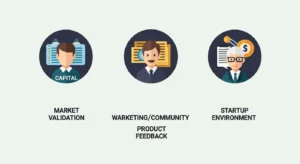
- Capital without gatekeepers. No bank underwriting metrics, no VC pattern-matching. If your audience believes in your product, you raise money.
- Market validation at scale. Every backer is a vote of confidence. A funded campaign is the cleanest proof of demand you can show future investors.
- Marketing and community building. Your campaign page ranks in search. Your backers share. Your early adopters become brand evangelists before you ship a single unit.
- Direct product feedback. Backers are emotionally invested. They comment, message, and suggest — giving you qualitative research you’d otherwise pay thousands for.
Is Crowdfunding Right for Your Startup?
Crowdfunding is not universally applicable. Run through this checklist before committing:
Industry Fit, Audience Fit, Funding Needs
Industry fit:
- Strong fit: Consumer products, hardware, tech gadgets, games, creative projects, food & beverage, fashion
- Moderate fit: SaaS tools with a strong consumer angle, health/wellness products with visual appeal
- Weak fit: Pure B2B services, deep enterprise software, highly regulated industries (financial services, pharmaceuticals)
Audience fit:
Your product must be understandable to a general audience in under 60 seconds. If your value proposition requires a 10-minute technical explanation, crowdfunding audiences will scroll past.
Funding needs:
- Product crowdfunding: Best for raising $50K–$500K (sometimes more for breakout campaigns)
- Equity crowdfunding: Realistically targets $250K–$5M under Reg CF
- If you need $10M+, crowdfunding is a supplement, not the primary vehicle — see our guide to finding investors for your startup
Crowdfunding Platforms for Startups: How to Choose
Not all platforms are created equal — and the wrong platform choice kills campaigns that had every other element right.
Platform Selection Criteria
|
Criteria |
What to Evaluate | Weight |
| Funding model | All-or-nothing vs flexible vs equity | 🔴 Critical |
| Audience fit | Does the platform’s community match your buyer persona? | 🔴 Critical |
| Fee structure | Platform fee + payment processing; total cost vs net proceeds | 🔴 Critical |
| Platform success rates | Historical % of campaigns that fund | 🟠 High |
| Geography + compliance | Can your backers/investors be in your target countries? | 🟠 High |
| Campaign duration | Standard 30/60-day windows vs open-ended options | 🟡 Medium |
| Integrations + analytics | CRM, email, tracking pixels, real-time dashboards | 🟡 Medium |
| Post-campaign tools | Fulfillment tools, investor updates, InDemand (ongoing sales) | 🟡 Medium |
Comparison Table: Top Crowdfunding Platforms by Model
| Platform | Model | Best For | Platform Fee | Funding Structure | Standout Feature |
| Kickstarter | Rewards | Consumer products, tech, design, games | ~5% + 3–5% processing | All-or-nothing | Largest engaged backer community globally |
| Indiegogo | Rewards | Hardware, product launches, ongoing sales | ~5% + 3–5% processing | Flexible or all-or-nothing | InDemand: keep raising after campaign ends |
| Wefunder | Equity (Reg CF) | Mission-driven startups, first-time raises | 7.5% + 2% processing | Flexible | Hands-on coaching; 86% campaign success rate |
| Republic | Equity (Reg CF) | Global raises, education-forward startups | 6% + 2% processing | Flexible | $10 min investment; co-investment vehicles |
| StartEngine | Equity (Reg CF) | Data-driven campaigns, secondary liquidity | 7–8% + 2% processing | Flexible | Most advanced analytics + secondary market |
| IFundWomen | Rewards | Women-founded startups | Varies | Flexible | Dedicated women founder community + coaching |
| Wefunder (Debt) | Revenue-share | Startups seeking non-dilutive growth capital | Varies | Revenue-based | No equity required; repaid from revenue |
Product vs Equity vs Debt Crowdfunding (Comparison Table)
| Factor | Product / Rewards | Equity (Reg CF) | Debt / Revenue-Share |
| Who it’s for | Pre-launch consumer products | Growth-stage startups with a story | Startups with early revenue |
| Typical raise | $25K–$500K | $250K–$5M | $50K–$500K |
| Dilution | None | Yes — shares or SAFEs | None (repaid from revenue) |
| Investor type | Customers (backers) | Retail + accredited investors | Revenue-based lenders |
| Effort level | High (fulfillment required) | Very high (SEC compliance + IR) | Moderate |
| Compliance | Low | High (Reg CF, Form C, disclosures) | Moderate |
| Best outcome | Pre-orders + proof of demand | Community investors + capital | Capital without equity |
| Main risk | Fulfillment failure | Cap table complexity | Revenue pressure |
How to Run a Crowdfunding Campaign (Step-by-Step)
Step 1 — Offer Design (Tiers / Rewards or Valuation)
For product campaigns: Build 3–5 reward tiers.
- Entry tier ($15–$50): Sticker pack, digital content, early access to updates — for enthusiasts with limited budgets
- Core tier ($75–$150): The product at an early-bird discount — this is your primary conversion target
- Premium tier ($200–$500): Product + exclusive colorway, limited edition, or founders-only access
- Superfan tier ($500+): Product + a call with the founder, behind-the-scenes access, or co-design input
Avoid overly complex tier structures. More than 7 tiers creates decision paralysis and drops conversion rates.
For equity campaigns: Set your valuation, investment structure (SAFE, priced round), and minimum investment amount before launch. Republic accepts minimums as low as $10; Wefunder and StartEngine typically start at $100–$500.
Step 2 — Campaign Assets (Video, Page, FAQ, Proof)
Your campaign video is your single highest-leverage asset. Campaigns with personal videos attract 150% more funding than those without. Campaigns with any video outperform no-video campaigns by 105%.
Video checklist (2–3 minutes maximum):
- Open with the problem (first 15 seconds — make it visceral)
- Show the product/solution in action
- Introduce the founder(s) authentically — backers fund people as much as products
- State the ask clearly: how much, what for, by when
- End with a specific call to action
Campaign page essentials:
- Hero image/GIF showing product in use
- One-line value proposition above the fold
- Social proof: press mentions, beta user testimonials, pre-orders, prior traction
- Clear FAQ section addressing: “When does it ship?”, “What if you don’t reach your goal?”, “How is this different from X?”
- Adding personal information to your campaign can drive 79% more backers.
Step 3 — Launch Plan (Email List, Partnerships, Ads)
The single biggest predictor of crowdfunding success is what you do before you launch.
30-Day Pre-Launch Timeline:
| Days Before Launch | Action |
| Day 30 | Finalize campaign page draft; begin email list building via landing page |
| Day 21 | Launch referral program: give early sign-ups a shareable link for queue priority |
| Day 14 | Reach out to press, bloggers, and niche newsletters in your category |
| Day 7 | Send teaser email to list; activate social media countdown content |
| Day 3 | Brief all co-founders, advisors, and supporters to pledge in first 48 hours |
| Launch Day | Email your full list; activate paid ads; send press embargo lifts |
Why the first 48 hours are critical: Kickstarter and Indiegogo both surface recently launched campaigns to their existing audience — but only campaigns showing momentum. Organic traffic sources can drive up to 35% of campaign funds. A dead launch week is almost impossible to recover from.
Traffic sources and their typical conversion rates:
- Email list (warm): 15–30% conversion
- Platform’s organic discovery: 5–10% (drops sharply after first week)
- Press / editorial coverage: Variable but high-intent — can drive 35% of total funds
- Paid social (Facebook/Instagram ads): 1–3% conversion; works best for retargeting page visitors
Step 4 — Backer Communication + Transparency (Updates Cadence)
Your backers are your first community. Treat them like investors, not customers.
Recommended update cadence:
- During campaign: Every 5–7 days — milestone announcements, stretch goals unlocked, new press coverage, behind-the-scenes content
- Post-campaign (pre-fulfillment): Monthly — manufacturing progress, delays disclosed proactively, team news
- Post-fulfillment: Quarterly — product updates, company milestones, how their support contributed
The rule of proactive disclosure: If there’s a delay, tell backers before they ask. Nothing destroys a crowdfunding community faster than backers discovering problems through internet forums instead of founder updates. Transparency is the only brand equity you have at this stage.
For equity campaigns, treat backer updates as investor relations practice — the discipline you build here will serve you through Series A and beyond.
Step 5 — Fulfillment + Post-Campaign Retention
For product campaigns, fulfillment is where most campaigns fail to convert initial success into lasting brand equity.
Fulfillment essentials:
- Build your manufacturer relationship before you launch — you need real lead times and cost estimates to set accurate delivery dates
- Bake 30–60% buffer time into your public shipping estimate. Under-promising and over-delivering is the highest ROI move in crowdfunding.
- Integrate a pledge management platform (PledgeBox, BackerKit) to collect shipping info, manage upgrades, and handle address changes post-campaign
- Budget shipping costs before setting reward tiers — international fulfillment has killed otherwise profitable campaigns
Post-campaign retention:
Turn backers into long-term customers and brand ambassadors:
- Migrate your backer email list to your CRM immediately post-campaign
- Build a private backer community (Slack, Discord, or Circle)
- Offer exclusive early access to new products before public launch
- Feature backer stories and testimonials in your post-launch marketing
Risks, Legal Notes, and Common Pitfalls
The honest trade-offs every founder should hear before launching:
- Equity crowdfunding adds hundreds of small investors to your cap table. Each one has rights — information rights, voting rights, pro-rata rights depending on your terms. When a future VC asks for a “clean cap table,” 400 Reg CF investors is not clean. Structure your Reg CF offering as a SAFE or through a Special Purpose Vehicle (SPV) to minimize cap table fragmentation.
- Regulation CF requires real disclosure. Under Reg CF, issuers must file Form C with the SEC, which includes audited or reviewed financials (depending on raise size), risk disclosures, use of proceeds, and management background. Budget $5K–$25K for legal and accounting preparation for a serious equity raise.
- Product crowdfunding creates a fulfillment obligation, not a donation. If you raise $500K in pre-orders and fail to deliver, you face legal liability, chargebacks, and reputational damage. Never launch a product campaign with an unproven manufacturer.
- Underestimating campaign marketing costs. Running a successful crowdfunding campaign requires budget — for video production, paid ads, PR outreach, and potentially a crowdfunding consultancy. The “free capital” narrative is a myth. Budget 10–20% of your fundraising target as campaign operating expenses.
- Platform-dependency risk. Your backer list lives on Kickstarter’s or Wefunder’s servers, not yours — at least during the campaign. Build your own email list in parallel from day one.
How GoCloud Supports Crowdfunding Startups
Crowdfunding campaigns often require robust technical infrastructure, from handling pre-orders and backer management to scaling e-commerce operations post-campaign. GoCloud provides cloud solutions that help startups build secure, scalable systems, optimize operational costs, and manage high traffic spikes — especially during campaign launch and fulfillment phases.
For equity crowdfunding campaigns, GoCloud’s cloud services also ensure secure investor data management, smooth updates to dashboards, and reliable analytics tracking, helping founders focus on growth and investor communications rather than server crashes or downtime.
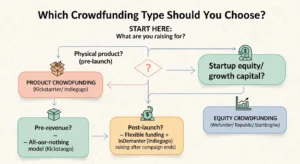
Visual Reference: Which Crowdfunding Type Should You Choose?
START HERE: What are you raising for?
FAQ
Q1: What is crowdfunding for startups?
Crowdfunding for startups is raising capital from a large group of people via an online platform. It comes in two primary forms: product/rewards crowdfunding (pre-selling to customers) and equity crowdfunding (selling ownership shares to investors via Reg CF).
Q2: What is Regulation Crowdfunding (Reg CF)?
Reg CF is the SEC framework that allows private companies to raise up to $5 million per year from both accredited and non-accredited investors via registered platforms. It requires a Form C filing, financial disclosures, and use of an SEC-registered intermediary like Wefunder, Republic, or StartEngine.
Q3: How much can you raise with crowdfunding?
Product campaigns typically raise $25K–$500K (breakout campaigns can raise millions). Equity crowdfunding under Reg CF allows up to $5M per year. Average successful product campaigns raise around $28,656; average equity crowdfunding investment per backer is $1,120.
Q4: What is the best crowdfunding platform for startups?
It depends on your model. For products: Kickstarter (all-or-nothing, largest community) or Indiegogo (flexible, InDemand ongoing sales). For equity: Wefunder (community-first, coaching), Republic (global reach, education-focused), or StartEngine (advanced analytics, secondary market).
Q5: Does a crowdfunding campaign affect my cap table?
Product crowdfunding does not affect your cap table — backers receive rewards, not equity. Equity crowdfunding does add investors to your cap table. Structuring your Reg CF offering as SAFEs or through an SPV minimizes fragmentation and keeps your cap table cleaner for future VC rounds.
Conclusion – Choosing the Right Crowdfunding Path for Your Startup
Crowdfunding can be a powerful engine for startup growth, offering capital, market validation, and community engagement — but only when the model, platform, and preparation align with your business. Product/rewards campaigns are ideal for pre-launch consumer products seeking early adopters and proof of demand, while equity crowdfunding under Reg CF suits growth-stage startups ready to offer ownership and attract a broad investor base.
Success depends on strategic planning: design clear tiers or investment terms, craft compelling campaign assets, build a pre-launch audience, and maintain transparent communication throughout. Tools like GoCloud can help startups manage the technical infrastructure behind campaigns, from scaling e-commerce operations to securely handling investor or backer data. By selecting the right approach, leveraging the appropriate platform, and preparing thoroughly — with GoCloud supporting your cloud and operational needs — founders can turn crowdfunding into a scalable growth strategy, transforming backers into loyal customers, investors, and advocates for their brand.