

AWS threat detection is not a single service. It is a cloud security program made up of telemetry collection, managed detections, investigation tooling, centralized findings, response automation, and governance across multiple accounts and Regions. If your design stops at “enable Amazon GuardDuty,” you will get findings, but you will not get a durable detection program that scales across AWS Organizations, reduces false positives, preserves evidence, and supports your SOC with repeatable triage and remediation workflows.
The modern AWS detection stack typically pulls together Amazon GuardDuty, AWS Security Hub, Amazon Detective, Amazon Security Lake, AWS CloudTrail, AWS Config, Amazon Macie, Amazon Inspector, Amazon EventBridge, AWS Lambda, and your SIEM/SOAR platform. The value comes from how these services work together: detections from GuardDuty and Inspector, context from Config and Detective, normalization in Security Lake, prioritization in Security Hub, and action through EventBridge and Lambda.
Why AWS Threat Detection Has To Be Designed As A Program, Not A Product:
A mature detection program answers five operational questions:
- What telemetry do we collect?
- What detections do we trust?
- How do analysts investigate quickly?
- What can we remediate safely?
- Where are the blind spots?
That is a different problem from “Which AWS service finds threats?” GuardDuty can detect malicious or anomalous behavior, but it does not replace centralized logging, forensic evidence handling, ticketing, threat hunting, or escalation workflows. Security Hub centralizes and enriches findings, Detective helps prove or disprove compromise, Security Lake centralizes telemetry at scale, and Config gives historical resource-state context that pure threat tools do not provide.
Implementation Guidance:
- Treat detection engineering, incident response, and cloud governance as one design problem.
- Define which findings are alerting signals, which are hunt signals, and which are compliance drift signals.
- Build your escalation path before you enable aggressive automation.
Common Mistakes:
- Running GuardDuty in only a subset of accounts or Regions.
- Sending everything into a SIEM without normalizing severity or ownership.
- Automating remediation before you understand blast radius.
Optimization Tip:
Create separate severity logic for identity, data, runtime, and control-plane findings. Those categories behave differently and need different responders.
AWS Threat Detection Architecture Across AWS Organizations:
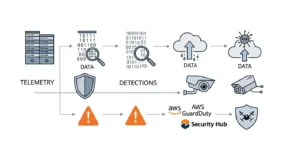
In an enterprise AWS environment, threat detection should be centralized but not flattened. The common design pattern is a multi-account model with a management account, a log archive account, a security tooling account, and workload accounts organized by environment or business unit. GuardDuty supports multi-account management through AWS Organizations, and AWS recommends Organizations-based management for consolidated findings and administration.
A strong architecture usually looks like this:
- Management account for organization governance only
- Log archive / security data lake account for centralized telemetry retention
- Security operations account for delegated administration of GuardDuty, Security Hub, Detective, and Security Lake
- Workload accounts where telemetry and findings originate
- Separate forensic or isolation account if your IR team needs a controlled investigation environment
This separation matters because detections should be centrally visible, but evidence and control actions should still respect blast-radius boundaries. Security Lake is explicitly designed to centralize security data from AWS, SaaS, on-prem, and cloud sources into a customer-owned S3-backed data lake, including rollup-Region patterns for multi-account analysis.
Regional Strategy Matters More Than Many Teams Expect:
Cloud-native attacks are often multi-Region even when your production footprint is not. Competitors mention enabling GuardDuty in all Regions, and that is still one of the most practical pieces of advice. Attackers test underused Regions for IAM misuse, crypto mining, staging activity, and low-visibility resource creation.
Best Practices:
- Enable core detection and logging services in every Region, not just primary workloads.
- Centralize findings into a single operating view, but preserve Region context.
- Use Config aggregators for multi-account, multi-Region configuration visibility.
Detection Engineering Consideration:
Region-based anomalies often become higher-value detections when combined with asset criticality, account purpose, and whether the Region is normally unused.
Telemetry Sources That Actually Power AWS Threat Detection:
The quality of AWS threat detection depends on telemetry depth. GuardDuty automatically ingests foundational data sources when enabled: CloudTrail management events, VPC Flow Logs for EC2, and DNS logs. Its optional protection plans add more coverage across EKS audit logs, S3 data events in CloudTrail, Lambda network activity logs, RDS login activity, runtime monitoring for EC2/EKS/ECS, and malware protection for EC2, S3, and AWS Backup.
AWS CloudTrail: Control-Plane And Data-Plane Truth:
CloudTrail remains the authoritative source for AWS API activity, governance, operational auditing, and risk auditing. It also supports CloudTrail Lake for immutably storing audit-worthy events and ingesting activity from AWS and non-AWS sources. For threat detection, CloudTrail is the primary record for IAM misuse, anomalous API calls, root credential use, privilege escalation activity, destructive changes, and S3 data-event investigations.
Implementation Guidance:
- Enable organization-wide trails and keep log destinations separate from workload accounts.
- Capture management events everywhere.
- Turn on high-value data events selectively, especially for S3 buckets with sensitive data.
Common Mistake:
Logging only management events and then discovering there is no object-level visibility during an exfiltration incident.
Optimization Tip:
Reserve full data-event logging for crown-jewel buckets and regulated data paths. Data events can drive large log volumes fast.
VPC Flow Logs And DNS Logs: Network Behavior And Command-And-Control Clues:
GuardDuty uses VPC Flow Logs and DNS logs to detect network-based threats, suspicious egress, known malicious destinations, and some crypto mining patterns. These sources are especially important for runtime compromise, credential theft followed by lateral movement, and C2-style communication.
Detection Engineering Consideration:
Network findings are noisy without context. Add enrichment for account owner, environment, subnet type, internet exposure, and expected egress profile.
EKS, Lambda, Runtime, And RDS Telemetry Close Important Gaps:
GuardDuty’s EKS Protection, Runtime Monitoring, Lambda Protection, and RDS Protection extend beyond classic control-plane detection. These sources matter because modern cloud attacks increasingly pivot into Kubernetes service accounts, container runtime behavior, serverless functions, and data stores instead of only abusing EC2 or IAM.
AWS Config: Not A Detection Engine, But A Critical Investigation Source:
Config records resource configurations, historical changes, compliance state, relationships between resources, and remediation state. It is not “threat detection” in the same sense as GuardDuty, but it is indispensable when analysts need to answer questions like:
- Was the security group already open?
- When did this IAM policy change?
- Was the bucket made public before or after the finding?
- What was the last known good configuration?
Amazon Security Lake: Enterprise Telemetry, Normalized:
Security Lake centralizes security data from AWS environments, SaaS providers, on-premises, and cloud sources into a purpose-built data lake in your account. It adopts OCSF so data can be normalized and analyzed across tools and accounts. This is the foundation for enterprise-scale detection engineering, long-horizon investigations, and SIEM cost optimization.
Common Mistake:
Sending all telemetry directly to a SIEM without a durable lake layer. That makes hunting expensive and long-term retention harder.
Optimization Tip:
Use Security Lake as the durable security data substrate, then push only the high-value or normalized subsets into your SIEM for near-real-time use cases.
The AWS Service Stack: Who Does What In A Real Detection Pipeline:
Amazon GuardDuty: First-Line Managed Threat Detection:
GuardDuty continuously analyzes foundational logs and optional protection-plan telemetry to generate findings. It now also includes Extended Threat Detection, which can correlate multi-stage attacks across multiple data sources and resource types over time inside an AWS account. That correlation capability is important because individual low-signal events often become meaningful only when stitched into an attack sequence.
AWS Security Hub: Central Findings, Correlation, And Prioritization:
Security Hub’s role is operational consolidation. AWS describes it as a unified security solution that centralizes visibility, correlates and enriches issues, adds risk context, and reduces response time through automated workflows and ticketing integration. In practice, Security Hub is the place where cloud findings become case management inputs.
Amazon Detective: Root Cause And Scoping:
Detective helps analysts verify or disprove suspicious findings by investigating IAM users, IAM roles, IPs, and accounts, then reviewing related historical activity. That makes it useful for the middle phase of incident response: not initial alerting, but scope expansion and root-cause validation.
Amazon Macie: Sensitive Data Context:
Macie automates sensitive data discovery in S3, assesses bucket inventory and access controls, and reduces triage time with reporting on sensitive data found in S3. Macie is not a replacement for GuardDuty, but it is the service that helps answer, “Was the target bucket actually sensitive?” That matters enormously for prioritizing exfiltration and exposure alerts.
Amazon Inspector: Exposure And Vulnerability Context:
Inspector detects software vulnerabilities and unintended network exposure across EC2, Lambda, ECR container images, and even some non-AWS resources such as code repositories and CI/CD tools. In a threat detection program, Inspector helps prioritize: a GuardDuty finding on a workload with active exploitable vulnerabilities is a different problem from a similar finding on a hardened host.
AWS Config: Change History, Compliance, Remediation Hooks:
Config adds resource inventory, rules, conformance packs, remediations, and aggregators. It supplies the configuration state that SIEM alerts usually lack.
Amazon EventBridge And AWS Lambda: Response Automation:
Security Hub sends new findings and updates to EventBridge in near real time, and EventBridge rules can trigger Lambda, EC2 Run Command, Kinesis, Step Functions, SQS, SNS, or third-party ticketing and IR tools. This is the event fabric for SOC automation in AWS.
SIEM And SOAR Integrations:
Security Lake and Security Hub are where AWS-native and third-party analytics meet. Security Lake stores normalized telemetry for analytics at scale, while Security Hub produces high-value findings and supports EventBridge-based routing into SIEM, chatops, ticketing, and SOAR workflows.
AWS Threat Detection Logic: What You Actually Need To Detect:
Credential Misuse And IAM Anomaly Detection:
This category includes compromised access keys, unusual IAM API sequences, use of root credentials, and credential exfiltration patterns. These detections are high-value because IAM is the control plane of the cloud. Once an attacker gets durable AWS credentials, the problem is rarely confined to one workload.
Implementation Guidance:
- Prioritize IAM findings above host-level findings unless proven benign.
- Correlate with CloudTrail to see exact API actions, source IPs, Regions, and service usage.
- Enrich with user type: workforce user, CI/CD role, workload role, break-glass role.
Crypto Mining And Anomalous Network Behavior:
Crypto mining detections still matter because they are often the first obvious symptom of broader compromise. GuardDuty detects related patterns across EC2, Lambda, and runtime-monitored environments.
Detection Engineering Consideration:
Crypto mining alerts often indicate egress anomalies, abuse of temporary credentials, or workload compromise. Do not close them as “just cost abuse.”
Data Exfiltration And Anomalous S3 Activity:
GuardDuty includes Exfiltration:S3/AnomalousBehavior and IAM-related exfiltration findings, while Macie tells you whether the affected S3 data is likely sensitive. Together, they create a much better triage path than either service alone.
Runtime Compromise And Containerized Workloads:
Runtime Monitoring findings matter for EKS, ECS, and EC2 when the control plane looks normal but the workload has clear malicious behavior, such as process injection, reverse shells, or suspicious execution chains. These are the findings that usually require the cleanest evidence-preservation process.
AWS Threat Detection Triage And Investigation Workflow:
A mature investigation workflow should be fast, repeatable, and evidence-conscious.
Step 1: Validate And Classify The Finding:
Start with:
- finding type
- severity
- affected account and Region
- resource type
- first seen / last seen
- whether this is a correlated or attack-sequence finding
GuardDuty Extended Threat Detection is especially useful here because a correlated attack sequence is usually more actionable than a single isolated medium-severity event.
Step 2: Pivot Into The Right Investigation Plane:
Use:
- CloudTrail: for API activity and principal behavior
- Detective: for IAM, IP, account, and historical relationship analysis
- Config: for configuration drift and blast-radius context
- Security Lake: for broader, cross-source hunting and timeline reconstruction
- Macie: for data sensitivity
- Inspector: for exposure and vulnerability context .
Step 3: Scope The Incident:
Questions to answer:
- Is this one principal or many?
- Is this isolated to one account, Region, cluster, or VPC?
- Did the actor touch S3 data, KMS keys, IAM policies, or network controls?
- Were any credentials exposed or exfiltrated?
- Did the workload also have exploitable vulnerabilities?
Step 4: Preserve Evidence Before Destructive Action:
If compromise is plausible:
- retain CloudTrail and Config history
- snapshot affected EBS volumes
- preserve relevant object versions or backups
- avoid deleting compromised resources before evidence capture
- record who did what, when, and under which authority
AWS emphasizes that remediation can have unintended impact and should be tested in non-production first. That caution matters doubly in investigations because premature isolation or deletion can both create outages and destroy evidence.
Common Mistakes:
- rotating credentials before identifying all sessions and use paths
- terminating EC2 immediately without snapshots
- letting analysts hunt directly in production without evidence handling rules
False Positive Tuning And Alert Prioritization:
False positives in AWS are rarely about “bad detections.” More often they are context failures. A finding may be valid but low risk in one account and critical in another.
Build Tuning Around Context, Not Blanket Suppression:
Use:
- account purpose
- environment tag
- internet exposure
- data sensitivity
- asset owner
- expected egress behavior
- whether the principal is human or workload
- whether the resource is vulnerable or misconfigured
Competitors mention trusted IP lists and suppression rules, and those are useful, but enterprise tuning should go further by adding business criticality and environment-aware enrichment before triage.
Prioritize By Blast Radius, Not Severity Alone:
A medium-severity finding in a production identity account can matter more than a high-severity finding in an isolated sandbox. Security Hub’s value is that it centralizes findings and adds correlation and risk context; use that to drive prioritization workflows instead of routing raw alerts one by one.
Best Practices:
- Maintain suppression rule reviews with expiration dates.
- Track false-positive causes by category.
- Separate “known benign” from “still unexplained but common.”
Common Mistake:
Suppressing categories permanently instead of fixing the enrichment or allow-list logic that makes them noisy.
Response Playbooks And Automation Patterns:
The safe pattern for AWS response automation is: finding → routing → enrichment → decision → response.
AWS recommends security response automation grounded in frameworks, quantitative objectives, and careful testing. It explicitly warns that actions like credential revocation, instance termination, and security group modification can affect availability, and notes that many organizations should start with notification-only or human-in-the-loop workflows for high-risk actions.
Common Response Patterns:
Using EventBridge and Security Hub, you can route findings to:
- Lambda functions
- Step Functions state machines
- EC2 Run Command
- SNS/SQS
- Kinesis streams
- ticketing systems
- third-party SIEM or IR platforms docs.aws.amazon.com
Good Playbooks To Automate Early:
- add tags to suspect resources
- open tickets with finding context
- notify account owner and security team
- snapshot an EBS volume
- detach or quarantine a security group
- disable an IAM access key with rollback approval
- isolate a non-production EC2 instance
- kick off a Step Functions investigation workflow
Playbooks To Automate Cautiously:
- terminating production instances
- deleting S3 objects
- removing IAM roles used by live workloads
- network isolation in clustered or stateful environments
Optimization Tip:
Implement a three-mode model: alert-only, analyst-approved, full auto.
Secure Evidence Collection And Forensics Considerations:
Cloud forensics is mostly about preserving high-value metadata and storage artifacts early enough to keep options open.
What You Should Preserve First:
- GuardDuty and Security Hub findings as originally emitted
- CloudTrail logs covering the incident window
- Config snapshots and rule evaluations
- relevant EBS snapshots
- S3 object versions or backups where applicable
- IAM credential details and session history
- network indicators from VPC Flow or DNS-derived findings aws.amazon.com docs.aws.amazon.com AWS Documentation
What Teams Often Miss:
- preserving evidence in the same account the attacker may still control
- documenting exact remediation timestamps for later reconstruction
- storing enough configuration history to prove whether a weakness was preexisting or attacker-driven
Best Practice:
Use a separate evidence or security account for long-term preservation where practical.
Detection Engineering Consideration:
Your forensic workflow should feed back into detections. Every hard incident should create new correlation, allow-list, or automation improvements.
Detection Coverage Gaps And Compensating Controls:
No AWS-native program covers everything.
Common Gaps:
- application-layer abuse that looks normal to cloud telemetry
- business-logic fraud
- east-west behavior inside applications without meaningful network or runtime signal
- identity attacks that blend in with legitimate automation
- unmanaged or non-AWS assets outside your core telemetry path
GuardDuty gives strong AWS-native coverage, but it does not replace application telemetry, endpoint telemetry, WAF analytics, or custom SIEM detections. Security Lake helps unify more sources, but you still need detection logic on top.
Compensating Controls:
- application audit logs
- CI/CD and code-repo telemetry
- endpoint/runtime agents where required
- custom detections in SIEM or data lake analytics
- preventive governance with SCPs, Config rules, and IaC policy checks
- stronger identity posture, including short-lived credentials and role hygiene
Cost And Data-Volume Implications For Enterprise Logging:
Threat detection architecture fails when teams ignore data economics.
CloudTrail, data events, VPC Flow-style telemetry, Security Lake retention, SIEM ingest, and cross-Region aggregation can all become major cost centers. AWS positions Security Lake as a way to centralize and optimize security data management at scale, and CloudTrail Lake as a place to immutably store and query audit-worthy activity. Both are useful, but neither removes the need to be selective about what is collected, retained, and forwarded.
Cost Controls That Matter:
- limit high-volume data events to high-value resources
- tier retention between hot SIEM, Security Lake, and cold archive
- use Security Lake for broad retention and SIEM for prioritized analytics
- avoid duplicating the same telemetry into multiple expensive destinations
- tune chatty detections and unused automations
Common Mistake:
enabling every possible data source globally, then discovering the SIEM bill is larger than the cloud security budget.
Optimization Tip:
Track “cost per useful incident” and “findings per analyst hour,” not just raw event volume.
Suggested Visual Elements:
AWS Threat Detection Reference Architecture:
Show AWS Organizations, workload accounts, security tooling account, log archive account, GuardDuty, Security Hub, Detective, Security Lake, SIEM, and EventBridge/Lambda response paths.
Reference image for automation inspiration: AWS Security Blog remediation flow image.
Centralized Logging And Telemetry Pipeline Diagram:
Map CloudTrail, VPC Flow Logs, DNS logs, S3 data events, EKS audit logs, Inspector, Macie, and Config into Security Lake and downstream SIEM analytics.
Detection-To-Remediation Playbook Chart:
Columns: finding type, likely telemetry source, analyst pivots, enrichment sources, safe automated actions, high-risk automated actions.
Investigation Workflow Diagram:
Show finding ingestion → Security Hub → analyst triage → Detective/CloudTrail/Config/Macie/Inspector pivots → evidence preservation → remediation → post-incident tuning.
Service Mapping Table:
Map GuardDuty, Security Hub, Detective, Security Lake, Macie, Inspector, Config, EventBridge, Lambda, and SIEM to their role in detection, investigation, or response.
FAQs:
Is Amazon GuardDuty Enough For AWS Threat Detection?:
No. GuardDuty is the managed detection engine, but it is not the whole program. You still need centralized findings, logging, investigation workflows, evidence retention, and automation controls around it.
What Logs Are Most Important For AWS Threat Detection?:
CloudTrail management events are foundational, and high-value S3 data events are often critical for data-access investigations. VPC Flow Logs, DNS-derived detections, EKS audit logs, runtime telemetry, and Config history all add different parts of the picture.
How Should Multi-Account AWS Threat Detection Be Designed?
Use AWS Organizations, centralize security operations, and avoid running threat detection as an account-by-account snowflake deployment. Findings should be centrally visible, but evidence retention and response actions should still respect account boundaries and blast radius.
What Is The Role Of AWS Security Lake?
Security Lake is the long-term, normalized security data layer. It centralizes telemetry from AWS, SaaS, on-prem, and cloud sources into a customer-owned data lake using OCSF, which makes broader analytics and cross-account investigations easier.
How Do Teams Reduce False Positives In AWS Threat Detection?
The best way is to add context, not just suppression. Use asset criticality, environment tags, data sensitivity, identity type, known-good network paths, and vulnerability context to prioritize findings before they hit analysts.
Conclusion:
The right aws threat detection strategy is not “turn on GuardDuty and wait for alerts.” It is an architecture. You need foundational telemetry like CloudTrail, VPC Flow Logs, DNS, S3 data events, runtime and EKS signals; managed detections through GuardDuty; centralized visibility in Security Hub; investigation depth from Detective, Config, Macie, and Inspector; scalable retention through Security Lake; and carefully staged EventBridge/Lambda playbooks that help the SOC move fast without creating outages. If you design AWS threat detection as a real program multi-account, evidence-aware, tuned for false-positive reduction, and connected to automated but safe remediation you get faster investigation, better prioritization, and materially stronger cloud incident response.