


If you’ve been managing infrastructure across on-premises environments and public cloud for the last few years, you’ve probably encountered both Google Anthos and Azure Arc. Both promise to solve one of the defining headaches of modern enterprise IT: the fragmentation of operating multiple environments — on-premises data centers, private clouds, edge locations, and multiple public clouds — with inconsistent tooling, security postures, and governance frameworks.
But the Google Anthos vs Azure Arc comparison is not as simple as picking the one with better benchmarks or lower sticker price. These two platforms approach the hybrid cloud problem from fundamentally different architectural philosophies, and the right choice depends heavily on your existing technology investments, your team’s skillset, and what “hybrid cloud management” actually means for your specific organization.
This guide breaks down the Google Anthos vs Azure Arc comparison across every dimension that matters to infrastructure and platform engineering teams: architecture and philosophy, Kubernetes strategy, management and governance, security, pricing, use case fit, and migration complexity. By the end, you’ll have a clear framework for making the decision — not based on vendor marketing, but on engineering reality.
First: Understanding What Each Platform Actually Is
Before the Google Anthos vs Azure Arc comparison can be meaningful, you need to understand the foundational philosophy behind each platform — because they’re solving the same problem using very different mental models.
What Is Google Anthos?
Google Anthos is Google Cloud’s hybrid and multi-cloud application platform, first introduced in 2019 and built on the open-source technologies Google has been central to developing: Kubernetes, Istio (service mesh), and Knative (serverless). Anthos’s core premise is application-centric: it creates a consistent, Kubernetes-native platform on which you can build, deploy, and manage containerized applications regardless of where the underlying infrastructure lives — Google Cloud, on-premises VMware or bare metal, AWS, or Azure.
Anthos is deeply, uncompromisingly Kubernetes-first. Every workload is treated as a Kubernetes object. Every configuration change goes through GitOps workflows. Every cluster — whether running in GKE on Google Cloud, in your on-premises data center, or on another cloud provider — is managed through the same Anthos control plane. The message is clear: modernize your applications to run on containers, and Anthos will make that experience consistent everywhere.
Key components of the Anthos platform include:
- GKE (Google Kubernetes Engine): The core Kubernetes engine, available on Google Cloud and as an on-premises deployment
- Anthos Config Management (ACM): GitOps-based configuration and policy enforcement across all clusters
- Anthos Service Mesh: Built on Istio, providing observability, traffic management, mutual TLS, and fine-grained access control across microservices
- Anthos Policy Controller: Kubernetes admission controller for enforcing organizational security and compliance policies
- Cloud Run for Anthos: Serverless container execution on your own clusters via Knative
What Is Azure Arc?
Azure Arc is Microsoft’s hybrid management platform, and its philosophy is structurally different from Anthos. Where Anthos says “modernize your workloads to run on Kubernetes, then we’ll manage them everywhere,” Azure Arc says “project everything — servers, Kubernetes clusters, databases, regardless of what they are — into Azure Resource Manager, and manage them with the same Azure tools you already use.”
Azure Arc is control-plane-first, not application-platform-first. It doesn’t prescribe how your workloads are packaged. It projects your existing resources — Windows servers, Linux servers, Kubernetes clusters, SQL Server instances, PostgreSQL instances — into Azure as first-class Azure resources. Once projected, you can apply Azure Policy, Microsoft Defender for Cloud, Azure Monitor, Role-Based Access Control (RBAC), and Azure Update Manager to them, exactly as you would for native Azure resources.
This approach makes Azure Arc uniquely valuable for organizations with significant investments in non-containerized workloads, Windows Server environments, and Microsoft SQL Server infrastructure that they want to bring under consistent governance without a wholesale application re-architecture.
Key components of Azure Arc include:
- Arc-enabled Servers: Connects Windows and Linux servers from any environment to Azure management
- Arc-enabled Kubernetes: Connects any CNCF-conformant Kubernetes cluster to Azure management
- Arc-enabled Data Services: Runs Azure SQL Managed Instance and Azure Database for PostgreSQL on your own infrastructure
- Azure Policy (via Arc): Enforces compliance policies on connected resources
- Microsoft Defender for Cloud (via Arc): Extends cloud security posture management to connected servers and clusters
- Azure Monitor (via Arc): Unified observability across all Arc-connected resources
The structural difference that defines everything else in the Google Anthos vs Azure Arc comparison: Anthos is a deployment and runtime platform for applications. Azure Arc is a management and governance overlay for resources. Both extend cloud capabilities to non-cloud environments — but they do so from fundamentally different starting points.
Google Anthos vs Azure Arc: Architecture and Kubernetes Strategy
The most consequential architectural difference between Google Anthos and Azure Arc is their relationship to Kubernetes.
Anthos: Kubernetes as the Foundation
In Anthos, Kubernetes is not optional — it is the platform. Anthos doesn’t manage bare-metal servers or traditional VMs as first-class resources. Its operational model assumes that workloads are containerized and running on Kubernetes clusters. Converting non-containerized workloads to run on Anthos requires application modernization effort: packaging them into containers, writing Kubernetes manifests, and integrating with the Kubernetes lifecycle management model.
This is both Anthos’s greatest strength and its most significant adoption barrier. Teams that are already running containerized workloads, have adopted GitOps workflows, and operate with DevOps maturity find Anthos’s model natural and powerful. Teams running large inventories of traditional VMs, bare-metal services, or Windows-based applications face a steep modernization journey before Anthos delivers value.
Anthos’s Kubernetes implementation is built on GKE, which is consistently ranked among the most mature and feature-rich managed Kubernetes services available. The operational experience for Kubernetes on Anthos is refined — cluster lifecycle management, node auto-provisioning, control plane reliability, and the integration between GKE and Anthos Config Management are all production-hardened.
Azure Arc: Kubernetes as One of Many Resource Types
Azure Arc takes a more inclusive approach to Kubernetes. Arc-enabled Kubernetes allows you to connect any CNCF-conformant Kubernetes cluster — AKS, GKE, EKS, OpenShift, Rancher, or a self-managed cluster — to Azure Arc for centralized management. But Kubernetes is one resource type among many. Arc also manages bare-metal servers, virtual machines, SQL Server instances, and PostgreSQL databases. You don’t need to containerize anything to get value from Arc.
This makes Azure Arc significantly more accessible to organizations in the earlier stages of their cloud-native journey, or to those with large estates of traditional infrastructure that they need to govern consistently without a mandate to modernize everything immediately.
For Kubernetes-specific operations, Arc provides GitOps-based configuration using the Flux operator — the same functional pattern as Anthos Config Management, but applied to any connected Kubernetes cluster regardless of origin. Policy enforcement, monitoring, and security integration work identically on an Arc-connected AKS cluster and an Arc-connected on-premises OpenShift cluster.
The Practical Architectural Takeaway :
If your primary challenge is managing containerized applications consistently across environments, Anthos provides a more opinionated, deeply integrated platform that treats the entire hybrid estate as one extended Kubernetes environment. If your primary challenge is governing a mixed estate of servers, VMs, databases, and Kubernetes clusters under consistent policy and security tooling, Azure Arc’s breadth of resource type support is a better fit.
Management, Configuration, and GitOps :
Both Google Anthos and Azure Arc implement GitOps-based configuration management, but with different scope and depth.
Anthos Config Management (ACM)
Anthos Config Management is a core, deeply integrated component of the Anthos platform. It uses a central Git repository as the source of truth for all configuration across your Anthos-managed clusters. Policy changes, Kubernetes resource configurations, and compliance rules are all stored as code in Git and reconciled automatically across every cluster in your Anthos fleet.
ACM supports the Policy Controller, which implements the Open Policy Agent (OPA) Gatekeeper admission controller for Kubernetes. This means you can define organizational policies — “all containers must have resource limits set,” “no workloads may run as root,” “only approved registries may be used” — and enforce them uniformly across every Anthos-managed cluster, with violations flagged and optionally blocked at deploy time.
The key strength of ACM is its tight integration with the full Anthos platform. Service mesh policies, cluster configurations, and application configurations all live in the same Git-based workflow. For platform engineering teams operating many clusters across multiple environments, this creates a genuinely powerful operational model.
Azure Arc GitOps with Flux :
Azure Arc implements GitOps for connected Kubernetes clusters using the Flux operator. Flux watches a designated Git repository and reconciles the desired state to connected clusters continuously. The model is functionally equivalent to ACM for Kubernetes workload configuration. Azure Policy governs both Kubernetes-level policies (via the Arc-enabled Kubernetes Azure Policy add-on) and non-Kubernetes resource governance (servers, databases) within the same policy management framework.
The key advantage of Azure Arc’s policy management approach is its unified scope across resource types. A single Azure Policy definition can enforce compliance rules on Arc-connected servers, Arc-connected Kubernetes clusters, and Arc-connected SQL instances simultaneously — something Anthos cannot offer, because its management surface is limited to Kubernetes workloads.
For organizations with existing Azure Policy expertise — which includes most enterprises already operating on Azure — Arc’s governance model has virtually zero learning curve. You use the same tools, the same portal experience, and the same policy definition language you’ve already invested in understanding.
Security: Google Anthos vs Azure Arc
Security is a multi-layered topic in the Google Anthos vs Azure Arc comparison, covering cluster security, workload security, identity and access management, and compliance posture management.
Anthos Security :
Anthos builds a strong security story around its service mesh layer. Anthos Service Mesh, based on Istio, provides mutual TLS (mTLS) between all services in a cluster by default — meaning that every service-to-service communication is encrypted and authenticated, with no additional application code required. Traffic management policies, fine-grained RBAC between services, and detailed observability of all service communications are built into the platform.
Anthos Policy Controller enforces organizational policies at the Kubernetes admission control layer, catching policy violations before workloads are even scheduled. Binary Authorization — a GCP security control that verifies container image signatures before allowing deployment — integrates with Anthos to ensure only approved, verified container images run in your clusters.
For identity and access management, Anthos integrates with Google Cloud Identity, Workload Identity Federation, and supports integration with external identity providers. GKE’s RBAC model is mature and well-documented.
The limitation of Anthos’s security model is its Kubernetes boundary. It secures Kubernetes workloads extremely well. It does not extend cloud-native security posture management to traditional VMs, bare-metal servers, or non-Kubernetes workloads. Organizations with mixed estates need separate tooling for the non-Kubernetes portion of their infrastructure.
Azure Arc Security :
Azure Arc’s security story centers on Microsoft Defender for Cloud, which extends cloud security posture management (CSPM) and cloud workload protection (CWP) to all Arc-connected resources — servers, Kubernetes clusters, SQL instances, and more. This is one of Azure Arc’s most distinct advantages in the Google Anthos vs Azure Arc comparison: a single security platform covers your entire hybrid estate, regardless of workload type.
Microsoft Defender for Cloud provides continuous vulnerability assessment, security recommendations, threat detection, and compliance reporting for Arc-connected resources. Defender for Servers, enabled on Arc-connected on-premises servers, brings the same endpoint detection and response (EDR) capabilities that protect native Azure VMs to your data center servers.
For Kubernetes-specific workload security, Arc integrates with Microsoft Defender for Containers, which provides threat detection for Kubernetes cluster misconfigurations, anomalous container behavior, and known attack patterns — covering Arc-connected clusters from any provider.
For organizations that are already using Microsoft Defender products across their Windows and Azure estate — which describes most large enterprises — the ability to extend the same security tooling to on-premises infrastructure via Arc creates genuine operational simplification and often reduces the total number of security consoles the team needs to monitor.
Azure Arc also integrates with Microsoft Sentinel for unified security event management, and with Azure Policy for compliance reporting against frameworks including CIS benchmarks, NIST, and PCI-DSS, across all Arc-connected resources.
Google Anthos vs Azure Arc Pricing: The Real Numbers
Pricing is one of the most concrete differentiators in the Google Anthos vs Azure Arc comparison — and also one of the most frequently misunderstood.
Google Anthos Pricing :
Anthos pricing is based on the number of vCPUs managed by the Anthos platform. The list price is approximately $0.072 per vCPU per hour, which translates to roughly $6,000 per month for every 100 vCPUs managed. This cost applies regardless of where those vCPUs run — on Google Cloud, on-premises, on AWS, or on Azure. Anthos pricing does not include the underlying infrastructure cost: GKE cluster costs, EC2 costs for Anthos on AWS, or on-premises hardware are all separate.
A minimum one-year commitment is required, and Anthos is sold in 100-vCPU blocks. This means a team that needs 125 vCPUs pays for 200 vCPUs — a meaningful inefficiency for organizations with smaller or non-round workload sizes. Enterprise support, which Google requires for production Anthos deployments, is priced at the greater of $15,000 per month or a percentage of total Google Cloud spend. For most organizations, this adds materially to the total Anthos cost of ownership.
The practical implication: Anthos is not a small-team solution. Its pricing model is designed for enterprise-scale Kubernetes deployments where the operational platform investment is amortized across many clusters and large compute footprints. For smaller organizations or those just beginning their Kubernetes journey, the minimum cost commitment is difficult to justify.
Azure Arc Pricing :
Azure Arc’s pricing model is structurally more accessible than Anthos’s. The core control plane — basic inventory, resource organization, RBAC, tagging, and Azure Resource Graph queries — is free. There is no charge simply for connecting servers or Kubernetes clusters to Azure Arc and making them visible in Azure Resource Manager.
Costs appear when you enable Azure-managed services on Arc-connected resources:
- Azure Policy guest configuration: $6 per server per month for non-Azure servers
- Microsoft Defender for Servers Plan 1: Approximately $5 per server per month
- Microsoft Defender for Servers Plan 2: Approximately $15 per server per month (includes Azure Policy guest configuration and Azure Update Manager at no additional charge)
- Azure Monitor Log Analytics: Priced per GB ingested
- Arc-enabled SQL Managed Instance: Per vCore per hour, with costs varying by tier
Organizations with active Software Assurance or Windows Server subscription licenses can unlock several Arc management features — Change Tracking and Inventory, Azure Machine Configuration, Windows Admin Center in Azure — at no additional service cost (though underlying log ingestion and storage costs still apply).
The modular pricing model means organizations can adopt Azure Arc incrementally: start with free inventory and governance, layer in Defender coverage for critical servers, and expand to data services only where needed. This aligns costs with actual value delivered, rather than requiring a large upfront commitment to unlock basic functionality.
Total Cost of Ownership Comparison :
Directly comparing Anthos and Arc TCO is difficult because they serve different use cases and have different coverage scope. For a 500-vCPU Kubernetes-centric environment, Anthos’s per-vCPU pricing may be competitive when weighed against the operational value of its integrated platform. For an environment with 200 servers and 5 Kubernetes clusters — a common enterprise hybrid estate — Azure Arc’s modular pricing typically delivers a significantly lower management cost while covering more resource types.
The honest conclusion: Anthos’s pricing is enterprise-scale, Kubernetes-workload-specific, and relatively opaque. Azure Arc’s pricing is modular, resource-type-inclusive, and starts with a free foundation. For organizations not running at significant Kubernetes scale, Arc’s pricing model is more practical.
Use Case Fit: When Each Platform Wins
Google Anthos Is the Better Choice When…
You’re Kubernetes-native and container-first. If your organization has already adopted Kubernetes as the standard application runtime — or has a committed program to get there — Anthos provides a more deeply integrated experience. The combination of GKE’s Kubernetes maturity, Anthos Config Management’s GitOps workflow, and Anthos Service Mesh’s zero-trust networking creates a unified platform that’s genuinely difficult to replicate with other tooling.
Your team lives and breathes Google Cloud. Organizations deeply invested in GCP’s ecosystem — BigQuery, Cloud Run, Cloud Spanner, Vertex AI — find that Anthos extends GCP’s operational model to their on-premises and multi-cloud environments in a natural way. The learning curve for GCP-native teams adopting Anthos is much lower than the equivalent for Google-unfamiliar teams.
You need a true multi-cloud application platform. Anthos’s ability to run the same GKE-based Kubernetes experience on AWS (Anthos on AWS) and Azure (Anthos on Azure), with the same management tooling, GitOps workflows, and service mesh, is functionally distinct from Azure Arc. For organizations that genuinely want to abstract away the underlying cloud provider from application teams — writing and deploying code that runs identically on GCP, AWS, and Azure — Anthos is currently the more mature platform.
Advanced service mesh and observability are priorities. Anthos Service Mesh provides one of the most mature Istio implementations available, with deep integration into Google Cloud’s observability stack. For organizations running large microservices architectures where service-to-service traffic management, distributed tracing, and zero-trust networking are first-class requirements, Anthos Service Mesh is a compelling capability.
Azure Arc Is the Better Choice When…
Your estate is mixed — servers, VMs, databases, and Kubernetes. Azure Arc’s fundamental advantage is breadth. It manages Windows servers, Linux servers, Kubernetes clusters, SQL Server instances, and PostgreSQL databases under a single management umbrella. If your hybrid estate includes traditional workloads alongside containerized ones, Arc is the only platform in this comparison that handles all of them natively.
Your organization is deeply embedded in Microsoft’s ecosystem. Organizations running Windows Server, Active Directory, Microsoft SQL Server, Microsoft 365, and Azure Active Directory (now Entra ID) will find Azure Arc’s integration with these systems seamless. Policy, RBAC, monitoring, and security all flow through familiar Microsoft tooling. The operational learning curve is minimal because the tools are the same ones your team already uses.
Windows workloads are part of your hybrid story. Anthos does not manage Windows servers or provide meaningful value for Windows-based workloads. Azure Arc was built with Windows as a first-class citizen. Arc-enabled SQL Server, Arc-enabled Windows Admin Center, and Arc’s integration with Software Assurance licensing all reflect this.
Compliance and governance across a large, mixed estate are your primary drivers. Azure Arc’s combination of Azure Policy, Microsoft Defender for Cloud, and Microsoft Purview creates the most comprehensive compliance and governance framework for hybrid infrastructure available from a major cloud provider. For regulated industries — financial services, healthcare, government — that need to demonstrate consistent compliance posture across on-premises and cloud resources, Arc’s audit trail and compliance reporting capabilities are particularly strong.
You want to start small and grow incrementally. Azure Arc’s free control plane allows you to connect and inventory your entire estate, apply basic governance policies, and get familiar with the tooling before committing to paid management services. This low-risk adoption path is easier to justify internally than Anthos’s upfront commitment model.
Migration and Adoption Complexity :
Both platforms require significant planning for enterprise adoption, but the nature of that complexity differs.
Adopting Google Anthos :
The largest adoption challenge for Anthos is workload readiness. Anthos delivers its value to containerized workloads running on Kubernetes. If your applications aren’t containerized, the first step is application modernization — containerizing workloads, building Kubernetes manifests, and adopting CI/CD pipelines that produce container artifacts. For organizations with mature DevOps practices and containerized application portfolios, this step may already be largely complete. For organizations earlier in their cloud-native journey, this represents a substantial program of work before Anthos unlocks its full value.
The operational setup for Anthos also requires Kubernetes expertise. Deploying and managing GKE clusters on-premises (via Anthos clusters on VMware or bare metal), configuring the Anthos Service Mesh with mTLS and traffic policies, and establishing GitOps workflows with ACM all require team members with solid Kubernetes operational knowledge. Google provides strong documentation and professional services, but the baseline team skill requirement is higher than for Azure Arc.
Adopting Azure Arc :
Azure Arc’s adoption path is generally more incremental. Connecting an existing server to Azure Arc requires installing the Connected Machine agent — a straightforward process that can be scripted and deployed at scale via automation tools. There is no requirement to containerize workloads or restructure applications before getting value from Arc’s governance and security capabilities.
The main adoption challenge for Azure Arc is service sprawl: Arc exposes a large number of Azure services that can be applied to connected resources, and understanding which services to enable (and how they interact with each other in terms of cost and functionality) requires careful planning. Organizations that have existing Azure expertise and established governance frameworks using Azure Policy and Azure Monitor will find the transition to managing on-premises resources via Arc relatively smooth. Organizations new to Azure tooling face a steeper learning curve — not in connecting resources, but in understanding and configuring the governance layer effectively.
Google Anthos vs Azure Arc: Decision Framework
After examining every dimension of the Google Anthos vs Azure Arc comparison, the decision comes down to a handful of clear criteria.
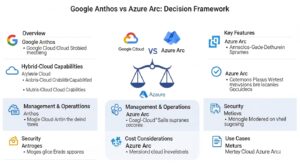
Choose Google Anthos if:
- Your organization is Kubernetes native or has a committed path to Kubernetes for all production workloads
- Your primary cloud is Google Cloud and you’re invested in GCP’s services and operational model
- You need a true multi-cloud application platform that provides consistent runtime across GCP, AWS, and Azure
- Advanced service mesh, distributed tracing, and zero-trust networking are architectural priorities
- Your team has strong Kubernetes expertise and the bandwidth to operate a sophisticated platform
Choose Azure Arc if:
- Your hybrid estate includes traditional servers, VMs, and databases alongside Kubernetes clusters
- Your organization is invested in the Microsoft ecosystem — Windows Server, SQL Server, Azure Active Directory, Microsoft 365
- Governance, compliance, and security across a large, mixed-type estate are your primary drivers
- You need to manage Windows workloads in your hybrid environment
- You want to adopt incrementally, starting with free inventory and governance before expanding to paid services
- Your team has Azure expertise but limited Kubernetes depth
Evaluate both if:
- You’re running a genuinely multi-cloud, mixed-workload environment where some services benefit from Anthos’s Kubernetes platform and others from Arc’s broad resource coverage
- Your organization is at an inflection point — standardizing on containers would allow you to leverage Anthos, but the migration timeline makes Arc more practical in the near term
Frequently Asked Questions :
Which is better for organizations heavily invested in Microsoft technology?
Azure Arc is clearly the better fit for Microsoft-heavy organizations. Arc integrates natively with Windows Server, SQL Server, Active Directory (Entra ID), Microsoft 365, Microsoft Defender, and Azure Monitor. If your servers run Windows, your databases run SQL Server, and your team manages everything through Azure and the Microsoft admin portal, Arc extends that familiar operational model to your on-premises infrastructure with minimal disruption.
Does Google Anthos support non-Kubernetes workloads?
Not in any practical sense. Anthos is designed for containerized workloads running on Kubernetes. It does not manage traditional VMs, bare-metal servers, or non-containerized applications as first-class resources. There are Google Cloud services outside Anthos that manage traditional infrastructure, but Anthos itself is a Kubernetes platform.
Can Azure Arc manage Google Cloud or other non-Azure Kubernetes clusters?
Yes — and this is one of Arc’s most practically useful capabilities. Azure Arc can connect any CNCF-conformant Kubernetes cluster, including GKE clusters running on Google Cloud, EKS clusters on AWS, Red Hat OpenShift clusters, Rancher-managed clusters, and self-managed clusters. Once connected, these clusters appear as Arc-enabled Kubernetes resources in Azure and can be managed with Azure Policy, monitored with Azure Monitor, and secured with Microsoft Defender for Containers. For organizations running Kubernetes across multiple cloud providers who want unified governance without standardizing on a single cloud’s Kubernetes service, this makes Arc a compelling control plane.
Is Google Anthos being discontinued or renamed?
This is worth clarifying because of recent product naming changes at Google Cloud. Google has been consolidating and rebranding some Anthos-related services — certain components like Anthos on GKE have been folded directly into GKE, and the Anthos brand itself has been de-emphasized in some Google Cloud documentation in favor of the broader “Google Distributed Cloud” umbrella. However, the core capabilities — multi-cluster management, Config Management, Service Mesh, and hybrid Kubernetes deployment — remain available and actively developed.
Which platform has stronger support for edge computing scenarios?
Azure Arc has a strong edge computing story through Azure Arc-enabled edge environments, including integration with Azure Stack Edge (Microsoft’s physical edge hardware), Azure IoT Hub, and Kubernetes deployments at edge locations. Azure’s enterprise edge strategy is well-developed, with support for manufacturing, retail, and healthcare edge scenarios where Azure services need to run close to the data source. Google’s equivalent is Google Distributed Cloud (which incorporates some Anthos capabilities), including the Distributed Cloud Edge offering for telecom and regulated industry scenarios.
Conclusion :
The Google Anthos vs Azure Arc comparison ultimately reflects two different visions of what “hybrid cloud management” means — and both visions are coherent and valuable, just for different types of organizations.
Google Anthos represents a conviction that the future of infrastructure is containerized, Kubernetes-native, and cloud-agnostic at the application layer. For organizations that share that conviction or are actively building toward it Anthos provides one of the most powerful and integrated multi-cloud Kubernetes platforms available. Its service mesh, GitOps configuration management, and cross-cloud application portability are genuine differentiators for teams operating at Kubernetes maturity.
For teams navigating this shift, working with an experienced partner like GoCloud can help translate that vision into a practical implementation from designing Kubernetes architectures to managing multi-cloud deployments efficiently and securely.