


Every engineering leader reaches this inflection point sooner or later. You need AI capabilities in your product, your internal workflows, or both. The question is not whether to adopt AI but how to adopt it build on AWS or buy an AI tool. Do you build on AWS using foundational services like Amazon Web Services offerings such as Amazon Bedrock, Amazon SageMaker, and AWS Lambda, or do you buy a ready-made AI tool that promises faster deployment? The answer is rarely straightforward, and getting it wrong can cost your organization hundreds of thousands of dollars in wasted engineering hours or vendor lock-in penalties.
This guide is written for CTOs, cloud architects, startup founders, and senior developers who are evaluating the build-versus-buy decision for AI infrastructure. We will break down the technical trade-offs, provide a structured decision framework, analyze real cost scenarios, and give you the implementation patterns that top-performing engineering teams use in production today.
The build-on-AWS-or-buy-an-AI-tool debate has evolved significantly. In 2024, the market was flooded with point solutions. In 2026, the ecosystem has matured, and the decision criteria have become more nuanced. Let us walk through every dimension that matters.

The Real Problem Behind the Build vs Buy Decision :
Most organizations frame this as a technology choice, but it is fundamentally a business strategy decision. When you build on AWS, you are investing in long-term flexibility and deep integration with your existing cloud infrastructure. When you buy an AI tool, you are trading customization for speed-to-market.
The problem intensifies when you consider the hidden costs on both sides. Building requires dedicated ML engineering talent, ongoing model maintenance, data pipeline management, and continuous optimization. Buying introduces vendor dependency, limited customization, potential data privacy concerns, and recurring subscription costs that compound over time.
Why This Decision Is Harder Than It Looks :
Engineers tend to underestimate the maintenance burden of custom-built AI systems. A language model fine-tuned on your proprietary data requires versioning, monitoring, retraining pipelines, and drift detection. These are not one-time costs. They are permanent operational overhead that grows as your system handles more edge cases and as the underlying foundation models release new versions.
On the other side, business leaders tend to underestimate the limitations of off-the-shelf AI tools. That chatbot platform might handle eighty percent of your use cases today, but what happens when you need custom entity extraction, domain-specific reasoning, or multi-modal capabilities that the vendor does not support? You end up building workarounds on top of a system you do not control.
The real question is not build or buy. It is this: Where on the build-to-buy spectrum should each AI capability in your organization sit? Most mature engineering teams operate at multiple points on this spectrum simultaneously.
A Structured Decision Framework for CTOs and Cloud Architects
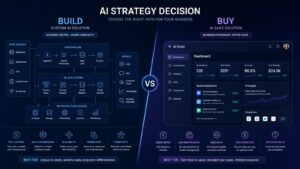
Before evaluating tools or services, run every AI initiative through this five-dimension framework. Each dimension should be scored on a scale of one to five, and the aggregate score will point you toward the right approach.
Dimension 1: Strategic Differentiation
Ask yourself whether this AI capability is a core differentiator for your product or business. If AI is what makes your product unique, building gives you control over the intellectual property, training data, and model behavior. If AI is a supporting function like internal document search or customer support automation, buying makes more sense because you are not competing on that capability.
Score it high if this capability is customer-facing, revenue-generating, and central to your competitive moat. Score it low if it is an internal productivity tool or a feature that many competitors also offer through third-party integrations. Companies like Stripe and Shopify build their core AI capabilities in-house precisely because those capabilities define their product experience.
Dimension 2: Data Sensitivity and Compliance
Regulated industries like healthcare, finance, and defense often cannot send proprietary data to third-party AI vendors without extensive compliance review. Building on AWS with services like Amazon Bedrock lets you keep data within your VPC, apply encryption at rest and in transit, and maintain full audit trails using AWS CloudTrail.
If your data includes PII, PHI, financial records, or classified information, the compliance overhead of evaluating and approving a third-party vendor can exceed the engineering cost of building the solution yourself. This is where AWS services like PrivateLink, KMS, and Macie become force multipliers. They let you satisfy compliance requirements without building custom security infrastructure from scratch.
Dimension 3: Engineering Capacity and Expertise
Building on AWS requires engineers who understand not just application development but also ML operations, prompt engineering, model evaluation, and infrastructure-as-code for AI workloads. If your team has three backend developers and no ML experience, buying an AI tool is the pragmatic choice for the first six to twelve months while you build internal expertise.
However, if you have a platform engineering team familiar with Terraform, CDK, SageMaker, and container orchestration, building custom AI pipelines on AWS can deliver superior results at lower long-term cost. Assess your team honestly. The gap between a team that can manage API integrations and a team that can manage ML infrastructure is significant.
Dimension 4: Time-to-Market Pressure
If you need AI capabilities in production within two weeks, buying is almost always the right move. If you have a three-to-six-month runway, building on AWS becomes viable and often more cost-effective for sustained workloads.
Consider a hybrid approach: buy a tool to validate the use case quickly, then build on AWS once you have confirmed product-market fit and understand the exact model requirements. This approach minimizes risk on both sides and gives you production data to inform your architecture decisions.
Dimension 5: Total Cost of Ownership Over 36 Months
Vendor pricing looks attractive at month one. But AI SaaS tools typically charge per API call, per seat, or per token. At enterprise scale, these costs can grow exponentially. A startup processing ten thousand API calls per month might pay two hundred dollars. At one million calls per month, that same tool could cost twenty thousand dollars or more.
Building on AWS with Bedrock or self-hosted models on EC2 with Inferentia chips often breaks even between month six and month twelve, depending on volume. After that, the custom-built solution is almost always cheaper per transaction. Model this carefully with your finance team before committing.
Build vs Buy: Head-to-Head Comparison
| Dimension | Build on AWS | Buy an AI Tool |
| Time to Deploy | Weeks to months | Days to weeks |
| Upfront Cost | High (engineering hours) | Low (subscription fees) |
| Long-term Cost | Lower at scale | Higher at scale |
| Customization | Full control | Limited by vendor |
| Data Privacy | Complete control via VPC | Depends on vendor policy |
| Maintenance | Your team handles it | Vendor handles updates |
| Scalability | Elastic with AWS auto-scaling | Bound by vendor limits |
| Vendor Lock-in | AWS-level (mitigable) | High (proprietary APIs) |
| Talent Required | ML + DevOps engineers | Product and integration team |
When Building on AWS Is the Right Call :
There are clear scenarios where building your AI stack on AWS delivers superior outcomes. Understanding these patterns helps you avoid both over-engineering and under-investing.
Scenario 1: You Need Custom Model Behavior
If your AI system requires domain-specific knowledge that general-purpose models cannot provide, building is the way forward. Amazon Bedrock allows you to fine-tune foundation models like Anthropic Claude, Meta Llama, and Amazon Titan on your proprietary data without the data ever leaving your AWS environment.
For example, a legal technology company that needs AI to understand jurisdiction-specific case law cannot rely on a generic chatbot API. Fine-tuning a model on millions of legal documents using SageMaker creates a defensible competitive advantage that no off-the-shelf tool can replicate. The model learns your domain’s terminology, reasoning patterns, and edge cases in ways that prompt engineering alone cannot achieve.
Scenario 2: You Operate at High Volume
When your application processes hundreds of thousands or millions of AI inference requests per day, the per-call pricing of commercial AI tools becomes prohibitively expensive. Deploying models on AWS Inferentia or Graviton instances with auto-scaling groups and spot pricing can reduce inference costs by sixty to eighty percent compared to API-based pricing.
The break-even analysis is straightforward. Calculate your monthly API spend with the vendor. Compare it to the cost of equivalent EC2 instances plus engineering time for deployment and maintenance. At high volumes, the math almost always favors building. Factor in Reserved Instances or Savings Plans to further reduce the AWS cost baseline.
Scenario 3: You Need Tight Integration with Existing AWS Infrastructure
If your application already runs on AWS with services like ECS, RDS, S3, EventBridge, and Step Functions, building AI capabilities natively on AWS eliminates the networking overhead, latency, and security complexity of routing data to an external vendor and back.
Using Amazon Bedrock with AWS Lambda creates serverless AI pipelines that scale automatically, cost nothing when idle, and integrate seamlessly with your existing event-driven architecture. This is particularly powerful for real-time processing use cases like fraud detection, content moderation, and dynamic pricing where every millisecond of added latency impacts business outcomes.
When Buying an AI Tool Makes More Sense
Scenario 1: You Are Validating a New Use Case
Before committing engineering resources to build a custom AI system, validate whether the use case delivers value. A third-party AI tool lets you test assumptions quickly. If the AI-powered feature increases user engagement or reduces support tickets, you have the data to justify a custom build later.
Many successful AI implementations at startups followed this exact pattern: buy to validate, then build to scale. The mistake is building a custom solution for a use case that might not survive its first contact with real users. Validate fast, iterate on requirements, and build only when you know exactly what you need.
Scenario 2: AI Is Not Your Core Product
If you are building a project management tool and want to add AI-powered task prioritization, that feature enhances your product but is not the product itself. Buying an AI tool or using an API like OpenAI or Anthropic’s Claude through a thin integration layer gives you the capability without diverting your engineering team from core product development.
The opportunity cost of your engineers spending three months building an AI feature is three months not spent on features that directly drive revenue and retention. For non-core AI capabilities, the speed and simplicity of a commercial tool almost always delivers better ROI than a custom build.
Scenario 3: Your Team Lacks ML Operations Experience
ML operations is a specialized discipline. It involves model versioning, A/B testing inference endpoints, monitoring model drift, managing training pipelines, and handling GPU resource allocation. If your team does not have this expertise, the learning curve can delay your project by months and introduce production reliability risks.
Buying a managed AI tool abstracts away this complexity. You trade control for operational simplicity, which is often the right trade-off for small-to-medium engineering teams that need to focus their energy on product development rather than infrastructure management.

The Hybrid Approach: Best of Both Worlds
The most sophisticated engineering organizations do not frame this as a binary choice. They use a hybrid strategy where different AI capabilities sit at different points on the build-to-buy spectrum based on strategic importance, data sensitivity, and volume.
Architecture Pattern: Core Build, Edge Buy
Build custom AI systems for capabilities that directly impact your product’s competitive position. Buy third-party tools for supporting functions like internal knowledge search, marketing content generation, and customer support automation.
For example, a fintech company might build custom fraud detection models on SageMaker that are trained on their proprietary transaction data while using a purchased AI tool for internal document search and employee onboarding chatbots. Each capability sits at the right point on the spectrum based on its strategic value.
Architecture Pattern: Buy First, Build Later
Start with a commercial AI API for fast deployment. Instrument everything to collect training data. Once you have accumulated enough labeled data and validated the use case, migrate to a custom model deployed on AWS. This pattern works exceptionally well because the bought solution generates the training data you need for the built solution.
You get market feedback while simultaneously building your data moat. By the time you are ready to build, you have months of real interaction data, clear quality benchmarks, and well-defined requirements that dramatically reduce the risk of the custom build.
Architecture Pattern: AWS Bedrock as the Middle Ground
Amazon Bedrock occupies a unique position in this spectrum. It is not fully custom, because you are using foundation models from Anthropic, Meta, or Amazon. But it is not fully bought either, because you deploy within your AWS account, fine-tune on your data, and maintain full control over the infrastructure and security boundaries.
For many organizations, Bedrock is the correct starting point. It offers the speed of buying with much of the control of building. You can then graduate specific workloads to fully custom SageMaker deployments as requirements become more specialized and your team develops deeper ML expertise.
Real-World Cost Analysis: Build on AWS vs Buy an AI Tool
Let us walk through a concrete example. Imagine a mid-size SaaS company that needs to process fifty thousand customer support queries per day using AI-powered response generation and classification.
Option A: Buy a Commercial AI Tool
A typical commercial AI support platform charges between three and eight cents per interaction at enterprise volume. At fifty thousand queries per day, that translates to one thousand five hundred to four thousand dollars per day, or forty-five thousand to one hundred twenty thousand dollars per month.
This includes the model, hosting, maintenance, and support. The cost is predictable but grows linearly with volume and provides no path to cost reduction as you scale. Negotiating volume discounts can help, but you remain fundamentally tied to the vendor’s pricing structure and business model.
Option B: Build on AWS with Bedrock
Using Amazon Bedrock with Claude Sonnet for the same workload, input and output token costs are significantly lower per interaction. Combined with intelligent caching using ElastiCache, prompt optimization, and tiered routing where simple queries go to smaller models, total infrastructure cost typically lands between eight thousand and fifteen thousand dollars per month.
Add two senior ML engineers for ongoing optimization at a loaded cost of fifteen thousand dollars per month each, and your total monthly cost is thirty-eight thousand to forty-five thousand dollars. Expensive at low volume, but at fifty thousand queries per day, you save thirty to seventy percent compared to the commercial tool. The savings compound as volume increases because infrastructure costs scale sub-linearly.
The Crossover Point :
For this workload profile, the cost crossover typically occurs between ten thousand and twenty thousand queries per day. Below that threshold, buying is cheaper. Above it, building on AWS delivers better unit economics that improve as volume grows. Every organization should model this crossover point for their specific use case before making the decision.
The variables that matter most are query volume, average response complexity and token count, model selection, engineering talent cost in your market, and whether you can leverage existing AWS infrastructure investments. Create a spreadsheet that models these variables over thirty-six months to make a data-driven decision.
Implementation Roadmap: From Decision to Production
Phase 1: Discovery and Evaluation (Week 1-2)
Score each AI initiative against the five-dimension framework described above. Map each capability to its optimal position on the build-to-buy spectrum. Identify quick wins for commercial tools and long-term investments for custom builds. Document your scoring rationale so the team can revisit decisions as conditions change.
Phase 2: Proof of Concept (Week 3-6)
For build decisions, deploy a minimal pipeline using Amazon Bedrock with a single foundation model. Use AWS Lambda for orchestration and S3 for data storage. Measure latency, cost per transaction, and output quality against your requirements. For buy decisions, run a paid pilot with your top two vendor choices and measure the same metrics for direct comparison.
Phase 3: Production Architecture (Week 7-12)
Design the production architecture with proper observability using CloudWatch and X-Ray, security controls using IAM and VPC endpoints, and cost guardrails using AWS Budgets and Usage Plans. Implement CI/CD pipelines for model deployment using CodePipeline or GitHub Actions. Build automated testing for model output quality.
Phase 4: Optimization and Iteration (Ongoing)
Monitor inference costs, latency percentiles, and output quality continuously. Implement model routing where high-complexity queries go to larger models and routine queries go to smaller, cheaper models. Evaluate new foundation models quarterly as the landscape evolves. Reassess your build-vs-buy positions every six months.
Seven Costly Mistakes Teams Make in the Build vs Buy Decision :
First, building before validating the use case. Engineering teams often start building custom AI before confirming that the use case delivers business value. Always validate with a bought solution or rapid prototype first. The most expensive AI system is one that solves a problem nobody has.
Second, underestimating ML operations costs. The model is only twenty percent of the work. Data pipelines, monitoring, retraining, drift detection, and incident response consume the majority of ongoing effort. Budget for at least two full-time engineers for production ML systems.
Third, ignoring vendor exit costs. Evaluate how difficult it would be to migrate away from a commercial AI tool before you commit. Check for data portability, API compatibility, and contractual lock-in clauses. If switching costs are high, factor that into your total cost of ownership.
Fourth, over-engineering the first version. Start with the simplest architecture that meets your requirements. You can add complexity, fine-tuning, and custom models as you learn what actually matters in production. Premature optimization in AI systems is even more dangerous than in traditional software.
Fifth, failing to instrument for learning. Whether you build or buy, collect detailed data on every interaction. This data is the foundation for future optimization and eventual custom model training. Without instrumentation, you cannot improve.
Sixth, choosing based on current volume only. Project your AI usage growth over the next twenty-four months. A solution that is cost-effective at current volume might become prohibitively expensive at projected scale. Always run the cost model at your twelve-month and twenty-four-month projected volumes.
Seventh, treating this as a permanent decision. The best teams continuously re-evaluate their build-vs-buy positions as their requirements evolve, their teams grow, and the AI tool ecosystem matures. Set a calendar reminder to revisit this decision every two quarters.
Security and Compliance Considerations for AI Infrastructure :
When you build on AWS, you inherit the AWS shared responsibility model. Your data stays within your account boundary. You control encryption keys through AWS KMS. You can restrict network access using VPC endpoints and security groups. And you can audit every access using CloudTrail. This level of control is essential for organizations that handle sensitive data.
When you buy an AI tool, you are trusting the vendor with your data. This requires due diligence on their SOC 2 compliance, data retention policies, model training policies including whether they train on your data, sub-processor agreements, and incident response procedures. Request their latest audit reports and review them carefully.
For organizations in regulated industries, the compliance advantage of building on AWS is often the deciding factor. The ability to demonstrate complete data sovereignty, maintain audit trails, and implement custom access controls can reduce compliance review timelines from months to weeks. This alone can justify the additional engineering investment.
Frequently Asked Questions
- Is it cheaper to build on AWS or buy an AI tool?
At low volume, buying is almost always cheaper because you avoid engineering overhead. At high volume, building on AWS with services like Bedrock and SageMaker typically costs thirty to seventy percent less per transaction. The crossover point depends on your specific workload, but it usually occurs between ten thousand and twenty thousand daily transactions.
- Can I use Amazon Bedrock as a middle ground between building and buying?
Yes. Amazon Bedrock lets you access foundation models from Anthropic, Meta, and Amazon within your AWS account. You get the speed of a managed service with the data control of a custom deployment. It is the most popular hybrid approach for teams evaluating build on AWS or buy an AI tool options.
- What AWS services do I need to build a custom AI pipeline?
At minimum, you need Amazon Bedrock or SageMaker for model hosting, S3 for data storage, Lambda or ECS for orchestration, IAM for access control, and CloudWatch for monitoring. For production workloads, add Step Functions for workflow management, ElastiCache for response caching, and CodePipeline for CI/CD.
- How long does it take to build an AI system on AWS?
A proof of concept using Amazon Bedrock can be deployed in one to two weeks. A production-grade system with proper security, monitoring, and scaling typically requires eight to twelve weeks of engineering effort from a team of two to three experienced developers.
- What are the biggest risks of buying a commercial AI tool?
The three primary risks are vendor lock-in with proprietary APIs that are difficult to migrate away from, data privacy concerns if the vendor processes your data on shared infrastructure, and cost escalation as your usage grows beyond initial pricing tiers. Always negotiate exit clauses and data portability rights.
Conclusion: Making the Right Build or Buy Decision for Your Organization
The build on AWS or buy an AI tool decision is not about choosing the objectively better option. It is about choosing the right option for your specific context, capabilities, and timeline. Use the five-dimension framework to evaluate each AI initiative independently. Consider hybrid approaches where you build core differentiators and buy supporting capabilities.
Start with clear success metrics. Whether you build or buy, define what success looks like before you begin. Measure cost per transaction, latency at the ninety-ninth percentile, output quality scores, and downstream business impact. Let data drive your decisions rather than engineering preferences or vendor sales pitches.
The AI infrastructure landscape is evolving rapidly. AWS continues to expand its AI service portfolio with new foundation models, improved pricing, and tighter service integrations. Commercial AI tools are becoming more capable and more affordable. The teams that win are not the ones that make a single perfect decision today but the ones that build the organizational muscle to continuously evaluate, adapt, and optimize their AI strategy over time.