

Generative AI has moved past the hype cycle. The companies generating real returns from this technology are not the ones experimenting with chatbots in sandbox environments. They are the ones deploying generative AI use cases into production workflows that directly impact revenue, operational efficiency, and customer experience. The gap between experimentation and production deployment is where most organizations stall, and this guide is designed to help you cross that gap.
This guide examines five real generative AI use cases that engineering teams are running in production today. These are not theoretical possibilities or demo projects. Each use case includes the technical architecture, implementation approach, infrastructure requirements, common pitfalls, and measurable business outcomes that real teams are achieving across industries from financial services to e-commerce to developer tooling.
If you are a CTO evaluating where to invest in generative AI, a cloud architect designing AI-enabled systems, or a developer building your first production AI pipeline, these use cases will give you a practical roadmap grounded in engineering reality rather than marketing promises. We have deliberately chosen use cases that span different levels of complexity and different parts of the business so you can identify which ones align with your organization’s priorities.
Why These Five Use Cases Were Selected
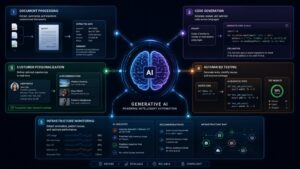
There are dozens of potential generative AI applications, but these five were chosen based on three criteria. First, they are being run in production by multiple organizations with measurable results, not just proof-of-concept experiments. Second, they represent different levels of implementation complexity, allowing organizations at different maturity levels to find a starting point. Third, they cover both internal efficiency gains and customer-facing revenue impact, giving leadership a balanced view of where generative AI creates value.
The use cases range from document processing, which most teams can deploy within weeks, to intelligent infrastructure operations, which requires deeper investment but delivers transformative operational improvements. Let us examine each one in detail.
Use Case 1: Intelligent Document Processing and Knowledge Extraction
The Business Problem
Every enterprise sits on massive volumes of unstructured documents: contracts, invoices, compliance reports, research papers, support tickets, and internal wikis. Traditional keyword search and manual review cannot keep up. Employees spend an estimated twenty to thirty percent of their workweek searching for information across siloed document repositories. This problem compounds as organizations grow and documentation accumulates faster than it can be organized.
Generative AI transforms document processing from a labor-intensive task into an automated pipeline that extracts, classifies, summarizes, and makes information accessible in real time. This is one of the highest-ROI generative AI use cases because the cost savings are immediate and measurable, and the technology has matured enough to deliver reliable results in production.
Technical Architecture
The production architecture for intelligent document processing typically involves four layers. First, an ingestion layer that accepts documents from multiple sources including S3 buckets, email attachments, API uploads, and shared drives. Second, a processing layer that uses OCR for scanned documents, layout analysis for structured documents, and text extraction for digital files. Third, an embedding and indexing layer that converts document content into vector representations using models like Amazon Titan Embeddings and stores them in a vector database such as Amazon OpenSearch Serverless or Pinecone. Fourth, a query and generation layer that uses retrieval-augmented generation to answer questions by retrieving relevant document chunks and generating contextual responses through a foundation model.
On AWS, this architecture runs on a combination of Amazon Textract for OCR, Lambda for orchestration, S3 for storage, OpenSearch Serverless for vector search, and Amazon Bedrock for generation. The entire pipeline can be serverless, scaling to zero when idle and handling burst traffic during business hours automatically.
Implementation Insights
The most common mistake teams make is treating this as a pure AI problem. In reality, eighty percent of the work is in data preparation. Document formats vary wildly. Tables, headers, footers, multi-column layouts, and embedded images all require different handling strategies. Invest heavily in your document preprocessing pipeline before focusing on model selection.
Chunking strategy is the single biggest factor in retrieval quality. Splitting documents by fixed token count produces mediocre results. Instead, use semantic chunking that respects paragraph boundaries, section headers, and document structure. Include metadata like document title, section heading, page number, and document date with each chunk to improve relevance scoring and allow users to verify sources.
Production teams report that RAG-based document systems achieve seventy to eighty-five percent accuracy on first deployment. Getting to ninety-five percent requires iterative prompt refinement, query expansion, re-ranking models, and human-in-the-loop feedback that continuously improves retrieval quality over three to six months of production use.
Measurable Outcomes
Organizations deploying this use case report a forty to sixty percent reduction in time spent searching for information, a twenty to thirty percent improvement in compliance review speed, and significant reductions in errors caused by employees working with outdated information. For a company processing ten thousand documents per month, this typically translates to savings of one hundred fifty thousand to three hundred thousand dollars annually in labor costs alone.

Use Case 2: AI-Powered Code Generation and Developer Productivity
The Business Problem
Software development is one of the most expensive functions in any technology organization. Senior engineers cost between one hundred fifty thousand and three hundred thousand dollars annually in total compensation, and they spend a significant portion of their time on repetitive tasks: writing boilerplate code, translating requirements into implementation, writing tests, debugging, and documenting their work.
Generative AI for code is not about replacing developers. It is about removing the friction that slows them down. The real generative AI use cases in development productivity focus on accelerating the mundane so engineers can focus on architecture, design, and complex problem-solving that requires human creativity and judgment.
Technical Architecture
Production code generation systems go far beyond a simple chatbot that writes functions. The architecture includes context-aware code completion integrated into the IDE, repository-level understanding where the model has access to the full codebase and coding standards, test generation that creates unit and integration tests based on existing code patterns, code review automation that identifies bugs, security vulnerabilities, and style violations, and documentation generation that creates inline comments, API docs, and architectural decision records.
The infrastructure typically involves a code embedding model that indexes the repository, a vector store for semantic code search, a generation model fine-tuned on the organization’s coding patterns, and a deployment pipeline that serves completions with sub-two-hundred-millisecond latency. AWS CodeWhisperer and Amazon Q Developer are managed services that provide many of these capabilities, while organizations with stricter requirements deploy custom solutions using SageMaker endpoints behind private VPC endpoints.
Implementation Insights
The biggest trap in AI code generation is measuring the wrong metrics. Lines of code generated per day is meaningless. The metrics that matter are time from requirement to working implementation, bug rate in AI-assisted code versus manually written code, developer satisfaction and adoption rate, and pull request review time. Track these metrics from day one and share them with the engineering team to build confidence in the tool.
Organizations that succeed with AI code generation invest in guardrails. Generated code passes through the same CI/CD pipeline, linting, and security scanning as manually written code. The AI accelerates writing but does not bypass quality controls. Teams that skip this step end up with technical debt that erases the productivity gains within a few months.
Measurable Outcomes
Teams that have successfully deployed AI code assistants report a twenty-five to forty percent increase in feature delivery velocity, a fifteen to twenty percent reduction in bug rates due to AI-generated tests catching issues earlier, and a thirty percent reduction in time spent on code review. For a team of twenty developers, this is equivalent to adding five to eight additional engineers without the hiring and onboarding overhead.
Use Case 3: Personalized Customer Experience at Scale
The Business Problem
Customers expect personalized interactions, but traditional personalization systems rely on predefined rules and segments. They can recommend products based on purchase history or tailor email subject lines based on demographics, but they cannot generate truly individualized content, respond to nuanced customer inquiries with contextual awareness, or adapt communication style to match each customer’s preferences in real time.
Generative AI enables a fundamentally different level of personalization. Instead of choosing from a library of pre-written content, the system generates unique content for each customer interaction. This is one of the most commercially impactful real generative AI use cases because it directly affects conversion rates, customer retention, and lifetime value.
Technical Architecture
The architecture for AI-powered personalization requires three interconnected systems. A customer data platform that aggregates behavioral data, purchase history, support interactions, and preference signals into a unified profile. A context engine that selects the relevant subset of customer data for each interaction and formats it as context for the generation model. And a generation layer that produces personalized content including product descriptions, email copy, support responses, and in-app messaging tailored to each individual customer’s profile and current context.
On AWS, this architecture leverages Amazon Personalize for recommendation signals, DynamoDB or ElastiCache for customer profile storage with sub-millisecond reads, Amazon Bedrock for content generation, and Amazon Pinpoint or SES for delivery. Real-time personalization requires sub-second response times, which means the context retrieval and generation pipeline must be highly optimized with caching at multiple layers.
Implementation Insights
The critical success factor is context quality, not model quality. A smaller model with excellent context about the customer will outperform a larger model with generic context every time. Invest in building a comprehensive customer context that includes recent interactions, stated preferences, behavioral patterns, relationship tenure, and current session activity.
A/B testing is non-negotiable. Generative AI can produce infinite variations, but not all variations perform equally. Build a robust experimentation framework that tests AI-generated content against control groups and against other AI variations. The best teams run continuous multi-arm bandit experiments that automatically shift traffic to higher-performing content variations.
Measurable Outcomes
E-commerce companies deploying generative AI personalization report a ten to twenty-five percent improvement in conversion rates, a fifteen to thirty percent increase in email engagement, and a five to twelve percent lift in average order value. A mid-market retailer processing one million customer interactions per month can attribute one to three million dollars in incremental annual revenue to AI-powered personalization.
Use Case 4: Automated Quality Assurance and Testing
The Business Problem
Software testing is a bottleneck in most engineering organizations. Manual testing is slow and error-prone. Traditional automated testing requires significant upfront investment in test script development and ongoing maintenance as the application evolves. When applications change frequently, test suites become brittle, and teams spend more time maintaining tests than writing new features.
Generative AI transforms testing from a scripted process into an intelligent exploration of application behavior. AI-powered testing systems can generate test cases from requirements documents, identify edge cases that human testers miss, automatically update tests when the application changes, and generate test data that covers realistic and adversarial scenarios.
Technical Architecture
The architecture includes a requirement analysis component that reads user stories and acceptance criteria to identify what needs testing. A test generation engine that creates test cases, test data, and expected outcomes using a foundation model fine-tuned on your testing patterns. A test execution layer that runs generated tests and captures results. And an analysis component that identifies patterns in test failures, suggests root causes, and prioritizes bugs by business impact.
The infrastructure runs on AWS with CodeBuild for test execution, Lambda for orchestration, Bedrock for test generation, and DynamoDB for storing test results and historical patterns. The system learns from each test run, improving its generation accuracy over time by analyzing which generated tests caught real bugs versus producing false positives.
Implementation Insights
Start with test generation for existing code, not new code. The AI needs examples of your testing patterns, naming conventions, and assertion styles before it can generate useful tests. Feed it your existing test suite as training examples, and it will produce new tests that match your team’s standards and conventions.
Focus on edge case generation where AI delivers the most value. Standard happy-path tests are straightforward for humans to write. The AI excels at generating boundary conditions, error handling scenarios, race conditions, and unusual input combinations that humans tend to overlook. These are the tests that catch the bugs that make it to production.
Measurable Outcomes
Teams using AI-powered testing report a thirty to fifty percent reduction in time spent writing test cases, a twenty to thirty-five percent improvement in code coverage, and a fifteen to twenty-five percent reduction in production bugs that escape to customers.
Use Case 5: Intelligent Infrastructure Operations and Incident Management
The Business Problem
Modern cloud infrastructure generates massive volumes of operational data: logs, metrics, traces, alerts, and events. Operations teams are overwhelmed by alert noise, spending time investigating false positives while real issues escalate. When incidents occur, the mean time to resolution is driven not by the fix itself but by the time it takes to diagnose the root cause across distributed systems with dozens of interdependent services.
Generative AI applied to infrastructure operations represents one of the most underrated real generative AI use cases. It transforms observability data from a flood of signals into actionable intelligence that reduces mean time to resolution and prevents incidents before they impact customers.
Technical Architecture
The architecture integrates with existing observability stacks. It includes a data aggregation layer collecting logs from CloudWatch, metrics from Prometheus, and traces from X-Ray into a unified store. An anomaly detection component using ML models to identify unusual patterns. A correlation engine that links related signals across services, identifying that a spike in API latency, a database connection pool exhaustion, and a memory pressure alert are all symptoms of the same underlying issue. And a remediation advisor that analyzes correlated signals and suggests diagnostic steps and remediation actions based on historical incident patterns and runbooks.
On AWS, this leverages CloudWatch for data collection, OpenSearch for log analysis, SageMaker for anomaly detection, Bedrock for natural language incident analysis, and SNS or PagerDuty integration for alerting. The system continuously learns from incident resolutions, building an organizational knowledge base that accelerates future diagnosis.
Implementation Insights
The most impactful starting point is alert summarization and correlation. Before building full automated remediation, deploy a system that groups related alerts, provides a natural language summary of what is happening, and suggests the most likely root cause based on historical patterns. This alone can reduce alert fatigue by fifty percent or more.
Build a runbook knowledge base that the AI can reference. Document your team’s incident response procedures, common failure modes, and proven remediation steps. The AI becomes dramatically more useful when it can match current symptoms against your organization’s specific infrastructure patterns and recommend actions your team has validated in previous incidents.
Measurable Outcomes
Organizations report a forty to sixty percent reduction in mean time to resolution, a thirty to fifty percent reduction in alert noise through intelligent correlation, and a twenty to thirty percent reduction in after-hours pages. For an engineering organization running fifty production services, this typically saves two to four full-time equivalent headcount in operations capacity.
Use Case Comparison: Complexity vs Business Impact
| Use Case | Complexity | Time to Value | ROI Timeline | Impact Level |
| Document Processing | Medium | 4-8 weeks | 3-6 months | High |
| Code Generation | Medium-High | 2-6 weeks | 1-3 months | Very High |
| Personalization | High | 8-12 weeks | 3-6 months | Very High |
| QA & Testing | Medium | 4-8 weeks | 2-4 months | High |
| Infrastructure Ops | High | 8-16 weeks | 4-8 months | High |
Cross-Cutting Implementation Patterns Across All Use Cases
Observability and Monitoring
Every production generative AI system needs comprehensive monitoring beyond traditional application metrics. Track model latency at each percentile, token usage and cost per request, output quality scores using automated evaluation frameworks, hallucination rates detected by validation layers, and user feedback signals. Build dashboards in CloudWatch or Grafana that give your team real-time visibility into AI system health and business impact alongside your existing application metrics.
Cost Management
Generative AI workloads can generate surprising costs if left unmanaged. Implement token budgets per request type. Use tiered model routing where simple tasks go to smaller, cheaper models and complex tasks go to more capable models. Cache common responses using ElastiCache to avoid redundant inference calls. Set up AWS Budget alerts with automatic scaling limits to prevent runaway costs during unexpected traffic spikes or recursive processing loops.
Security and Data Governance
All five use cases involve processing sensitive data. Implement input sanitization to prevent prompt injection attacks. Apply output filtering to catch personally identifiable information, inappropriate content, or hallucinated data before it reaches end users. Use AWS IAM roles with least-privilege access, encrypt data at rest with KMS, and maintain audit logs of all AI interactions for compliance and forensic purposes.
How to Prioritize These Generative AI Use Cases for Your Organization
The Prioritization Matrix
Not every organization should start with the same use case. The right starting point depends on three factors: your current technical maturity, the urgency of the business problem, and the availability of quality data. Organizations with strong DevOps practices and existing CI/CD pipelines will find code generation and automated testing easier to adopt because they already have the infrastructure for integration, quality measurement, and continuous deployment.
Companies with large customer bases and existing personalization infrastructure should consider AI-powered personalization because the incremental effort to add generative AI capabilities onto existing recommendation systems is relatively low compared to building a personalization system from scratch. The foundation of customer data, experimentation frameworks, and delivery channels is already in place and can be leveraged immediately.
Organizations drowning in operational complexity should prioritize intelligent infrastructure operations. If your team spends more than thirty percent of its time on incident response and alert triage, the productivity gains from AI-powered operations will be felt immediately and will free up engineering capacity to pursue the other use cases on this list.
Building a Twelve-Month Generative AI Roadmap
The most effective approach is a phased rollout that builds organizational muscle progressively. In months one through three, pick your highest-impact, lowest-complexity use case and deploy a production-grade implementation with proper monitoring and evaluation. In months four through six, measure results rigorously, optimize based on real production data, and begin planning your second use case while documenting the lessons learned from the first deployment.
In months seven through nine, deploy the second use case while continuing to refine the first. By this point, your team has established operational patterns for AI systems that can be reused across deployments. In months ten through twelve, evaluate results across both deployments, share metrics and learnings across the organization, and plan the next phase of your generative AI strategy with the credibility that comes from demonstrated production results.
This cadence gives your team time to build internal expertise, establish operational patterns, and demonstrate measurable ROI to stakeholders before expanding. Resist the temptation to pursue multiple use cases simultaneously in the early stages. The operational learning from your first production deployment will dramatically improve the speed and quality of every subsequent deployment.
Common Organizational Pitfalls
The first pitfall is starting too many use cases at once. Spreading engineering resources across three or four parallel AI initiatives almost always results in none of them reaching production quality. Focus is more important than breadth in the first year of generative AI adoption. Pick one, ship it, prove it, then expand.
The second pitfall is underinvesting in evaluation and monitoring. Teams that deploy AI systems without robust quality measurement end up with systems that degrade silently over time as data distributions shift and user patterns change. Budget at least twenty percent of your AI engineering effort for evaluation, monitoring, and continuous improvement infrastructure.
The third pitfall is treating generative AI as a purely technical initiative without business alignment. The most successful deployments have executive sponsorship, clear business metrics, and cross-functional collaboration between engineering, product, and the business units that will benefit from the AI capabilities. Without this alignment, even technically excellent implementations fail to deliver their full potential business impact and risk losing organizational support.
Frequently Asked Questions
- Which generative AI use case should we implement first?
Start with the use case that has the clearest ROI and the lowest implementation risk. For most organizations, intelligent document processing or AI-powered code generation delivers measurable value within four to eight weeks with manageable complexity.
- What cloud infrastructure do we need for production generative AI?
At minimum, you need a foundation model service like Amazon Bedrock, object storage for data, a vector database for retrieval-augmented generation, and serverless compute for orchestration. Add monitoring, caching, and security layers as you move from proof of concept to production.
- How much does it cost to run generative AI use cases in production?
Costs vary significantly by use case and volume. A document processing system handling ten thousand documents per month typically costs two thousand to five thousand dollars in infrastructure. Code generation tools cost fifty to one hundred dollars per developer per month. Budget for both infrastructure and the engineering time required for ongoing optimization.
- What are the biggest risks of deploying generative AI in production?
The three primary risks are hallucination where the model generates incorrect but plausible information, cost escalation from unmanaged token usage, and security vulnerabilities from prompt injection attacks. All three are manageable with proper architecture and operational guardrails.
- How do we measure the success of generative AI implementations?
Define metrics before deployment. Track both technical metrics like latency, accuracy, and cost per request, and business metrics like time saved, revenue impact, and customer satisfaction. Run controlled experiments comparing AI-assisted workflows against baseline performance to isolate and quantify the real impact.
Conclusion: Moving From Experimentation to Production with Generative AI
These five real generative AI use cases represent the frontier of what engineering teams are deploying in production today. The common thread is that success comes not from choosing the most powerful model but from building the right architecture, implementing proper guardrails, and measuring outcomes rigorously against business objectives.
Start with a single use case that aligns with your organization’s most pressing problem. Build a minimal viable pipeline, validate that it delivers measurable value, and then invest in scaling and hardening the system. Use the cross-cutting patterns for observability, cost management, and security from the beginning rather than bolting them on later when problems emerge.
The generative AI landscape will continue to evolve rapidly. Models will become more capable and more affordable. New use cases will emerge. But the engineering fundamentals of building production AI systems will remain constant: good architecture, clean data, robust monitoring, and a relentless focus on delivering measurable business value. The teams that master these fundamentals today will be the ones leading the next wave of AI-powered innovation.