


A year ago, most AI projects were experiments. Today the budget is approved, the deadline is real, and the question sitting in front of every CTO, ML engineer, and startup founder is the same: do we build on AWS or buy an AI tool?
Both choices are being made badly. Teams are spending three months engineering custom RAG pipelines on Amazon Bedrock for use cases a $30/month SaaS tool could have validated in an afternoon. At the same time, other teams are handing sensitive proprietary data to third-party AI vendors with unclear data residency policies, only to discover they have zero control over model behavior when the vendor pivots or raises prices.
The decision to build on AWS or buy an AI tool is not about which approach is universally better. It is about matching the right approach to the right use case at the right stage of your organization’s AI maturity. This guide gives you a framework for making that decision with clarity covering cost, control, customization, data privacy, speed, and the specific AWS services that change the equation.
What ‘Build on AWS’ Actually Means in 2026
Building AI on AWS does not mean training your own large language model from scratch. That is a path reserved for companies with hundreds of millions in AI R&D budgets and decades of ML research expertise. For the vast majority of teams, building on AWS means assembling AI capabilities using managed AWS services — without the infrastructure burden of managing model infrastructure, but with full control over how models are accessed, what data they see, and how outputs are processed.
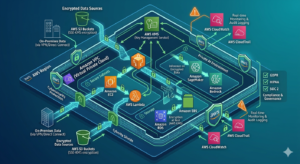
The AWS AI Service Stack
The AWS AI services most relevant to the build decision in 2026 fall into three layers:
- Foundation Model Access — Amazon Bedrock: Managed access to frontier models including Anthropic Claude (Opus, Sonnet, Haiku), Meta Llama, AI21 Labs, Cohere, Stability AI, and Amazon Titan. Bedrock provides API access to these models without managing any model infrastructure, with data processed within your AWS account and not used for model training by default
- Vector Storage and RAG Infrastructure — Amazon OpenSearch, Aurora pgvector, Kendra: Services for building Retrieval Augmented Generation (RAG) systems that ground AI responses in your proprietary knowledge base
- Orchestration and Agents — Amazon Bedrock Agents, AWS Lambda, Step Functions: Infrastructure for building AI workflows, multi-step reasoning agents, and automated pipelines that call AI models as part of larger application logic
- Data Preparation — Amazon S3, AWS Glue, SageMaker Data Wrangler: The data layer that feeds your AI systems — document processing, embedding generation, and structured data preparation
- Monitoring and Safety — Amazon CloudWatch, Amazon Bedrock Guardrails: Tools for monitoring AI application behavior, enforcing content policies, and detecting harmful outputs
Building on AWS means assembling these services into an AI system that is owned, operated, and controlled within your AWS account. Your data never leaves your infrastructure. Model behavior is transparent. And the system integrates directly with your existing AWS security posture, IAM policies, and compliance controls.
What ‘Buying an AI Tool’ Actually Means in 2026
Buying an AI tool means procuring a software product — typically SaaS — that packages AI capabilities into a ready-to-use application. Rather than assembling the pieces yourself, you configure and deploy a pre-built product that embeds AI in its core functionality.
The range of AI tools available in 2026 spans every business function:
- Customer support: Intercom, Zendesk AI, Freshdesk Freddy — AI-powered ticket routing, auto-responses, and agent assist
- Sales and CRM: Salesforce Einstein, HubSpot AI, Gong — AI for lead scoring, call analysis, and pipeline forecasting
- Developer productivity: GitHub Copilot, Cursor, Tabnine — AI code completion and review integrated into the IDE
- Document and knowledge management: Notion AI, Guru, Confluence AI — AI search and generation on top of internal knowledge bases
- Marketing and content: Jasper, Copy.ai, Writer — AI content generation, brand consistency, and workflow automation
- Data analytics: Tableau AI, ThoughtSpot, Microsoft Power BI Copilot — natural language querying and automated insight generation
The defining characteristic of the buy path is speed. A bought AI tool can be deployed in days or weeks. It requires no ML engineering expertise to implement. The vendor manages model updates, infrastructure scaling, and safety improvements. You configure it; they operate it.
Build on AWS vs Buy an AI Tool: Full Comparison Matrix
| Dimension | Build on AWS (Bedrock + Services) | Buy an AI Tool (SaaS) |
| Time to First Value | Weeks to months — requires engineering | Days to weeks — configuration only |
| Data Control | Full — data stays in your AWS account | Limited — data processed by vendor |
| Data Privacy / Residency | Full control — AWS region selection | Vendor-dependent — verify DPA and region |
| Customization | Deep — model choice, prompting, fine-tuning | Surface level — configuration options only |
| Competitive Moat | High — proprietary system, hard to replicate | None — competitors access the same tool |
| Cost (Early Stage) | Higher upfront — engineering + AWS spend | Lower — per-seat or per-use subscription |
| Cost (Scale) | Lower per-unit at high volume | Scales with seats/usage — can become expensive |
| ML Expertise Required | Moderate — AWS services abstract model ops | None — product teams can implement |
| Vendor Lock-in | AWS lock-in — but open model access via Bedrock | Double lock-in — vendor and underlying model |
| Integration Depth | Deep — native AWS VPC, IAM, CloudWatch | Limited — REST APIs and webhook integrations |
| Compliance Controls | Full — inherits AWS compliance posture | Vendor-dependent — review SOC 2, GDPR, HIPAA |
| Model Updates | Your choice — control model version pinning | Vendor-managed — may change without notice |
| Support and Maintenance | Your team + AWS support | Vendor provides — included in subscription |
| Scaling | Auto-scales with AWS infrastructure | Scales with vendor platform — not your concern |
| Best For | Sensitive data, custom workflows, differentiation | Generic use cases, speed, non-technical teams |
The 5 Factors That Actually Determine Build vs Buy
The build vs buy decision is not binary and it is not permanent. But five factors consistently determine which path creates more value for a specific use case. Work through each before committing to either direction.
Factor 1: Data Sensitivity and Privacy Requirements
This is the most important factor for enterprise and regulated-industry teams. If your AI use case requires processing sensitive personal data, protected health information (PHI), proprietary financial data, or legally privileged information, the buy path requires extremely careful vendor evaluation.
SaaS AI vendors process your data on their infrastructure, under their data processing agreements. Even vendors with SOC 2 Type II certification and GDPR compliance still mean your data is processed outside your direct control. Data residency, subprocessor chains, and model training exclusions all need verification.
Building on Amazon Bedrock addresses this directly. Data processed through Bedrock is not used to train the underlying models, and it stays within your AWS VPC. For organizations in healthcare (HIPAA), finance (SOC 2, PCI), or government (FedRAMP), Bedrock’s integration with existing AWS compliance controls is a meaningful advantage.
| Expert Insight
Before evaluating any SaaS AI tool for sensitive data use cases, request the vendor’s Data Processing Agreement (DPA), their subprocessor list, and their model training exclusion policy. If any of these documents are unclear or unavailable, treat it as a significant risk signal regardless of the vendor’s brand reputation. |
Factor 2: Speed to Value
If you need to demonstrate AI value in your product or operations within four weeks, building on AWS is almost certainly the wrong path. Custom development on Amazon Bedrock requires engineering time for prompt engineering, RAG pipeline construction, API integration, error handling, and testing. Realistically, a well-resourced team delivers a production-quality custom AI feature in six to twelve weeks minimum.
A bought AI tool can be deployed in days. GitHub Copilot is active for your engineering team within hours of procurement. A customer support AI tool from Intercom or Zendesk can be configured and handling tickets within a week. When the goal is validation — proving that AI improves a specific workflow before committing engineering resources — buying is almost always the right first step.
The key insight is that speed to value and build vs buy are not permanently linked. Many mature AI strategies start by buying a tool to validate the use case, then building on AWS when the use case is proven and the limitations of the bought tool become constraints.

Factor 3: Competitive Differentiation
Does AI in this use case create competitive advantage, or is it table stakes? This question separates the build and buy decisions more cleanly than almost any other factor.
If you are using AI to automate generic business processes — customer support ticket routing, marketing copy generation, meeting summarization — every competitor in your industry can buy the same tool and achieve the same capability. There is no differentiation in buying a tool that is equally available to everyone.
If you are using AI to analyze your proprietary data in ways that create unique insights, personalize experiences at a depth your competitors cannot replicate, or automate workflows that are specific to your operational model, building on AWS creates an asset that competitors cannot simply purchase.
The rule of thumb: buy AI for operational efficiency where the goal is to match industry standard capability. Build AI where the goal is to exceed industry standard capability using data and workflows unique to your organization.
Factor 4: Total Cost of Ownership Over 24 Months
The cost comparison between build and buy is often misframed. Buy advocates compare upfront build cost (high) to SaaS subscription cost (low). Build advocates compare per-unit economics at scale (low for AWS) to per-seat SaaS costs at scale (high).
Both comparisons miss the full picture. Total cost of ownership over 24 months should include:
- Build path: Engineering time for initial development, ongoing maintenance, model version updates, infrastructure costs (Bedrock, Lambda, OpenSearch), security review, and iteration cost
- Buy path: Subscription cost (which scales with usage and seats), integration engineering time, data migration costs if you switch vendors, and the cost of limitations — features you need that the tool does not provide
At small scale and early stage, buying almost always has lower 24-month TCO. At large scale and with custom requirements, building on AWS often has lower 24-month TCO. The crossover point depends heavily on your use case volume and the complexity of customization required.
Factor 5: Internal AI Capability
Building effectively on Amazon Bedrock requires specific skills: prompt engineering, RAG architecture design, AWS service integration, API error handling, and AI output evaluation. These are not skills every engineering team currently has at sufficient depth.
If your team does not have at least one engineer with hands-on LLM application development experience, a build-on-AWS project will take significantly longer and produce lower-quality output than the same project completed by an experienced team. Buying an AI tool removes this dependency entirely — implementation is configuration, not engineering.
This does not mean you should never build. It means your timeline and cost estimates for a build path need to account for the learning curve and capability gap honestly.
When to Build on AWS: The Clearest Signals
Building on AWS is the right choice — not just a viable choice — in specific, well-defined scenarios.
- Your use case requires processing sensitive, proprietary, or regulated data that cannot leave your AWS account
- The AI capability you are building is a direct source of competitive differentiation, not operational efficiency
- You have validated the use case with a bought tool and are now ready to remove the vendor’s limitations
- Your usage volume means the per-unit cost of AWS API calls will be meaningfully lower than per-seat SaaS pricing at scale
- You need deep integration with your existing AWS infrastructure VPC networking, IAM policies, CloudWatch monitoring, existing data pipelines
- You require custom fine-tuning or model behavior that SaaS tools cannot provide
- Your organization has strong AI engineering capability or is committed to building it
When to Buy an AI Tool: The Clearest Signals
Buying is not a concession — it is frequently the highest-ROI AI decision an organization makes, particularly at the early stage or for non-differentiating use cases.
- You need to demonstrate AI value within four weeks and cannot wait for custom development
- The use case is generic and available equally to every competitor — operational efficiency, not differentiation
- The data involved is not sensitive or regulated, and vendor data processing terms are acceptable
- Your team does not have sufficient AI engineering capability to build a quality custom solution on a reasonable timeline
- The use case is experimental — you are validating whether AI improves this workflow before committing engineering resources
- The AI capability is not core to your product — it is an internal efficiency tool for marketing, HR, legal, or operations
- You are a startup and engineering time is a scarcer resource than subscription budget
The Hybrid Approach: Buy to Validate, Build to Scale
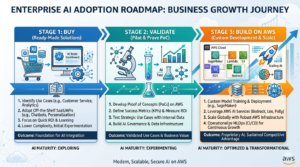
The most effective AI strategies in 2026 are not exclusively build or buy — they are sequenced. Buy to validate; build to scale. This pattern consistently produces better outcomes than forcing a binary choice at the beginning of an AI initiative.
Phase 1: Buy to Validate (0-3 Months)
Deploy a bought AI tool for the target use case. The goal is not perfection it is validation. Does AI improve this workflow? Do users adopt it? Does the output quality meet the threshold for the use case? What are the most common failure modes?
This phase costs weeks of implementation time and a few months of subscription fees. It produces real usage data, identified limitations, and a validated business case or a fast, cheap invalidation before significant engineering investment.
Phase 2: Identify Build Triggers (3-6 Months)
After three to six months of operating a bought AI tool, you will have a clear picture of where the tool’s limitations create meaningful constraints. Common build triggers:
- The tool cannot access your proprietary data at the depth required for quality outputs
- The vendor’s model behavior is inconsistent or inappropriate for your use case without customization options
- Per-seat or per-use costs are scaling faster than the value delivered
- Compliance requirements that the vendor’s data processing model cannot satisfy
- Competitive differentiation requires capabilities the vendor tool does not offer
Phase 3: Build Selectively on AWS (6+ Months)
With validated use cases and clear limitation signals, you build on Amazon Bedrock and AWS services only for the components where custom development creates measurable advantage. Not everything just the parts where the build investment produces capabilities the vendor tool cannot provide.
This approach avoids both failure modes: over-engineering unvalidated use cases and over-dependence on vendor tools for differentiating AI capabilities. It is the approach used by most mature enterprise AI programs in 2026.
Conclusion: The Right Answer Is Context-Dependent
The decision to build on AWS or buy an AI tool does not have a universal correct answer. It has a correct answer for your specific use case, at your specific stage, with your specific data and capability constraints.
Key takeaways:
- Buy when speed matters, the use case is generic, data privacy terms are acceptable, and engineering resources are better spent on differentiating features
- Build on AWS when data sensitivity requires infrastructure control, competitive differentiation requires custom AI capabilities, or scale economics favor custom development over SaaS pricing
- The hybrid approach — buy to validate, build selectively where it creates advantage — produces better outcomes than forcing a binary choice at the start of an AI initiative
- Amazon Bedrock changes the build economics significantly: access to frontier models like Claude within your AWS account, without managing model infrastructure, reduces the engineering complexity of the build path
- Always define data classification, validation thresholds, and switching cost before committing to either path — not after
Whether you decide to build on AWS or buy an AI tool, the organizations that win with AI in 2026 are not those with the most powerful models they are the ones that make deployment decisions quickly, evaluate outcomes rigorously, and adjust their approach based on real usage data rather than theoretical frameworks.
Start with the question that matters most: does this AI use case process data or create capabilities that require you to own the system? Everything else follows from that answer.