


A multi-cloud strategy has become essential for modern enterprises seeking flexibility, cost optimization, and resilience. Organizations are no longer confined to single-vendor cloud ecosystems instead, they are strategically distributing workloads across multiple cloud providers like AWS, Microsoft Azure, Google Cloud, and others. This comprehensive guide explores the benefits of multi-cloud strategy, implementation frameworks, and practical strategies that drive competitive advantage for CTOs, DevOps engineers, cloud architects, and development teams.
The shift toward multi-cloud adoption reflects a fundamental change in how enterprises approach infrastructure. Rather than optimizing for a single ecosystem, organizations are building flexible, distributed architectures that leverage the strengths of each cloud provider. Understanding these benefits and implementing them correctly is crucial for digital transformation success.
Executive Summary: Multi-Cloud Strategy Benefits Overview
Before diving into technical implementation, it is critical to understand the core benefits of multi-cloud strategy at an executive level:
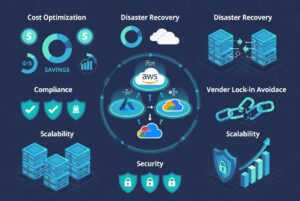
- Reduces vendor lock-in by distributing infrastructure across multiple cloud providers
- Enables significant cost optimization through competitive pricing and workload placement
- Improves business continuity with multi-region failover and disaster recovery capabilities
- Accelerates innovation by accessing specialized services and geographic reach across platforms
- Enhances security posture through defense-in-depth and regulatory compliance options

1. Breaking Free from Vendor Lock-In: The Strategic Imperative
Understanding Vendor Lock-In Risks
Vendor lock-in represents one of the most significant organizational risks in cloud computing. When enterprises rely entirely on a single cloud provider, they become dependent on that vendor’s pricing models, service roadmaps, and contractual terms. This lack of flexibility creates negotiating disadvantage and limits strategic optionality.
A multi-cloud strategy fundamentally changes this dynamic. By deploying applications and data across AWS, Azure, Google Cloud, and potentially private cloud infrastructure, organizations retain the ability to migrate workloads, renegotiate contracts, or pivot to alternative providers without catastrophic costs or downtime.
Implementing Portability Across Clouds
True portability requires architectural decisions made at design time. Consider these implementation approaches:
- Containerization: Deploy applications using Docker/Kubernetes to achieve consistent runtime environments across AWS EKS, Azure AKS, and Google GKE
- Infrastructure as Code: Use Terraform, Pulumi, or CloudFormation with abstraction layers to define infrastructure in cloud-agnostic formats
- API-First Architecture: Design microservices using standard APIs rather than cloud-specific SDKs, enabling quick pivoting between providers
- Data Portability: Implement formats and tools (Parquet, CSV, standard databases) rather than proprietary cloud storage formats
Real-World Vendor Lock-In Escape: Case Example
Consider a mid-sized SaaS company that initially standardized entirely on AWS. After five years, they faced a 40% price increase during contract renewal. By having previously containerized their application stack and abstracted database layers, the company negotiated a competitive Azure proposal in three months and successfully migrated 60% of workloads, reducing costs by $2M annually. This escape would have been impossible without multi-cloud architectural foresight.
2. Cost Optimization Through Intelligent Workload Placement
The Cost Optimization Advantage
Different cloud providers offer competitive pricing for different workload categories. AWS excels at compute-intensive operations, Azure provides superior pricing for hybrid scenarios with SQL Server licensing, and Google Cloud leads in big data and machine learning services. A multi-cloud strategy leverages these price differences.
Strategic Workload Placement Modelaws
Implement cost optimization by analyzing workload characteristics and matching them to best-priced providers:
- High-Performance Computing: Deploy CPU-intensive batch processing to AWS Spot Instances or Google Cloud Preemptible VMs at 70-90% discounts
- Database Workloads: Place SQL Server applications on Azure for license advantage; PostgreSQL/MySQL on AWS RDS for cost efficiency
- ML/Analytics: Utilize Google Cloud BigQuery cost structure for data warehousing; AWS SageMaker for ML model training
- Storage & Archival: Leverage AWS Glacier for cold storage; choose based on retrieval patterns
Cost Optimization Metrics Dashboard
Track these key metrics across your multi-cloud environment:
- Cost per Compute Unit: Monitor dollars/vCPU-hour across each provider
- Storage Cost Efficiency: Track GB/dollar for different storage classes
- Network Transfer Costs: Optimize inter-cloud egress to minimize bandwidth charges
- Reserved vs. On-Demand Ratio: Ensure adequate reserved capacity planning
3. Enterprise-Grade Resilience Through Multi-Cloud Architecture
Beyond Single-Region Availability Zones
While single cloud providers offer high availability through multiple availability zones within a region, true resilience requires geographic and provider diversity. A multi-cloud strategy enables active-active deployments where workloads run simultaneously across AWS, Azure, and Google Cloud regions.
Multi-Cloud Failover Architecture
Implement resilience through these architectural patterns:
- Active-Active Global Load Balancing: Route traffic based on health checks and latency across multiple cloud regions
- Database Replication: Synchronize data across AWS RDS, Azure Cosmos DB, and Google Cloud SQL with conflict-free eventual consistency
- Automated Failover: Use services like Terraform, Flux CD, or ArgoCD to automatically shift deployments when cloud regions become unavailable
- Disaster Recovery Objectives: Achieve RTO under 5 minutes and RPO under 1 minute
Resilience in Practice: Financial Services Example
A global fintech company implemented a multi-cloud strategy across AWS (primary), Azure (secondary), and Google Cloud (DR). When AWS us-east-1 experienced a widespread outage, their intelligent load balancer automatically shifted 100% of traffic to Azure regions within 30 seconds. Transaction processing continued uninterrupted, and the company maintained full SLA compliance. Single-cloud competitors suffered multi-hour outages.
4. Accessing Specialized Services and Competitive Advantages
The Cloud Service Portfolio Gap
Each cloud provider excels in different domains. AWS leads in breadth of compute options, Azure dominates enterprise integration, and Google Cloud offers superior ML/AI services. A multi-cloud strategy enables organizations to use best-in-class services rather than mediocre alternatives from a single provider.
Leveraging Specialized Capabilities
Strategic service selection across clouds:
- Machine Learning: Google Cloud Vertex AI for advanced ML; AWS SageMaker for enterprise ML operations; Azure ML for enterprise integration
- Real-Time Analytics: Google Cloud Pub/Sub and Bigtable for high-throughput streaming; AWS Kinesis for data streaming
- Serverless Computation: AWS Lambda for scale; Azure Functions for .NET ecosystems; Google Cloud Functions for high-concurrency functions
- IoT Platforms: Azure IoT Hub for enterprise IoT; AWS IoT Core for device connectivity; Google Cloud IoT for data analytics
Innovation Velocity Through Service Diversity
Organizations adopting multi-cloud strategies report 30-40% faster time-to-market for new features by leveraging cutting-edge services from each provider rather than waiting for competitive feature parity or implementing custom solutions.
5. Enhanced Security Posture and Regulatory Compliance
Defense-in-Depth Architecture
Multi-cloud strategy enables defense-in-depth security architecture where no single provider compromise affects entire infrastructure. Implement security across multiple layers and providers:
- Network Segmentation: Isolate workloads across separate cloud networks with inter-cloud VPN connectivity
- Identity Management: Implement federated identity across AWS IAM, Azure AD, and Google Cloud Identity
- Encryption: Use provider-agnostic encryption with bring-your-own-key models and centralized key management across all clouds
- Threat Detection: Deploy cloud-agnostic SIEM platforms (Datadog, Splunk) that monitor all cloud providers simultaneously
Compliance and Data Residency
Different regulatory frameworks require specific data locations and processing restrictions. Multi-cloud strategy enables compliance by deploying governed workloads to appropriate jurisdictions:
- GDPR Compliance: Store EU customer data on Azure Europe regions with specific residency guarantees
- HIPAA Compliance: Deploy healthcare workloads on AWS GovCloud or Azure Government for HIPAA-eligible services
- CCPA Compliance: Maintain California-based data on AWS US regions with proper contractual safeguards
- Data Sovereignty: Control data location explicitly rather than relying on single provider residency assumptions
6. Multi-Cloud Implementation Framework: From Strategy to Execution
Phase 1: Assessment and Readiness
Begin with comprehensive organizational assessment:
- Current State Analysis: Document existing workloads, dependencies, and cloud footprints
- Skills Gap Analysis: Identify training needs across DevOps, platform engineering, and security teams
- Architecture Review: Evaluate application portability and identify refactoring opportunities
- Compliance Audit: Map regulatory requirements to cloud provider capabilities
Phase 2: Platform Engineering Setup
Establish infrastructure abstraction layers:
- Unified Orchestration: Deploy Kubernetes across all clouds (EKS, AKS, GKE) for consistent container management
- Infrastructure-as-Code: Implement Terraform modules that abstract cloud-specific details
- GitOps Pipelines: Set up Flux CD or ArgoCD for continuous deployment across all environments
- Observability Stack: Deploy Prometheus, Grafana, and Loki across all clouds for unified monitoring
Phase 3: Workload Migration and Optimization
Systematically migrate and optimize workloads:
- Pilot Projects: Start with 1-2 non-critical workloads to validate multi-cloud approach
- Cloud-Native Refactoring: Re-architect applications for containerization and serverless where appropriate
- Cost Optimization: Implement automated cost monitoring with FinOps practices across providers
- Governance Implementation: Deploy policy-as-code to enforce organizational standards
7. Multi-Cloud Architecture Patterns and Best Practices
Distributed Active-Active Architecture
Deploy applications across multiple clouds with active traffic distribution:
- Traffic Distribution: Use geographic routing (AWS Route 53, Azure Traffic Manager) for latency-based traffic steering
- Stateless Design: Ensure applications do not depend on local storage; use shared databases and caches
- Event-Driven Patterns: Implement async messaging to decouple services across clouds
Data Synchronization Strategies
Manage data consistency across distributed clouds:
- Eventual Consistency: Accept temporary data differences for higher availability (suitable for most workloads)
- Multi-Master Replication: Use databases like CockroachDB for true multi-cloud ACID compliance
- Event Sourcing: Maintain event logs across clouds for state reconstruction and consistency
8. Operational Excellence in Multi-Cloud Environments
Unified Observability and Monitoring
Maintain visibility across dispersed cloud infrastructure:
- Centralized Logging: Aggregate logs from all clouds to platforms like Datadog, Splunk, or ELK Stack
- Distributed Tracing: Use OpenTelemetry to track requests across cloud boundaries
- Unified Alerting: Implement single pane of glass for alerts across all providers
- Cost Visibility: Deploy FinOps dashboards showing spending by cloud, region, and cost center
Incident Response and Post-Mortems
Prepare teams for multi-cloud incidents:
- Incident Playbooks: Document cloud-specific failure modes and recovery procedures
- Regular Drills: Conduct game days simulating cloud provider outages to validate failover procedures
- Cross-Cloud Runbooks: Maintain detailed procedures for diagnosing issues across infrastructure
9. Multi-Cloud Challenges: Realistic Assessment and Solutions
Operational Complexity
Challenge: Managing multiple cloud platforms requires expertise across different consoles, APIs, and service models.
Solution: Implement abstraction layers through Kubernetes, Terraform, and unified observability platforms to reduce cognitive load on operations teams.
Skills and Staffing
Challenge: Finding engineers with expertise across multiple cloud platforms remains difficult and expensive.
Solution: Invest in cross-platform training programs and prioritize cloud-agnostic skills like Kubernetes, Terraform, and observability tools.
Cost Optimization Complexity
Challenge: Optimizing costs across multiple providers with different pricing models becomes significantly more complex.
Solution: Implement centralized FinOps platforms, establish chargeback mechanisms, and automate cost optimization through infrastructure-as-code policies.
Data Consistency and Integration
Challenge: Maintaining data consistency across cloud boundaries introduces latency and complexity.
Solution: Adopt event-driven architectures, implement eventual consistency patterns, and use managed services for data synchronization.
10. Future Trends in Multi-Cloud Strategy
As organizations mature their multi-cloud deployments, several emerging trends are shaping the landscape:
- AI/ML-Driven Optimization: Intelligent platforms automatically optimize workload placement based on cost, performance, and compliance
- Kubernetes Dominance: Container orchestration across Kubernetes distributions becomes the de facto standard
- Edge Computing Integration: Extending multi-cloud strategy to include edge locations with AWS Outposts, Azure Stack, or Google Distributed Cloud
- Sustainability Focus: Multi-cloud enables matching workloads to regions with renewable energy percentages for ESG compliance
- Platform Engineering Maturity: Internal developer platforms abstract cloud complexity and accelerate feature velocity
Conclusion: Strategic Multi-Cloud as Competitive Advantage
The benefits of multi-cloud strategy extend far beyond simple cost reduction. Organizations embracing multi-cloud architectures gain strategic flexibility, operational resilience, and access to cutting-edge services that single-cloud competitors cannot match. The transition requires thoughtful planning, appropriate tooling, and skills development, but the competitive advantages justify the investment.
CTOs and cloud architects must view multi-cloud adoption not as a technical complexity but as a business imperative. By implementing the frameworks and best practices outlined in this guide, organizations can navigate the multi-cloud landscape effectively, capturing benefits while mitigating operational challenges. The future belongs to enterprises that master distributed cloud architectures, and the time to start is now.