

Every aws managed services provider will tell you they monitor, secure, and optimize your AWS environment. At GoCloud, we start from a sharper conviction, one we arrived at the hard way across dozens of engagements: most cloud operational failures are not caused by technology limitations. They are caused by process gaps. Absent ownership, configuration standards applied inconsistently, monitoring that was set up once and never revisited, and policies that live on paper but are never enforced.
That single observation is the reason our AWS Managed Service exists, and it shapes everything about how we deliver it. We do not operate Amazon Web Services (AWS) environments as a menu of disconnected tasks. We operate them through a structured methodology we call the GoCloud Operational Blueprint, the same framework that earned us the AWS Cloud Operations Competency. This article explains what that methodology means in practice, how it maps to the AWS services your business depends on, and why the way an environment is managed matters as much as the technology inside it.
Running AWS Well Is Now the Hard Part
Adopting the cloud is no longer difficult. Providers have made it trivial to launch a server, stand up a database, or spin up storage in minutes. Running that environment responsibly, at scale, over years, is where the real difficulty now lives. What began as moving workloads off on-premises hardware has evolved into managing vast, interconnected ecosystems of accounts, regions, services, and policies.
Organizations now wrestle with harder questions than they did five years ago. How do we maintain governance across dozens of accounts? How do we detect security misconfigurations before they become incidents? How do we understand what we are spending on AWS, and why? These are not questions a migration project answers. They are ongoing operational questions, and they demand deliberate investment in the people, processes, and tooling that keep environments secure, observable, and cost-accountable. A mature AWS Managed Service is precisely that investment, delivered as a service rather than assembled painfully in-house.
Why We Built Our Managed Services Practice the Way We Did
Organizations that scaled AWS without a corresponding investment in operations tend to arrive at GoCloud with the same recurring symptoms. We have seen them often enough to treat them as predictable outcomes, not exceptional events:
- Security findings numbering in the thousands, many left unresolved for weeks because no structured triage process exists — frequently traced back to ungoverned AWS IAM policies and over-permissioned roles.
- Cost overruns from untagged, oversized, and forgotten resources that no team clearly owns, making AWS cost management guesswork.
- Compliance failures caused by configuration drift that accumulates quietly over months until an audit exposes it.
- Outages from thresholds that were never monitored, or alerts that fired into a channel no one watched.
These are not edge cases. They are the natural result of treating cloud operations as an afterthought — something that happens automatically once workloads are live. In regulated industries especially, the cost of a single compliance failure far exceeds the cost of the controls that would have prevented it. Rather than treat each incident as a one-off fire to put out, GoCloud absorbed the lessons and encoded them into repeatable frameworks. Our managed service is the continuous application of those frameworks to a live AWS environment. That is what we mean by AWS cloud management as a discipline: not reacting to problems, but engineering them out of the environment before they occur.
What “Managed” Actually Means at GoCloud
A managed service should be judged by where responsibility sits. When GoCloud manages your AWS environment, we own the ongoing operational work end to end: the health of your AWS infrastructure management, the enforcement of security posture, the monitoring and response, the patching and backups, the cost governance, and the incident lifecycle. Your internal teams are freed to focus on building products and shipping features, rather than firefighting infrastructure they were never staffed to run.
Crucially, this is not a hand-off where we take the keys and disappear. GoCloud operates as an extension of your team, with defined ownership, transparent reporting, and escalation paths agreed up front. You always know who is responsible for what, which alerts route where, and how decisions get made. That clarity is itself a control: the ambiguity around ownership is one of the process gaps that causes the failures described above, so we eliminate it by design.
The GoCloud Operational Blueprint: Our Operating Model for AWS
The Blueprint rests on four principles, and every capability in our AWS Managed Service maps to one of them. This is deliberately not a feature list. It is the lens through which we design, deploy, monitor, and manage every environment we take on. When we evaluate an environment for the first time, we assess it against these four principles, and when we operate it day to day, these principles decide what good looks like.
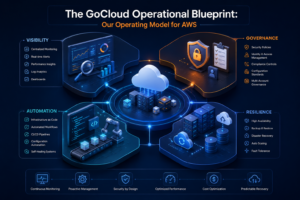
Visibility — Nothing Unknown, Nothing Unmonitored
The most persistent challenge we encounter is the gap between an environment generating data and a team able to act on it. Telemetry alone is not observability; a wall of unread alerts is not visibility. GoCloud’s cloud monitoring practice closes that gap with a layered observability framework built on AWS CloudWatch and complementary tooling, structuring raw output into meaningful signals.
In practice, that means reducing alert noise through correlation rules so a single root cause does not generate fifty separate pages, assigning severity classifications aligned to genuine business impact rather than technical thresholds, and delivering dashboards that give teams immediate situational awareness without forcing them to interpret raw metrics. Every signal that matters has a defined owner and a runbook. Issues are detected and escalated before they reach your customers, not discovered afterward in a post-incident review.
Governance — Policy Enforced Consistently
For customers on multi-account architectures, AWS security begins with governance, not with a scanning tool bolted on after the fact. GoCloud builds governance on AWS Organizations and AWS Control Tower, using Service Control Policies to enforce permission boundaries and preventive guardrails that block non-compliant configurations before they are ever deployed. Least-privilege access is enforced through carefully governed AWS IAM roles and policies, so a compromised credential cannot become a catastrophe.
The centerpiece of our governance model is an account vending approach that provisions every new AWS account with logging, monitoring, security tooling, and tagging standards baked in from day one. This matters more than it sounds. Governance gaps compound over time, and preventive governance at the moment of provisioning is dramatically cheaper than retroactive remediation across a sprawling, inconsistent estate. We would rather make the correct configuration the default than chase misconfigurations across dozens of accounts later.
Automation — Reliable Execution at Scale
Manual operations do not scale, and they vary with the knowledge and availability of whoever happens to be on call. GoCloud’s AWS DevOps practice standardizes on Infrastructure as Code using Terraform and the AWS CDK, producing version-controlled, repeatable deployments that can be reviewed, audited, and rolled back like any other code. There is no undocumented, click-ops configuration that only one engineer understands.
We integrate AWS Systems Manager for automated patching across fleets, and where compliance drift is detected, automated remediation workflows trigger corrective actions within minutes rather than waiting for a human to notice. For us, automation is about consistency first and efficiency second. Automated processes produce uniform outcomes every single time; manual processes produce whatever the individual remembered to do that day. Consistency is what turns a good operational practice into a reliable one.
Resilience — Predictable Recovery When Failures Occur
Resilience is a design decision, not a hope you fall back on during an outage. Across the AWS infrastructure management we provide, compute on Amazon EC2 is paired with AWS Auto Scaling so capacity tracks real demand rather than a fixed guess, databases on Amazon RDS run with automated maintenance and multi-AZ failover, and durable object storage on Amazon S3 is governed by appropriate lifecycle, versioning, and access policies.
Data protection is centralized through AWS Backup with policy-driven schedules, so backups are not left to individual teams to remember. We pair that with tested recovery procedures and documented disaster recovery planning, because a backup you have never restored from is a theory, not a safeguard. The objective is simple and non-negotiable: when a component fails, systems recover predictably and data is never at risk.
Cost Management and Cloud Optimization Are Not Optional
Uncontrolled AWS spend is one of the clearest signals of an under-managed environment, and it is where many organizations quietly leave the most money on the table. GoCloud treats AWS cost management as a first-class operational discipline rather than a quarterly cleanup. That begins with visibility: enforced tagging standards mean every dollar of spend can be attributed to a team, project, or environment, so there is no untraceable line on the bill.
From there, our cloud optimization work is continuous. We right-size instances against actual utilization, apply Auto Scaling policies so you pay for capacity you use rather than capacity you provisioned in case, identify and retire idle or orphaned resources, and structure Savings Plans and Reserved Instance commitments around genuine usage patterns. This is FinOps in practice: connecting AWS spending to measurable business outcomes so cost becomes a lever you control, not a surprise you absorb. Reduced spend is not the result of cutting corners; it is the result of eliminating waste that never delivered value in the first place.
Measured Against the AWS Well-Architected Framework
We do not want you to take our word for whether an environment is healthy, so we measure it against a standard AWS itself defines. Every environment GoCloud manages is assessed using the AWS Well-Architected Framework and its pillars: operational excellence, security, reliability, performance efficiency, cost optimization, and sustainability. We conduct Well-Architected reviews to surface risks and improvement opportunities, then remediate them systematically as part of the ongoing service.
This gives you an objective, independent yardstick. Progress is not measured by how busy we look or how many tickets we close, but by whether your environment is demonstrably better aligned to the practices AWS recommends for production workloads. It is the same rigor AWS applied when validating our Cloud Operations Competency, turned inward on every environment we run.
How We Prove Our Managed Services Work
The AWS Cloud Operations Competency is not awarded on documented frameworks alone. AWS requires verified evidence that a partner’s practices have produced measurable improvements in real customer environments — a requirement that, in our view, gives the competency its genuine weight. We hold our managed service to that same standard internally.
For every engagement, we document the operational state at the start, the interventions we implement, and the outcomes they produce. That means tracking incident resolution times, security finding backlogs, and cost trajectories continuously throughout an engagement, not assembling numbers retroactively to look good in a report. Environments managed under the GoCloud Operational Blueprint consistently show lower security finding backlogs, faster incident resolution, and reduced AWS spend. When AWS reviewers examined our practice, they validated not only these outcomes but the methodology behind them — confirming our approaches were aligned to best practices, reproducible across contexts, and verifiable with the customers who lived them.
The Team Behind the Service
Operational excellence has to be institutional, not concentrated in a handful of individuals who become single points of failure. GoCloud’s competency is validated by certifications spanning Solutions Architect Professional, DevOps Engineer Professional, Security Specialty, and Advanced Networking. That breadth matters because a real AWS environment does not respect the boundaries between disciplines — a cost problem can be a scaling problem, a security finding can be a networking problem, and the engineer managing your environment needs the depth to see across all of them.
When AWS Solutions Architects reviewed our practice for the Cloud Operations Competency, they probed not just whether our frameworks existed, but whether our engineers understood them deeply enough to apply them in novel, unscripted situations. That depth is exactly what your environment draws on every day it runs under our management.
What Working With GoCloud Looks Like
A managed services engagement with GoCloud begins with an honest assessment rather than an immediate rollout. We map your existing AWS environment against the four Blueprint principles to see clearly where visibility is thin, where governance is inconsistent, where operations are still manual, and where resilience is assumed rather than tested. That assessment becomes a prioritized plan, because governance gaps and security exposure typically warrant attention before optimization.
From there, we bring the environment under the Blueprint incrementally: establishing baseline monitoring and alerting, enforcing governance guardrails, codifying infrastructure, and putting backup and recovery on a tested footing. Throughout, you receive transparent reporting on what changed, what improved, and what we recommend next. The relationship is continuous and collaborative — the environment is monitored around the clock, and the improvement work never really stops, because a well-run AWS environment is maintained, not finished.
Where GoCloud Is Taking Managed Services Next
The competency establishes a validated baseline, not a ceiling, and our managed service continues to evolve. We are extending it with AI-assisted operations using Amazon DevOps Guru for predictive operational insights that flag anomalies before they become incidents, deeper FinOps frameworks that tie AWS spending ever more tightly to measurable business outcomes, and pre-configured compliance postures for HIPAA, PCI-DSS, SOC 2, and ISO 27001.
For customers in regulated industries, that last point removes a significant burden: the ability to deploy into environments that are compliant by design, without rebuilding governance and control frameworks from scratch for every new workload. It is the natural extension of our core philosophy — make the correct, compliant, well-governed configuration the default, and the rest of operations becomes far simpler.
Who Manages Your AWS Environment Matters
For organizations running production workloads on AWS, the question of who operates those environments is a technical, financial, and risk question all at once. An under-managed environment does not announce itself; it accumulates security findings, quiet cost overruns, and unnoticed drift until something breaks or an auditor arrives. GoCloud answers that question with a validated methodology, verified customer outcomes, and independent authority — and with a genuine conviction that cloud operations deserve to be treated as a discipline rather than an afterthought.
Talk to GoCloud about bringing the Operational Blueprint — Visibility, Governance, Automation, and Resilience — to your Amazon Web Services environment, so your team can stop firefighting infrastructure and get back to building.