

Open the AWS partner finder and you will see a row of badges next to each company name. Managed Service Provider. DevOps Competency. Security Competency. Service Delivery. It is easy to assume they all mean roughly the same thing: “AWS likes this partner.” They do not.
Understanding AWS MSP Program vs Competencies is one of the most useful things a buyer can do before choosing a partner, and one of the most useful things a partner can do before choosing which validation to chase. The two programs answer different questions, use different checks, and signal different strengths.
This guide explains both in plain language. You will learn:
- What the AWS MSP Program and the AWS Competency Program each validate
- How partners earn each one, and what AWS checks along the way
- A side by side comparison of purpose, evidence, and benefits
- Which competencies matter most for managed services work
- How to verify a badge, and how to choose when a partner has one but not the other
Programs change, and some are being retired. This guide links to AWS’s own pages, and it flags what has already been announced. Confirm current requirements in AWS Partner Central or on AWS’s partner pages before you rely on any detail.
What Is the Difference Between the AWS MSP Program and Competencies?
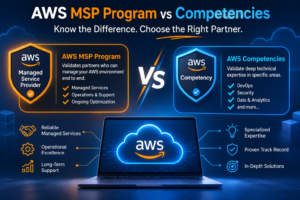
The AWS MSP Program recognizes partners that can run customers’ AWS environments end to end, including planning, migration, operations, and optimization. AWS Competencies recognize partners with proven expertise in a specific solution area, industry, or workload. One validates a managed services operating model; the other validates specialized technical skill.
A simple way to remember it: the MSP badge asks, “Can this company run my AWS environment well, every day?” A Competency badge asks, “Does this company have proven depth in this specific kind of work?”
Both sit under what AWS calls its AWS Specializations, the umbrella for validated partner designations. AWS says it has over 120 partner specializations across industries, and you can browse them on its Work with a Partner page.
What Is the AWS Managed Service Provider (MSP) Program?
The AWS MSP Program validates and recognizes partners that excel at delivering comprehensive solutions across the entire cloud journey, from planning and migration to ongoing operations and optimization.
To become a validated AWS MSP, a partner must complete a rigorous third-party audit. AWS says the audit assesses the partner’s technical skills and its business health against enterprise standards. In return, partners receive an AWS MSP badge and program benefits, including funding, go-to-market and co-selling support, and technical enablement.
The program is aimed at companies whose core product is ongoing cloud operations. Think monitoring, incident response, patching, security, backup, cost management, and automation delivered as a service.
What Is the AWS Competency Program?
The AWS Competency Program is designed to identify, validate, and promote partners with demonstrated AWS technical expertise and proven customer success in specialized areas. AWS says partners undergo a technical validation and an assessment of the security, performance, and reliability of their solutions.
Competencies are organized by solution area, workload, or industry. Examples that appear in AWS’s partner announcements include DevOps, Migration and Modernization, Security, Resilience, and Data and Analytics, plus industry areas such as financial services and healthcare.
One of them is especially relevant to managed services. AWS launched the Cloud Operations Competency in 2023, covering five solution areas: Cloud Governance, Cloud Financial Management, Monitoring and Observability, Compliance and Auditing, and Operations Management.
What About Service Delivery and Service Ready?
Two older designations sit near these programs. AWS Service Delivery validated partners with deep knowledge and proven success delivering specific AWS services, such as Amazon Redshift or AWS Lambda. AWS Service Ready validated software products built by partners to work with specific AWS services.
According to AWS’s specializations page, both are being retired. AWS says the Service Delivery and Service Ready specializations will be deprecated on June 1, 2027, and new applications are closed. If a partner lists one of these, treat it as supporting evidence, and look for a current Competency or MSP designation alongside it.
How AWS Partner Tiers Fit In
Tiers are a separate scale. AWS places services partners in Select, Advanced, and Premier tiers, which recognize organizations that have shown technical expertise and customer experience. According to AWS’s partner tiers page, the MSP Program is open to Advanced and Premier tier partners. AWS has also described the Advanced tier as the point where partners can start pursuing Competencies.
So a tier is a prerequisite and a size signal. The MSP badge and Competencies are the proof of specific capabilities that sit on top of it.
Related Programs You May See
- Well-Architected Partner Program. Partners trained to run reviews against the AWS Well-Architected Framework. See the program page.
- Partner-Led Support. A model where the partner is the customer’s single point of contact for technical support, with AWS Support behind it. See AWS’s Partner-Led Support page.
These are useful signals, but they validate different things. Keep them separate when you compare partners.
AWS MSP Program vs Competencies: Side by Side
This table summarizes the main differences. The details come from AWS’s partner program pages and its partner blog posts, so confirm the current rules in AWS Partner Central.
| Question | AWS MSP Program | AWS Competency Program |
| What does it validate? | The ability to deliver managed services across the full cloud lifecycle | Deep, proven expertise in a specific solution area, workload, or industry |
| What is the core question? | Can this company run my AWS environment well? | Does this company have proven depth in this kind of work? |
| Who checks? | An independent third-party auditor | AWS technical validation, including review by AWS Partner Solutions Architects |
| What is examined? | Technical skills, business health, and managed services processes | Customer case studies, architecture, and specific technical requirements |
| Scope | The partner’s managed services practice as a whole | One solution area at a time |
| Tier needed | Advanced or Premier | Advanced is where partners can start pursuing them |
| What does the partner get? | An MSP badge, funding, go-to-market and co-selling support, technical enablement | A Competency badge and specialization benefits |
| Best for buyers who need | Ongoing operations, 24/7 support, governance | Proven skill in a particular technical or industry area |
Two programs, two different lenses. A partner can hold one, both, or neither.
How the MSP Program Validation Works
AWS describes a staged path on its MSP Program page:
- Talk to your AWS partner manager. The partner discusses its MSP business model, milestones, and timelines.
- Review the checklist. The partner studies the MSP Program Validation Checklist and completes a self-assessment using AWS’s calibration guides.
- Apply in AWS Partner Central. The AWS MSP team reviews the application and prerequisite documents.
- Pass technical validation. The partner goes through the third-party audit.
- Unlock benefits. Validated partners receive the badge and program benefits.
AWS’s partner blog has described a pre-assessment before the full audit, and a full audit repeated every three years, with lighter checks in between. Those details come from earlier posts, and AWS has updated the MSP checklist since, including a consolidated version effective April 1, 2024. So treat the timing as a guide, and ask a partner when it was last audited.
How Competency Validation Works
AWS publishes a validation checklist for each Competency. AWS’s partner blog describes two layers:
- Prerequisites. Minimum requirements such as tier level, customer case studies, and AWS technical certifications.
- Specific technical requirements. Each Competency has its own requirements for the work it covers.
AWS says common technical requirements are based on the AWS Well-Architected pillars, so each solution and practice follows AWS best practices. Partners then go through technical validation, where AWS Partner Solutions Architects review architecture, customer documentation, and case study details.
AWS also reserves the right to revoke a Competency designation if a partner no longer meets the program requirements. So a Competency is something partners keep earning, not a one-time trophy.
What Each Program Proves, and What It Does Not
The MSP badge proves that an independent auditor examined the partner’s managed services operations and business health. It does not prove deep expertise in your specific workload, such as a particular database, an AI pipeline, or a regulated industry.
A Competency proves that AWS reviewed the partner’s depth and customer evidence in one area. It does not prove that the partner can run your environment 24/7, or that it has the processes and staffing for ongoing operations.
That is why serious buyers look at both. One answers “can they operate?” and the other answers “are they strong where I need them?”
Benefits for Partners
AWS says specialization partners can enhance market visibility with partner badges, priority placement in the Partner Solutions Finder, an improved co-sell score, and direct access to AWS sales teams. MSP partners also get the funding, go-to-market support, and technical enablement described above.
These benefits explain why partners pursue the designations. They also explain why you should read badges as evidence, not endorsements. A badge shows that a partner passed a review. It does not guarantee a good fit for you.
Benefits for Buyers
For customers, the main benefit is a shorter, safer shortlist. Instead of judging a partner’s claims alone, you can lean on a review someone else performed. The MSP audit is an independent check of the operating model. A Competency is an AWS technical review of one area.
Buyers also gain a common vocabulary. When a partner says “we are MSP validated and hold a DevOps Competency,” you now know that means two different checks, and you can ask for evidence of each.
Which AWS Competencies Matter Most for Managed Services?
If you are hiring for ongoing operations, the MSP badge is your starting filter. The Competencies then tell you where a partner is deepest. Match them to your needs.
| If you need | Competency to look for | Why it matters |
| Ongoing governance, monitoring, and operations | Cloud Operations | Covers governance, financial management, monitoring, compliance, and operations management |
| CI/CD pipelines and automation | DevOps | Validates delivery practices and automation on AWS |
| Moving workloads to AWS | Migration and Modernization | Validates migration and modernization experience |
| Regulated or sensitive workloads | Security | Validates security expertise and customer success |
| Managed security monitoring and response | Level 1 Managed Security Service Provider | Validates managed security services |
| Strict recovery targets | Resilience | Validates resilience design and recovery work |
| Analytics and data platforms | Data and Analytics | Validates data engineering and analytics delivery |
AWS adds and reorganizes Competencies over time, so check the current list on its Specializations page.
The Cloud Operations Competency
This is the Competency closest to managed services. AWS describes five solution areas: Cloud Governance, Cloud Financial Management, Monitoring and Observability, Compliance and Auditing, and Operations Management. The AWS Cloud Operations partner page lets you search validated partners by category.
Partners can earn it in specific solution areas rather than all five, so ask which categories a partner holds. A partner validated in Monitoring and Observability has not necessarily been validated in Cloud Financial Management.
Competencies Are Category Specific
This point trips up many buyers. A Competency badge usually names a category or solution area. “DevOps Competency” says one thing, and “DevOps Competency in Consulting Services” says another, because AWS validates partners by the type of work they do. Look at the full listing on the partner’s profile, not just the badge icon.
Can a Partner Hold Both?
Yes, and the strongest partners often do. An MSP-validated partner with a matching Competency has had its operating model audited by a third party and its depth in a specific area reviewed by AWS. That combination is a strong, though not perfect, signal.
Older AWS partner guidance said MSP validation involved a checklist across many AWS services and Competencies. Requirements have changed over the years, so do not assume that every MSP holds every Competency. Verify each one you care about.
Should You Require Both?
It depends on your situation:
- You need a full operations partner: require MSP validation, then ask which Competencies they hold in your area.
- You need a specialist for a project: a matching Competency may matter more than the MSP badge.
- You have a regulated workload: look for a Security Competency, and read the partner’s own audit reports.
- You have a small budget: consider capable partners without every badge, and test them with a pilot.
Badges narrow the field. They do not replace references, a pilot, or a close reading of the contract.
How to Verify an AWS MSP or Competency Badge
Do not rely on a logo on a website. Check it.
- Search the AWS partner finder. Use AWS’s Partner Solutions Finder and look up the company by name.
- Read the profile. Confirm that the MSP badge or Competency appears there, along with the specific categories.
- Ask which categories apply. Competencies are earned by category, so ask which ones and for which type of work.
- Ask about timing. Ask when the partner was last validated or renewed.
- Request evidence. Ask for case summaries tied to the designation, and for references you can call.
- Check the tier. Confirm the partner’s tier on its profile. MSP partners should be at Advanced or Premier.
- Confirm who will do the work. A company-level badge does not mean the right engineers are assigned to you.
Common Claims That Need a Closer Look
- “AWS certified MSP.” AWS certifications belong to individuals. Partner designations are called validations or specializations. Ask exactly which one the partner holds.
- “AWS approved” or “AWS endorsed.” These are marketing phrases, not program names.
- “Competency partner” with no category. Ask which Competency and which solution area.
- Service Delivery as the headline credential. AWS says that specialization is being deprecated, so look for current designations too.
- A badge with no date. Ask when it was earned or renewed.
AWS Partner Terms Glossary
Partner marketing mixes these words freely. Use this table to keep them straight.
| Term | What it means |
| AWS Partner Network (APN) | The global community of companies that build on or sell around AWS |
| Partner tier (Select, Advanced, Premier) | A size and track record measure for services partners, based on certified staff and customer engagements |
| AWS MSP Program | Third-party audited validation of a partner’s managed services capability |
| AWS Competency | Validation of proven expertise in a specific solution area, workload, or industry |
| AWS Service Delivery | Validation for delivering specific AWS services; being deprecated June 1, 2027 |
| AWS Service Ready | Validation for software products that work with specific AWS services; being deprecated June 1, 2027 |
| Well-Architected Partner | A partner trained to run Well-Architected Framework reviews |
| Partner-Led Support | A model where the partner is the customer’s front door for technical support, backed by AWS Support |
| AWS Certified | A certification earned by an individual person, not a company |
| AWS Managed Services (AMS) | An AWS operated service, not the same as a third party MSP |
The last two rows cause the most confusion. A company cannot be “AWS certified” the way an engineer can, and AWS Managed Services is a different thing from a managed services provider that happens to work with AWS.
How to Read a Partner Profile in Five Minutes
Once you know the vocabulary, a partner’s profile becomes much easier to judge. Try this quick routine:
- Look at the badges first. Note whether it shows the MSP badge, which Competencies, and which categories.
- Read the tier. Advanced or Premier is a baseline for MSP partners.
- Scan the case studies. Look for work similar to yours in size and industry.
- Check the regions and languages. Support coverage matters for 24/7 operations.
- List what is missing. If you need security and the profile shows no security work, ask why.
Then take your notes into the conversation. A short, informed question such as “Which Cloud Operations categories are you validated in?” tells the partner you have done your homework, and it usually gets you a straighter answer.
How to Choose a Partner Using AWS MSP Program vs Competencies
Use this order when you are comparing providers. It keeps the badges in their proper place.
- Define the job. Decide whether you need ongoing operations, a specialist project, or both.
- Start with the MSP filter for operations. If you need 24/7 management, build your shortlist from validated AWS MSP partners.
- Add the Competency filter for depth. Match Competencies to your workload, such as DevOps, Security, Migration, or Cloud Operations.
- Verify every badge. Use the AWS partner finder, and confirm categories and dates.
- Check the tier. Look for Advanced or Premier, which MSP partners must hold.
- Ask for evidence. Request references, sample reports, and case summaries tied to the designations.
- Run a pilot. A short, scoped trial shows what no badge can.
- Review the contract. Confirm account ownership, SLAs, pricing, and exit terms in writing.
How Partners Earn Each Designation
If you are on the partner side, the two paths look different. Both begin in AWS Partner Central, and both require patience and evidence.
The MSP Path
- Join the AWS Partner Network and reach the Advanced or Premier tier.
- Talk to your AWS Partner Development Manager about your MSP business model and timeline.
- Review the MSP Program Validation Checklist and the MSP Program Guide.
- Complete a self-assessment against the checklist, and fix the gaps.
- Apply in AWS Partner Central so the AWS MSP team can review your documents.
- Pass the third-party technical validation, then keep up with renewals.
AWS’s partner blog advises partners to engage early with their AWS team, and to have both technical and operations experts available during the audit.
The Competency Path
- Reach the required partner tier for the Competency.
- Choose the Competency and category that match your real practice.
- Download its validation checklist and compare it with your capabilities.
- Prepare customer case studies and the documentation the checklist requires.
- Apply and schedule the technical validation with AWS.
- Bring certified engineers or architects and the people who run the work.
AWS recommends that partners have individuals who can speak in depth about the requirements and customer examples during validation.
Which Should a Partner Pursue First?
- If your business is built on ongoing operations, the MSP Program is the natural first target.
- If you are a specialist in one area, such as security or migration, start with the Competency that fits.
- If you do both, plan them together, since the evidence (customer examples, processes, certified staff) overlaps.
Partners should only pursue designations that match what they genuinely do. AWS reserves the right to revoke them, and customers ask for evidence.
Questions to Ask Any AWS Partner About Its Badges
- Are you currently MSP validated, and when was your last audit or renewal?
- Which Competencies do you hold, and in which categories?
- Which customer examples support those designations?
- Who will work on my account, and what AWS certifications do they hold?
- How do your processes for incidents, patching, and backups work in practice?
- What does the contract say about account ownership and exit?
A confident partner answers these quickly and in writing. Vague answers are a signal in themselves.
Decision Guide: Which Badge Matters for Your Situation?
- You want someone to run your AWS environment: put MSP validation first, then check Competencies that match your workload.
- You need a one time migration or build: a Migration or DevOps Competency may matter more than the MSP badge.
- You have compliance requirements: look for a Security Competency and the partner’s own independent audit reports.
- You need help with cost and governance: the Cloud Operations Competency, particularly Cloud Financial Management and Cloud Governance, is a good sign.
- You are unsure: ask partners to explain what their badges validate, and pick the one who explains it clearly.
Common Mistakes When Comparing AWS Partner Designations
- Treating all badges as equal. They validate different things.
- Stopping at the logo. Confirm the designation in the AWS partner finder.
- Ignoring categories. A Competency in one area does not cover another.
- Assuming an MSP is a specialist. MSP validation shows operational maturity, not depth in every workload.
- Assuming a Competency partner can run operations. It may have the skill without the managed services model.
- Relying on retiring designations. Service Delivery and Service Ready are being deprecated on June 1, 2027.
- Skipping references and pilots. Reviews show a standard was met, not that the partner suits you.
One honest limit applies. AWS changes its programs, benefits, and requirements over time, and some documents sit behind a Partner Central login. Treat this guide as a map and confirm details with AWS or the partner.
Practical Examples
These scenarios are illustrative, not real customer cases.
The lean startup. A small team wants round-the-clock monitoring and patching. It shortlists validated MSP partners first, then checks which of them hold a Cloud Operations or DevOps Competency, and picks one after a short pilot.
The migration project. A company needs to move a set of applications within six months. It looks for a partner with a Migration and Modernization Competency, and asks about ongoing support once the move finishes.
The audit season. A healthcare software firm needs strong security practice. It checks for a Security Competency and asks each provider for its own independent audit reports, instead of assuming the badge covers everything.
Quick Recap: MSP vs Competency in Five Lines
- The MSP badge says a third party audited how the partner runs AWS environments for customers.
- A Competency badge says AWS reviewed the partner’s depth and customer proof in one specific area.
- MSP is about the operating model. A Competency is about specialized skill.
- The two work best together, and neither replaces references or a pilot.
- Always verify the designation, the category, and the date in AWS’s own partner finder.
Keep this list handy when a sales deck puts six badges on one slide. It turns a wall of logos into a short set of questions you can actually ask.
Conclusion
The difference between AWS MSP Program vs Competencies is simple once you see it. The MSP Program validates a partner’s ability to run AWS environments for customers, through a third-party audit. Competencies validate depth in a specific solution area, through technical review and customer evidence. They answer different questions, and the best partners can show both.
When you choose a partner, filter by MSP validation for operations, add Competencies for depth, verify every badge, and finish with references and a pilot. Start this week by writing down what you need run and what you need built, and then check which partners can prove each.