
Qualiphy (Healthcare – Amazon EKS + RDS + Compliance)
Standardizing Secure CI/CD and Infrastructure Automation for a Telehealth Platform on AWS
Executive Summary
Qualiphy is a leading telehealth solutions provider, empowering medspas and clinics with
compliant, secure, and seamless virtual care. To support rapid growth and ensure a
scalable, compliant infrastructure, Qualiphy engaged GoCloud as its Managed Services
Provider to modernize and operate its AWS environment while implementing best
practices for governance, security, and automation. They required a well-architected
multi-account setup to isolate production and non-production workloads, streamline
deployments, and meet strict healthcare compliance standards.
GoCloud partnered with Qualiphy to implement account provisioning and security
guardrails while establishing a governed multi-account architecture. In addition, GoCloud
modernized Qualiphy’s containerized workloads on Amazon EKS and implemented an
integrated CI/CD pipeline to ensure consistent and secure deployments across
environments. GoCloud also provides 24/7 monitoring and operational support, ensuring
system availability and rapid incident response. Through continuous monitoring,
operational management, and automation, this foundation now enables Qualiphy to
deliver telehealth services at scale, maintain regulatory compliance, and provide a reliable,
high-quality experience for clinics and their patients worldwide.
About the Customer
About Qualiphy

Qualiphy is a leading
telehealth solution provider,
empowering member clinics
with compliant, secure, and
scalable virtual care. To
support their rapid growth
and ensure a reliable,
compliant infrastructure,
Qualiphy needed to
modernize its AWS
environment and implement
best practices for
governance, security, and
automation. They required a
well-architected multiaccount setup to isolate
production workloads,
streamline deployments, and
meet strict healthcare
compliance standards.
Customer Challenge
Infrastructure provisioning
Manual infrastructure provisioning created inconsistent deployments and increased operational overhead.
Multi-account governance
Limited multi-account governance and environment isolation made enforcing security and compliance difficult.
Containerized workloads
Containerized workloads lacked standardized orchestration, impacting scalability and resource efficiency.
Backup
Monitoring, backup, and recovery processes were not centralized, increasing operational risk.
Security
Security controls, credential management, and policy enforcement were handled manually, raising the risk of misconfigurations.
Why Amazon
Web Services
Why Qualiphy
Chose GoCloud
GoCloud’s Solution
Services Used
Amazon EKS →
Managed Kubernetes clusters for Dev, Stage, Release and Prod with high availability and auto-scaling.
AWS CodePipeline →
Automated CI/CD pipelines integrated with Bitbucket for continuous delivery.
AWS CodeBuild →
Builds and tests application code as part of the CI/CD workflow.
Amazon ECR →
Stores and manages Docker container images for deployment into EKS.
Amazon RDS MySQL (Multi-AZ) →
Highly available relational database with daily backups, storage auto-scaling, and point-in-time recovery.
AWS Secrets Manager →
Secure storage, rotation, and encryption of database and application credentials.
Elastic Load Balancer (ELB/ALB) →
Distributes traffic across EKS worker nodes and ensures resilience.
Amazon VPC (private subnets) →
Isolated network architecture for worker nodes, databases, and sensitive workloads.
AWS NAT Gateway →
Provides redundant outbound internet access for resources in private subnets.
AWS Backup →
Centralized backup for RDS MySQL with daily snapshots and 7-day retention.
AWS Systems Manager →
Centralized operations management, automation, and patching for workloads.
Amazon S3 →
Scalable storage for CI/CD artifacts, logs, and state files across environments.
AWS CloudFormation →
Infrastructure as Code (IaC) for consistent, repeatable provisioning of all environments.
Amazon CloudWatch →
Monitoring, logging, and performance metrics for EKS, RDS, andapplication workloads.
AWS IAM Access Analyzer →
Continuously analyzes IAM policies and resource permissions to identify unintended public or cross-account access, improving security and policy governance.
Amazon Inspector →
Automatically scans Amazon EC2 instances and Amazon ECR images to detect software vulnerabilities and configuration issues for improved workloadsecurity.
Amazon CloudWatch Anomaly Detection →
Uses machine learning to automatically detect abnormal patterns in metrics and trigger alerts for proactive issue detection.
Architecture Diagram
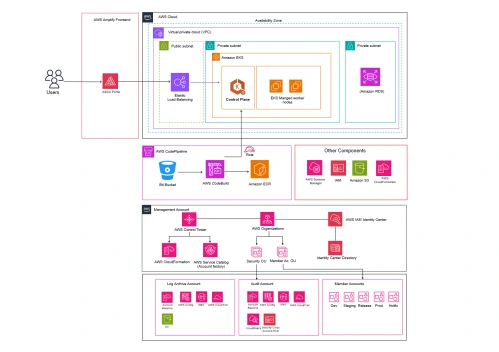
Workflow
Applications run on Amazon EKS with CI/CD automated using AWS CodePipeline and CodeBuild, with container images stored in Amazon ECR. Staging mirrors production, while production EKS clusters operate across multiple AZs behind an Elastic Load Balancer with Amazon RDS MySQL in Multi-AZ mode and secure credential management through AWS Secrets Manager.
The network architecture enforces private subnet isolation for all worker nodes, databases, and sensitive workloads. Access is tightly controlled through IAM roles, NAT gateways, and security groups, with AWS Secrets Manager ensuring that credentials remain encrypted, rotated, and centrally managed. Supporting services such as AWS Systems Manager, IAM, S3, and CloudFormation provide centralized management, secure storage, and governance.
The environment is designed with high availability and failure resilience in mind. EKS worker nodes and RDS MySQL are deployed across multiple AZs, with Elastic Load Balancing distributing traffic only to healthy nodes. Amazon EKS leverages AWS’s managed control plane for fault tolerance, while NAT gateways ensure resilient outbound connectivity. At the database layer, Multi-AZ RDS MySQL ensures automatic failover, with AWS Backup providing daily snapshots and 7-day retention for point-in-time recovery. During failover or node replacement, Secrets Manager ensures uninterrupted reconnections between applications and services.
Scalability is achieved at every layer. Amazon EKS worker nodes auto scale based on CPU, memory, and custom application metrics in both Stage and Prod. Elastic Load Balancers automatically adapt to traffic spikes, and RDS MySQL supports both storages auto-scaling and read replicas to handle growing workloads. Code Pipeline manages deployments seamlessly, while Amazon S3 provides near-infinite scalability for artifacts, logs, and state files. Secrets Manager scales transparently to manage growing application secrets.
The design balances tradeoffs between Multi-AZ and Multi-Region. The current strategy favors Multi-AZ for cost-efficiency, with AWS Backup configured for crossregion recovery if needed. Similarly, managed services like Amazon EKS, RDS MySQL, and Secrets Manager are leveraged to reduce operational overhead while ensuring reliability and security. Private subnet architecture strengthens data protection but requires precise NAT Gateway and Secrets Manager integration for outbound access and connectivity.
The overall architecture is validated with evidence artifacts, including a multi-account architecture diagram showing Dev, Stage, Release and Prod environments with EKS, RDS MySQL, Elastic Load Balancers, Code Pipeline, Code Build, and Amazon ECR. Documentation highlights HA and scalability features such as Multi-AZ deployments, RDS MySQL daily backups, EKS auto scaling, and Secrets Manager integrations. Failure handling is addressed comprehensively across the application, database, networking, and credential layers. With AWS Backup, CloudFormation, and Secrets Manager forming the backbone of resilience and automation, this environment ensures that applications remain highly available, secure, and easily recoverable.
Results, Operational Improvements, and Business Impact
Infrastructure is provisioned through AWS CloudFormation, enabling repeatable and consistent deployments while reducing operational overhead and minimizing configuration risks.
• Centralized Multi-Account Governance
AWS Control Tower establishes structured multi-account governance with security guardrails, environment isolation, and policy enforcement across Development, Staging, and Production environments.
• Enhanced Security and Compliance
AWS Secrets Manager centralizes credential management with automated rotation, while encryption at rest (AWS KMS) and in transit (SSL/TLS), combined with Control Tower governance, strengthens security and compliance across the environment.
Amazon EKS provides a consistent container orchestration platform, enabling scalable application deployments, efficient resource utilization, and reliable workload management across environments.
• Reliable Backup and Recovery
Amazon RDS and CloudFormation-managed resources leverage automated backups, monitoring, and recovery processes, reducing downtime risk and improving data protection.
• Proactive Security & Access Visibility
AWS IAM Access Analyzer and Amazon Inspector provide continuous monitoring of IAM policies and automated vulnerability scanning for Amazon EC2 and Amazon ECR, enabling GoCloud to detect security risks early and maintain strong security governance across customer workloads.
