

Navigating the Generative AI Landscape
By 2026, over 75% of enterprises have integrated generative AI into their core operations, yet choosing the right platform remains one of the most critical technical decisions CTOs face today. If you’re evaluating AWS Bedrock vs OpenAI for your organization’s AI strategy, you’re weighing two fundamentally different approaches to foundation models and large language models (LLMs).
AWS Bedrock offers a multi-model marketplace deeply integrated with Amazon Web Services’ enterprise infrastructure, while OpenAI provides cutting-edge proprietary models like GPT-4 and ChatGPT through direct API access. The choice between these generative AI platforms impacts everything from your data sovereignty and security posture to long-term costs and model customization capabilities.
This comprehensive comparison delivers actionable insights for developers, ML engineers, startup founders, and enterprise decision-makers. We’ll examine architecture differences, pricing models, security features, deployment strategies, and real-world use cases to help you determine which AWS Bedrock vs OpenAI solution aligns with your technical requirements and business objectives.
Whether you’re building conversational AI applications, implementing retrieval augmented generation (RAG) systems, or deploying enterprise-scale GenAI solutions, this guide provides the decision-making framework you need.
What is AWS Bedrock?
Amazon Bedrock is AWS’s fully managed service that makes foundation models (FMs) from leading AI companies available through a single API. Launched as part of Amazon Web Services’ comprehensive AI/ML portfolio, Bedrock positions itself as the enterprise-grade gateway to generative AI without the operational overhead of model hosting and management.

Key Features of AWS Bedrock
Multi-Model Marketplace Architecture
AWS Bedrock’s defining characteristic is its model-agnostic approach. Rather than locking you into a single provider, Bedrock offers access to multiple foundation models including:
- Anthropic Claude (Claude 3 Opus, Sonnet, Haiku) for advanced reasoning and long-context understanding
- Amazon Titan models for text generation, embeddings, and multimodal tasks
- AI21 Labs Jurassic-2 for multilingual capabilities
- Cohere for enterprise text generation and embeddings
- Meta Llama 2 for open-source flexibility
- Stability AI for image generation with Stable Diffusion
This multi-model strategy allows organizations to choose the best model for specific tasks without managing multiple vendor relationships or integration points.
Deep AWS Ecosystem Integration
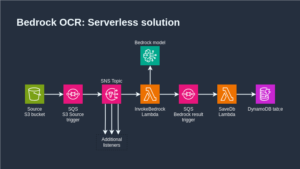
Bedrock seamlessly integrates with AWS’s extensive cloud computing infrastructure:
- Amazon SageMaker for custom model fine-tuning and evaluation
- AWS Lambda for serverless AI application deployment
- Amazon S3 for secure data storage and retrieval
- AWS IAM for granular access control and identity management
- Amazon VPC for network isolation and private connectivity
- AWS KMS for encryption key management
This native integration reduces architectural complexity and leverages existing AWS investments.
Knowledge Bases and RAG Support
Bedrock includes built-in capabilities for retrieval augmented generation, allowing you to ground model responses in your proprietary data. The Knowledge Bases feature automatically handles:
- Vector database creation and management
- Document chunking and embedding generation
- Semantic search and retrieval orchestration
- Context injection into prompts
Agents Framework
AWS Bedrock Agents enable autonomous task execution by orchestrating API calls, data retrieval, and multi-step reasoning. Agents can break down complex requests, make decisions, and execute actions using your defined tools and APIs.
Model Customization Options
Bedrock supports fine-tuning and continued pre-training for select models, allowing organizations to adapt foundation models to domain-specific language, terminology, and use cases while maintaining data privacy.
Use Cases for AWS Bedrock
Enterprise AI Applications:
- Internal knowledge management systems with RAG
- Automated customer service with multi-model fallback strategies
- Document processing and intelligent summarization
- Code generation and developer productivity tools
Regulated Industry Deployments:
- Healthcare applications requiring HIPAA compliance
- Financial services with strict data residency requirements
- Government and defense with FedRAMP compliance needs
- Legal tech with attorney-client privilege protection
Multi-Model AI Strategies:
- Routing different request types to optimal models
- A/B testing model performance across providers
- Cost optimization through model selection
- Resilience through provider diversification
What is OpenAI?
OpenAI is the artificial intelligence research organization behind GPT-4, ChatGPT, DALL-E, and Whisper—models that have fundamentally reshaped public perception of AI capabilities. Founded with the mission to ensure artificial general intelligence benefits humanity, OpenAI provides access to its proprietary large language models through direct API integration.
Key Features of OpenAI
State-of-the-Art Proprietary Models
OpenAI’s competitive advantage lies in its cutting-edge model development:
- GPT-4 Turbo offers advanced reasoning, 128K token context windows, and multimodal understanding
- GPT-4o (Omni) provides real-time audio, vision, and text processing with faster response times
- GPT-3.5 Turbo delivers cost-effective performance for standard language tasks
- DALL-E 3 enables high-quality image generation from text descriptions
- Whisper provides robust speech-to-text transcription
- Text-Embedding-3 models for semantic search and similarity
OpenAI consistently leads in benchmark performance across reasoning, mathematics, coding, and creative writing tasks.
Developer-First API Design
The OpenAI API prioritizes simplicity and developer experience:
- Straightforward REST API with comprehensive documentation
- Official SDKs for Python, Node.js, and other popular languages
- Playground interface for rapid prototyping and testing
- Streaming responses for real-time user experiences
- Function calling for structured outputs and tool integration
This focus on developer experience reduces time-to-first-token and accelerates AI application development.
Fine-Tuning Capabilities
OpenAI allows custom model fine-tuning on GPT-3.5 Turbo and GPT-4, enabling organizations to:
- Adapt models to specific writing styles and formats
- Improve performance on domain-specific tasks
- Reduce prompt engineering complexity
- Maintain consistent brand voice
ChatGPT Enterprise and Team Plans
Beyond API access, OpenAI offers managed ChatGPT deployments with:
- Unlimited GPT-4 access for knowledge workers
- Admin controls and usage analytics
- Data exclusion from model training
- Enhanced security and compliance features
Assistants API and Advanced Features
OpenAI’s Assistants API provides persistent threads, built-in retrieval, code interpreter, and function calling—enabling complex multi-turn conversations and autonomous task execution.
Use Cases for OpenAI
Consumer-Facing AI Products:
- Conversational interfaces and chatbots
- Content generation platforms and writing assistants
- Educational tutoring and learning applications
- Creative tools for marketing and design
Developer Productivity:
- Code generation and debugging assistance
- Documentation automation
- Test case creation and code review
- Technical content writing
Rapid Prototyping and Innovation:
- Startup MVPs requiring quick iteration
- Research projects exploring AI capabilities
- Proof-of-concept demonstrations
- Hackathons and experimental applications
AWS Bedrock vs OpenAI: Key Differences
Practical Comparison:
| Aspect | AWS Bedrock | OpenAI |
| Model Providers | 5+ providers (Anthropic, AI21, Cohere, Meta, Stability AI, Amazon) | OpenAI proprietary models only |
| Model Selection | Choose per-request across providers | Select from OpenAI’s model family |
| Access to Latest Models | Depends on provider partnership timelines | Immediate access to new OpenAI releases |
| Model Performance Consistency | Varies by selected model | Consistent across OpenAI model family |
| Multimodal Capabilities | Available through specific models (Claude 3, Titan Image) | GPT-4o, GPT-4 Vision, DALL-E 3 |
Pricing Models
Understanding the cost structure of AWS Bedrock vs OpenAI requires analyzing both token-based pricing and additional infrastructure costs.
AWS Bedrock Pricing Structure
Bedrock charges per 1,000 input and output tokens, with rates varying significantly by model:
Example Pricing (Approximate – Verify Current Rates):
| Model | Input Tokens (per 1K) | Output Tokens (per 1K) |
| Claude 3 Opus | $15.00 | $75.00 |
| Claude 3 Sonnet | $3.00 | $15.00 |
| Claude 3 Haiku | $0.25 | $1.25 |
| Amazon Titan Text Express | $0.20 | $0.60 |
| Cohere Command | $1.00 | $2.00 |
OpenAI Pricing Structure
OpenAI also uses token-based pricing with tiered models:
Example Pricing (Approximate – Verify Current Rates):
| Model | Input Tokens (per 1M) | Output Tokens (per 1M) |
| GPT-4 Turbo | $10.00 | $30.00 |
| GPT-4o | $5.00 | $15.00 |
| GPT-3.5 Turbo | $0.50 | $1.50 |
| GPT-4o Mini | $0.15 | $0.60 |
| Embeddings (text-embedding-3-large) | $0.13 | N/A |
Cost Comparison Scenario:
Use Case: Customer service chatbot processing 10 million input tokens and generating 2 million output tokens monthly
AWS Bedrock (Claude 3 Haiku):
- Input: 10M tokens × $0.25/1K = $2,500
- Output: 2M tokens × $1.25/1K = $2,500
- Total: ~$5,000/month
OpenAI (GPT-4o Mini):
- Input: 10M tokens × $0.15/1M = $1,500
- Output: 2M tokens × $0.60/1M = $1,200
- Total: ~$2,700/month
OpenAI (GPT-4 Turbo):
- Input: 10M tokens × $10/1M = $100,000
- Output: 2M tokens × $30/1M = $60,000
- Total: ~$160,000/month
Pricing Insights:
- Budget-conscious projects: OpenAI’s GPT-3.5 Turbo and GPT-4o Mini offer excellent value
- High-performance requirements: Claude 3 Opus (Bedrock) and GPT-4 Turbo have comparable premium pricing
- Mixed workload optimization: Bedrock’s model variety enables sophisticated cost management
- Startup/prototype phase: OpenAI’s no-infrastructure-cost model reduces initial complexity
Data Privacy and Security
Security posture and data handling practices represent critical differentiators in the AWS Bedrock vs OpenAI evaluation, especially for regulated industries.
Security Comparison Table:
| Security Feature | AWS Bedrock | OpenAI |
| Private Network Connectivity | ✅ VPC endpoints, PrivateLink | ❌ Internet-only access |
| Data Residency Control | ✅ Region-specific deployment | ⚠️ Limited control |
| Customer-Managed Encryption | ✅ AWS KMS integration | ❌ Not available |
| HIPAA Compliance | ✅ Eligible | ⚠️ Limited scenarios only |
| FedRAMP Authorization | ⚠️ In progress | ❌ Not available |
| Training Data Exclusion | ✅ Guaranteed | ✅ Guaranteed (with proper plan) |
| Zero Data Retention | ✅ Configurable | ✅ Enterprise option |
| SSO Integration | ✅ Via AWS IAM, SAML | ✅ Enterprise/Team plans |
Function Calling for Structured Outputs:
Both platforms support function calling, but OpenAI pioneered this approach and offers more mature implementation for tool integration and structured data extraction.
Customization Comparison:
| Capability | AWS Bedrock | OpenAI |
| Fine-Tuning Ease | ⚠️ More complex setup | ✅ Very straightforward |
| Data Requirements | Higher (hundreds to thousands) | Lower (10+ examples) |
| Training Speed | Hours to days | Minutes to hours |
| Custom Model Privacy | ✅ Stays in your AWS account | ⚠️ Processed by OpenAI |
| Continued Pre-Training | ✅ Available | ❌ Not offered |
| Model Selection for Tuning | Limited to specific models | GPT-3.5, GPT-4 (limited) |
| RAG/Knowledge Base Support | ✅ Built-in Knowledge Bases | Requires custom implementation |
When to Choose AWS Bedrock
AWS Bedrock is the optimal choice for organizations with specific requirements around infrastructure, security, and strategic flexibility.
Ideal Scenarios for AWS Bedrock
- Existing AWS Infrastructure Investment
If your organization already operates on Amazon Web Services, Bedrock offers seamless integration with your current architecture. Teams familiar with IAM policies, VPC configuration, and AWS SDK patterns can implement Bedrock without learning new infrastructure paradigms.
Cost Advantage: Leverage existing AWS Enterprise Support agreements, consolidated billing, and Reserved Instances for compute resources that support AI workloads.
- Strict Compliance and Regulatory Requirements
Organizations in healthcare (HIPAA), financial services (PCI DSS), government (FedRAMP), and other regulated industries benefit from Bedrock’s comprehensive compliance posture.
Key Compliance Benefits:
- Data never transits public internet (VPC endpoints)
- Customer-managed encryption keys
- Detailed audit trails via AWS CloudTrail
- Geographic data residency guarantees
- BAA (Business Associate Agreement) support for HIPAA
- Multi-Model Strategy and Vendor Diversification
Teams that value optionality and want to avoid single-vendor lock-in should choose Bedrock. The platform’s model-agnostic architecture enables:
Risk Mitigation:
- Implement fallback models if primary provider has outages
- A/B test model performance across providers
- Switch models as pricing or capabilities change
- Negotiate better terms with multiple providers
Task Optimization:
- Route coding queries to code-specialized models
- Send creative writing to models optimized for generation
- Use cost-effective models for simple classification
- Reserve premium models for complex reasoning
- Enterprise-Scale RAG Implementations
Bedrock’s Knowledge Bases feature provides managed infrastructure for retrieval augmented generation at scale. This is ideal for:
- Internal knowledge management systems
- Customer support with proprietary documentation
- Legal and compliance document analysis
- Research platforms with large document repositories
When to Choose OpenAI
OpenAI excels in scenarios where cutting-edge model performance, rapid development velocity, and developer experience take priority.

Ideal Scenarios for OpenAI
- Maximum Model Performance Requirements
When your application demands state-of-the-art reasoning, creative writing, or multimodal understanding, OpenAI’s GPT-4 and GPT-4o consistently lead industry benchmarks.
Performance Leadership Areas:
- Complex reasoning and multi-step problem solving
- Advanced mathematics and logic
- Code generation and debugging (especially complex algorithms)
- Creative writing with nuanced style control
- Multilingual capabilities with subtle context understanding
- Real-time multimodal processing (GPT-4o)
Benchmark Example: GPT-4 scores 86.4% on MMLU (Massive Multitask Language Understanding) compared to Claude 3 Opus at 86.8% and other models at 75-80%.
- Rapid Prototyping and MVP Development
Startups and innovation teams prioritizing speed-to-market should choose OpenAI for its exceptional developer experience:
Development Velocity Advantages:
- Setup in under an hour vs. days for AWS infrastructure
- Comprehensive documentation with executable examples
- Active community providing solutions and best practices
- Playground for no-code testing and experimentation
- Minimal DevOps overhead
Startup Success Pattern: Many successful AI startups built initial products on OpenAI, then migrated to multi-model strategies (including Bedrock) after product-market fit.
- Consumer-Facing Applications
Products where end-users directly interact with AI benefit from OpenAI’s conversation quality and brand recognition:
Consumer Use Cases:
- Conversational AI chatbots and virtual assistants
- Content generation tools for writing, marketing, social media
- Educational platforms and tutoring applications
- Creative tools for art, music, and design
- Productivity software with AI copilot features
Brand Value: The “Powered by GPT-4” label carries consumer recognition and trust built through ChatGPT’s massive adoption.
- Teams Without AWS Expertise
Organizations without existing AWS infrastructure or cloud architecture expertise face a steep learning curve with Bedrock. OpenAI eliminates this barrier:
No Infrastructure Requirements:
- No AWS account needed
- No VPC configuration
- No IAM policy management
- No region selection complexity
- Simple API key authentication
Accessibility: Junior developers and non-DevOps teams can successfully implement OpenAI integration, democratizing AI development.
- Advanced Multimodal RequirementsDE
GPT-4o (Omni) provides industry-leading multimodal capabilities, processing text, images, audio, and video in a unified model:
Multimodal Advantages:
- Real-time audio conversations with natural interruption handling
- Vision understanding with detailed image analysis
- Cross-modal reasoning (e.g., answering questions about images)
- Unified API for all modalities
AWS Bedrock vs OpenAI: Decision Matrix
To help you make the optimal choice for your specific situation, use this comprehensive decision matrix:
Decision Framework
| Evaluation Criteria | Choose AWS Bedrock If… | Choose OpenAI If… |
| Infrastructure | You already use AWS extensively | You want minimal infrastructure management |
| Compliance | HIPAA, FedRAMP, or strict data residency required | Standard enterprise compliance (SOC 2) sufficient |
| Model Strategy | You want multi-model optionality | You prefer best-in-class single provider |
| Development Speed | You can invest 1-2 weeks in setup | You need to deploy within days |
| Team Expertise | You have AWS DevOps expertise | You have limited cloud infrastructure experience |
| Cost Structure | You want to optimize through model selection | You prefer simple, predictable pricing |
| Performance Priority | Good performance with flexibility is acceptable | Cutting-edge performance is non-negotiable |
| Security Model | VPC isolation and customer-managed keys required | Standard encryption and data exclusion sufficient |
| Customization | You need continued pre-training or RAG at scale | Fine-tuning with limited data is your primary need |
| Use Case | Enterprise B2B, internal tools, regulated industries | Consumer-facing, content generation, rapid innovation |
Real-World Use Case Examples
Understanding how organizations successfully deploy AWS Bedrock vs OpenAI in production illuminates practical decision-making.
Case Study 1: Healthcare Documentation Platform (AWS Bedrock)
Organization: Mid-size healthcare technology company
Challenge: Automated clinical documentation from physician voice notes
Solution: AWS Bedrock with Claude 3 and custom Knowledge Bases
Why Bedrock:
- HIPAA compliance requirements mandated VPC deployment and BAA
- PHI (Protected Health Information) required encryption with customer-managed keys
- Medical terminology required RAG with proprietary clinical database
- Data residency regulations required US-only deployment
Implementation:
- Amazon Transcribe Medical for speech-to-text
- Bedrock Knowledge Bases for medical knowledge grounding
- Claude 3 Sonnet for clinical note generation
- Custom fine-tuning on de-identified clinical notes
Results:
- 70% reduction in documentation time
- Full HIPAA compliance maintained
- $0.85 per note average cost (Claude 3 Sonnet)
- 94% physician satisfaction with output quality
Key Insight: AWS’s comprehensive healthcare compliance made Bedrock the only viable option despite higher complexity.
Case Study 2: AI Writing Assistant SaaS (OpenAI)
Organization: Early-stage startup building writing productivity tools
Challenge: Bring AI writing assistant to market within 3 months
Solution: OpenAI GPT-4 Turbo with fine-tuned models for brand voice
Why OpenAI:
- Two-person technical team with no DevOps experience
- Needed rapid iteration during beta testing
- Consumer audience valued “Powered by GPT-4” positioning
- Limited initial capital couldn’t support AWS infrastructure investment
Implementation:
- GPT-4 Turbo for long-form content generation
- GPT-3.5 Turbo fine-tuned for social media formats
- Text-embedding-3-large for semantic content search
- Assistants API for multi-turn editing conversations
Results:
- MVP deployed in 6 weeks
- 10,000 users acquired in first quarter
- $12,000 monthly OpenAI costs at scale
- 85% user retention rate
Key Insight: OpenAI’s simplicity enabled fast market entry; team plans to evaluate multi-model strategy after Series A funding.
Results:
- 45% call center volume reduction
- Average response cost: $0.15 (Haiku routing), $0.85 (Sonnet), $2.50 (GPT-4 fallback)
- 92% query accuracy for account information
- Full compliance with financial regulations
Output Filtering:
- Scan outputs for PII, credentials, or sensitive data
- Implement content moderation for harmful content
- Validate outputs against business rules
Access Control:
- Implement least-privilege access principles
- Rotate API keys regularly
- Use temporary credentials where possible
- Audit access logs regularly
Frequently Asked Questions (FAQ)
Q1: Can I use both AWS Bedrock and OpenAI together?
A: Yes. Many organizations use hybrid architectures combining AWS Bedrock and OpenAI.
OpenAI is often used for development, while Bedrock is used for production.
Abstraction layers like LangChain make switching providers easier.
Q2: Which platform is more cost-effective for high-volume applications?
A: Cost depends on workload type and scale.
AWS Bedrock allows routing requests to cheaper or premium models as needed.
OpenAI’s smaller models offer strong value for standardized, high-volume use cases.
Q3: Does AWS Bedrock support the same models as OpenAI?
A: No, AWS Bedrock does not provide OpenAI GPT models.
Instead, it offers models like Claude, Amazon Titan, and Meta Llama.
GPT-4 requires direct OpenAI access or Azure OpenAI Service.
Q4: How do data privacy policies differ between AWS Bedrock and OpenAI?
A: Both platforms state they do not train on customer data.
AWS Bedrock keeps all data inside your AWS account and region.
OpenAI processes data on its infrastructure but excludes API data from training.
Q5: Which platform is better for startups with limited resources?
A: OpenAI is usually better for early-stage startups.
It offers faster setup, simpler APIs, and quicker time-to-market.
Bedrock fits better when startups need AWS-native compliance or control.
Conclusion: Making Your AWS Bedrock vs OpenAI Decision
Choosing between AWS Bedrock vs OpenAI fundamentally depends on your organization’s infrastructure maturity, compliance requirements, development priorities, and long-term AI strategy. Neither platform is universally superior—each excels in specific contexts.
With expert guidance from GoCloud, businesses can evaluate both platforms, design hybrid architectures, and implement secure, scalable AI solutions aligned with their technical and compliance needs.