

Running a cloud environment today is fundamentally different from what it was five years ago. What began as moving workloads off on-premises hardware has evolved into managing vast, interconnected ecosystems of services, accounts, regions, and policies. Organizations are now grappling with harder questions: How do we maintain governance across dozens of accounts? How do we detect security misconfigurations before they become incidents? How do we understand what we are spending, and why?
These challenges require deliberate investment in cloud operations — in the people, processes, and tooling that keep environments secure, observable, and cost-accountable. GoCloud’s journey toward the AWS Cloud Operations Competency was the story of building exactly that kind of operational maturity not to satisfy a checklist, but because our customers demanded it and because serious cloud operations required a serious, validated standard of excellence.
Why Cloud Operations Has Become a Business Priority
The case for mature cloud operations is no longer theoretical. Organizations that scaled AWS environments without corresponding operational investment have experienced the consequences: security incidents from ungoverned IAM policies, cost overruns from untagged resources, compliance failures from configuration drift, and outages from unmonitored thresholds.
These are not edge cases. They are predictable outcomes of treating cloud operations as an afterthought. Security findings in enterprise AWS environments often number in the thousands, with many unresolved for weeks due to the absence of structured triage. In regulated industries, the cost of a compliance failure far exceeds the cost of the controls that prevent it.
The AWS Cloud Operations Competency exists because AWS recognizes that operational excellence must be deliberately built, consistently practiced, and independently validated — not just assumed by virtue of adopting cloud services.
Building a Foundation for Operational Excellence
GoCloud’s approach to cloud operations developed incrementally as we encountered real operational challenges, absorbed those lessons, and encoded them into repeatable frameworks. The starting point was a clear observation: most cloud operational failures are caused by process gaps, not technology limitations — absent ownership, inconsistent configuration standards, monitoring that was configured once and never revisited, and policies that existed on paper but were not enforced.
Addressing these gaps led to the GoCloud Operational Blueprint: a structured methodology defining how we design, deploy, monitor, and manage AWS environments. The Blueprint is built on four principles — Visibility (nothing unknown or unmonitored), Governance (policy enforced consistently), Automation (operational tasks executed reliably at scale), and Resilience (systems recover predictably when failures occur). These principles shaped every decision in our operations practice and formed the lens through which we evaluated our own readiness for the competency assessment.
Strengthening Governance, Visibility, and Automation
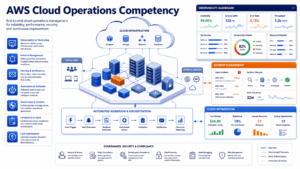
Cloud Governance at Scale. As customers expanded to multi-account architectures, GoCloud built its governance framework on AWS Organizations and Control Tower, using Service Control Policies to enforce permission boundaries and preventive guardrails to block non-compliant configurations. We developed an account vending model that provisions new accounts with pre-configured logging, monitoring, security tooling, and tagging standards from day one.
Monitoring and Observability. The most persistent challenge we encountered was the gap between environments generating monitoring data and teams able to act on it. GoCloud built a layered observability framework that structures output into meaningful signals — reducing alert noise through correlation rules, establishing severity classifications aligned to business impact, and delivering dashboards that gave teams immediate situational awareness without interpreting raw telemetry.
Automation and Infrastructure Consistency. Manual operations do not scale. GoCloud standardized on Infrastructure as Code using Terraform and AWS CDK, enabling version-controlled, repeatable deployments. We integrated AWS Systems Manager for automated patching, and where compliance drift occurred, automated remediation workflows triggered corrective actions within minutes — maintaining policy adherence without operational overhead.
Demonstrating Customer Success Through Real Outcomes
The AWS Cloud Operations Competency is not awarded on documented frameworks alone. AWS requires verified evidence that a partner’s practices have produced measurable improvements in real customer environments — a requirement that, in our view, gives the competency its genuine weight.
For each engagement submitted, we documented the operational state at engagement start, the interventions GoCloud implemented, and the measurable outcomes produced. We tracked incident resolution times, security finding backlogs, and cost trajectories before and after our frameworks were deployed. Across submissions, environments managed under the GoCloud Operational Blueprint consistently showed lower security finding backlogs, faster incident resolution, and reduced AWS spend. AWS reviewers validated not only the outcomes but the methodology behind them — confirming that our approaches were aligned to best practices, reproducible across contexts, and customer-verified.
Navigating the AWS Validation Process
The competency assessment is a substantive technical evaluation, not a documentation exercise. AWS Solutions Architects conducted architecture review sessions with our senior engineers, examined our operational tooling, reviewed customer evidence packages, and held direct reference calls with customers. They probed not just whether our frameworks existed, but whether our teams understood them deeply enough to apply them in novel situations.
The process required specificity that most teams do not maintain by default not “we monitor all environments” but detailed configurations, notification channels, escalation paths, and runbook documentation for each capability area. Completing the self-assessment honestly surfaced areas where our documentation needed strengthening, and that process was itself valuable independent of the outcome. Our team’s certifications spanning Solutions Architect Professional, DevOps Engineer Professional, Security Specialty, and Advanced Networking confirmed that GoCloud’s competency was institutional, not concentrated in a few individuals.
Key Learnings from the Journey
- Operational maturity requires deliberate investment. Frameworks that pass AWS validation must be intentionally designed, documented, and maintained — they do not emerge organically from experience.
- Documentation is a discipline, not a task. The level of operational documentation the competency requires is higher than most teams maintain. Building a culture that sustains it requires explicit organizational commitment.
- Customer evidence must be specific and verifiable. AWS requires metrics tracked continuously throughout engagements — not assembled retroactively for a submission.
- Governance gaps compound over time. Preventive governance at account provisioning is far cheaper than retroactive remediation across a sprawling multi-account estate.
- Automation is consistency, not just efficiency. Automated processes produce uniform outcomes; manual processes vary with individual knowledge and availability.
Looking Ahead
The competency establishes a validated baseline, not a ceiling. GoCloud is investing in AI-assisted operations using Amazon DevOps Guru for predictive operational insights, FinOps frameworks that connect AWS spending to measurable business outcomes, and pre-configured compliance postures for HIPAA, PCI-DSS, SOC 2, and ISO 27001 — enabling customers in regulated industries to deploy into compliant environments without rebuilding frameworks from scratch.
Conclusion: What Operational Excellence Actually Requires
The AWS Cloud Operations Competency is a statement about what it takes to operate cloud environments responsibly at scale — one that requires documented evidence, verified customer outcomes, and independent validation to make credibly. GoCloud built the governance frameworks, observability architectures, automation pipelines, and customer accountability practices that the competency validates, because the organizations we serve depend on them every day.
For organizations running production workloads on AWS, the question of who manages those environments matters — technically, financially, and from a risk perspective. The AWS Cloud Operations Competency answers that question with independent authority. GoCloud is proud to hold that designation, and more committed than ever to the operational excellence it represents.