


Joining or engaging with the AWS Partner Network (APN) isn’t a vendor decision—it’s an ecosystem decision that can change your delivery velocity, risk profile, and total cost of ownership. The APN is a global community of organizations that “leverage AWS technologies, programs, funding, and tools to build solutions and services for customers.”
This guide is written for CTOs, founders, and cloud architects who want to extract real operational and financial value—and avoid partner relationships that quietly create lock‑in, cost sprawl, and dependency.
What You’ll Learn (Executive Summary)
You can use the APN to:
- Buy speed: engage partners to accelerate delivery and avoid rebuilding patterns from scratch.
- Buy certainty: use AWS validation programs (e.g., MSP validation) to reduce operational risk.
- Access programs that are operationally difficult to run without partner experience—especially migrations via AWS Migration Acceleration Program (MAP) and startup credits via AWS Activate.
- Streamline procurement using AWS Marketplace features like private offers and standardized contract templates.
1) The APN Is Not “One Thing” — Understand the Ecosystem Before You Engage :
AWS positions the APN as a mechanism for partners to build and deliver solutions and services, including resale, professional services, and managed services. Practically, that means partner business models differ, and the same partner will rarely be best at all of: architecture, migration factory execution, 24/7 operations, compliance evidence, and cost governance.
2) Three Partner Types—and When Each Matters
2.1 Consulting Partners (Services / SIs)
Use when you need a defined outcome: migration, landing zone, security uplift, platform modernization, or architecture remediation. The asset you’re buying is delivery capability + repeatable patterns, ideally delivered as code and documentation you own. (AWS broadly describes partners delivering training, professional, and managed services as part of APN support.)
Best-fit engagements
- Landing zone / multi-account foundations
- Migration waves & cutover execution
- IaC standardization (Terraform/CDK), CI/CD enablement
- Security baseline + audit evidence readiness
Primary risk
- dependency if work product isn’t transferred (repos, runbooks, ADRs, training).
2.2 Technology Partners (ISVs)
These are product companies that sell software that runs on or integrates with AWS—monitoring, security tooling, data platforms, etc. The strategic play is often buy vs build, and Marketplace can reduce friction via standardized procurement and private offers.
Best-fit engagements
- Observability platforms, security platforms, data platforms
- Faster procurement using Marketplace contract templates
- Negotiated terms via private offers / channel partner private offers.
2.3 AWS Managed Service Provider (MSP) Program Partners
MSPs are for “run and operate” at production intensity. AWS states the AWS MSP Program validates and recognizes partners delivering solutions across the cloud journey, and that to become a validated AWS MSP Partner a partner “must complete a rigorous third-party audit.”
Best-fit engagements
- 24/7 operations and incident response
- Continuous improvement (patching, monitoring, operational excellence)
- Organizations that can’t justify a full internal 24/7 SRE rotation
The key differentiator
- “Validated through rigorous audits” is the point—not just “they offer managed services.”
Partner Type Comparison Table (decision snapshot)
| Partner type | Primary function | Typical engagement | Best for |
| Consulting Partner | design/build/migrate | project or staff augmentation | one-off initiatives, modernization |
| Technology Partner (ISV) | product/software | subscription/license (often via Marketplace) | buy-vs-build tooling & platforms |
| Validated MSP | operate/run/optimize | ongoing managed services | 24/7 operations + governance |
(Use this as an executive filter, then go deeper into validations and contracts.)
3) The Partner Tier System — What Tiers Actually Signal
AWS uses tiers (commonly discussed as Select/Advanced/Premier for services partners). AWS publishes tier requirements and benefits for AWS Services Partner Tiers—these include accredited individuals, certification minimums, launched opportunities, and (for Premier) additional requirements such as sustained attainment and program criteria.
How to interpret tiers correctly
- Tiers mostly measure scale + program attainment, not guaranteed niche expertise.
- Tier is useful for “capacity to execute at scale,” but it’s not your best predictor of deep skill in your domain.
- Your best predictor is typically validated specialization/competency alignment to your workload type. (See next section.)
4) The Real Trust Signals: Validations > Marketing
4.1 AWS Specialization Program
AWS states its Specialization Program validates partners who demonstrate technical excellence “across industries, use cases, and services,” and that achieving a specialization requires “rigorous technical assessments” including review of multiple customer success examples.
Decision rule
- Prefer a partner whose validation matches your workload (security, migration, SaaS, data, ML) over a general “top tier” badge.
4.2 MSP validation (for “run” outcomes)
If your requirement is 24/7 operations, prioritize validated MSPs because AWS explicitly ties MSP validation to a third-party audit and enterprise standards.
4.3 Device / Edge hardware: AWS Partner Device Catalog
If you’re doing IoT/edge, AWS provides a “curated catalog of qualified devices from AWS Partners” meant to “simplify and accelerate implementation” by choosing hardware qualified to work with AWS services.
5) The Financial Levers Most Teams Underuse (and How to Use Them Safely)
5.1 AWS Migration Acceleration Program (MAP)
AWS describes MAP as a “comprehensive and proven cloud migration program” with an outcome-driven methodology, expertise from AWS Partners, and AWS investment. MAP uses a three-phase framework—Assess, Mobilize, Migrate and Modernize—and is positioned to help “offset the initial cost of migrations” and reduce risk.
How to use this strategically
- If you’re planning a material migration, treat MAP participation as a core part of your business case (timeline, funding, partner selection, governance).
- Ask prospective partners to show MAP experience in the form of: deliverable samples, runbooks, and a realistic wave plan aligned to MAP phases (Assess/Mobilize/Migrate & Modernize).
5.2 Startup runway: AWS Activate Credits
AWS states eligible startups can apply for up to $100,000 in AWS Activate Credits, and differentiates between:
- Activate Founders (self-funded path)
- Activate Portfolio (provider-sponsored path that starts “if you have an Org ID from an Activate Provider”).
Strategic takeaway
- If you qualify for Portfolio, that Org ID path can be a meaningful lever—so your partner ecosystem (accelerator/VC/provider relationships) can be a funding multiplier, not just “help on architecture.”
5.3 Procurement speed: AWS Marketplace procurement features
AWS Marketplace highlights procurement mechanisms that matter to decision-makers:
- Private Offers and Channel Partner Private Offers for custom pricing/terms
- Pre-negotiated contract templates to reduce per-vendor negotiation
- Faster SaaS adoption workflows (“find, try, subscribe, configure, deploy”).
This matters because vendor procurement latency is often an invisible drag on engineering delivery—Marketplace can turn procurement into an execution enabler.
6) Measuring ROI From an APN Engagement — A 90‑Day Framework
You shouldn’t wait 12 months to discover a partner isn’t producing value. Use a 90-day validation window with unambiguous deliverables, and score outcomes weekly.
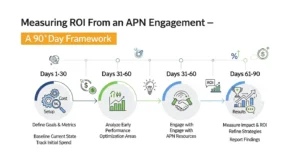
Weeks 1–2: Audit & Baseline
Activities
- Architecture + operational baseline review
- Spend visibility and allocation plan (tagging model, account boundaries)
- Risk register creation (security + reliability + cost)
Deliverables
- “Current state” architecture snapshot
- Cost and risk baseline report
- Prioritized backlog (with owners)
Month 1: Quick wins
Activities
- Low-risk cost hygiene, basic monitoring posture, foundational security configuration
Deliverables
- Implemented changes log + measurable deltas
- Operational runbook drafts (on-call, incident response, deployment)
Months 2–3: Structural improvement
Activities
- Landing zone maturity work, compliance evidence building, modernization roadmap execution
- MAP wave plan execution if migrating (Assess/Mobilize/Migrate & Modernize alignment).
Success criteria
- “We can run this without you” handover plan exists (even if you stay as partner)
7) Lock‑In Prevention: Contract for Independence Up Front
AWS Marketplace and the APN accelerate engagement—but they don’t prevent lock‑in by default. You prevent lock-in by contractual and delivery standards.
Non-negotiable clauses (practical)
- Your Git repo ownership (all IaC, pipelines, policies, scripts)
- No proprietary abstraction layer requirement (native AWS tooling first)
- Exit and transition plan with defined artifacts and timelines
- Documentation deliverables: runbooks, diagrams, ADRs, and access model
- Operational transparency (monitoring dashboards accessible in your accounts)
Why this matters Marketplace can simplify software procurement, but your operating model must ensure you retain control of the architecture and operational history.
Where to Actually Find Partners (and How to Shortlist)
Use the Partner Solutions Finder to search and filter partners (partners/solutions/practices/devices). It explicitly positions “AWS Competency Partners” as having deep technical expertise and demonstrated specialization and customer success.
Start your shortlist by filtering on:
- program alignment (e.g., validated MSP if you need “run”)
- specialization alignment (security/migration/etc.).
- geography and customer segment fit.
FAQs :
Q1: What is the AWS Partner Network (APN)?
The APN is “a global community of organizations that leverage AWS technologies, programs, funding, and tools to build solutions and services for customers.”
Q2: What is the AWS Migration Acceleration Program (MAP)?
MAP is an AWS migration program that provides an outcome-driven methodology and a three-phase framework (Assess, Mobilize, Migrate and Modernize). AWS positions MAP as helping accelerate migration and modernization, reduce risk, and offset initial migration costs, leveraging tools, training, partner expertise, and AWS investment.
Q3: How do I find a reputable AWS partner for my business?
Start with the Partner Solutions Finder, then filter based on the type of partner you need (consulting vs MSP vs device/edge) and the validations that match your workload. Use AWS’s specialization framework to prioritize validated technical excellence and customer success examples.
Q4: What are AWS Competencies and Specializations?
AWS Competencies and Specializations recognize partners who demonstrate technical expertise and proven customer success in areas like Migration, DevOps, Security, or Data & Analytics. These validations help businesses choose partners with deep experience for their specific workloads.
Q5: What is an AWS Managed Service Provider (MSP)?
An AWS MSP is a partner validated by AWS for delivering full lifecycle cloud services, including cloud infrastructure management, migration support, and ongoing optimization. MSPs like GoCloud provide 24/7 monitoring, operational excellence, and security best practices to ensure reliable, scalable AWS environments.
Conclusion :
The APN is best understood as infrastructure for collaboration, encompassing a network of delivery capabilities, validated operating models such as MSP audits, procurement acceleration through the Marketplace, and structured migration support via MAP. GoCloud emphasizes intentionality as the winning approach choose the right partner type—whether to build, run, or buy software—prioritize validated depth through specializations, competencies, and MSP validation, contract for independence, and enforce a 90-day ROI scoreboard to track results effectively.