

Navigating the Cloud Platform Decision
The GCP vs AWS decision represents one of the most consequential technology choices facing organizations in 2026. With Amazon Web Services commanding approximately 32% of the global cloud infrastructure market and Google Cloud Platform holding 11%, both hyperscalers offer compelling capabilities—yet they serve fundamentally different organizational priorities.
Amazon Web Services pioneered Infrastructure as a Service (IaaS) in 2006 and has built the most comprehensive cloud platform with over 200 services. Google Cloud Platform, launched in 2008, leverages Google’s engineering excellence in data analytics, machine learning, and container orchestration to deliver what many consider the most technically sophisticated cloud infrastructure.
For CTOs, developers, startup founders, and ML engineers, the GCP vs AWS evaluation extends beyond feature checklists. This decision impacts development velocity, operational costs, talent acquisition, AI/ML capabilities, and long-term strategic flexibility. Organizations migrating from on-premises infrastructure face different considerations than startups building cloud-native applications from scratch.
This comprehensive guide delivers actionable insights for making informed cloud decisions. We’ll examine compute and storage capabilities, machine learning platforms, pricing models, networking architectures, security features, and real-world deployment patterns to help you determine whether Google Cloud Platform vs Amazon Web Services better aligns with your technical requirements and business objectives.
What is AWS (Amazon Web Services)?
Amazon Web Services is the world’s most widely adopted cloud platform, offering over 200 fully featured services spanning compute, storage, databases, networking, analytics, machine learning, security, and application development. Launched in 2006 with Simple Storage Service (S3) and Elastic Compute Cloud (EC2), AWS pioneered the Infrastructure as a Service model that transformed how organizations build and scale technology.
Key Features of AWS
Unmatched Service Breadth and Depth
AWS‘s defining advantage is comprehensiveness—services cover every conceivable cloud computing need:https://go-cloud.io/aws/
- Compute: EC2 virtual servers, Lambda serverless functions, ECS/EKS container orchestration, Fargate managed containers, Batch for batch computing, Lightsail for simplified VPS
- Storage: S3 object storage (11 nines of durability), EBS block storage, EFS file systems, Glacier for archival, FSx for Windows/Lustre file systems
- Databases: RDS managed databases (Aurora, PostgreSQL, MySQL, MariaDB, Oracle, SQL Server), DynamoDB NoSQL, Redshift data warehouse, DocumentDB, Neptune graph database, Timestream time-series
- Networking: VPC for network isolation, CloudFront CDN, Route 53 DNS, Direct Connect for dedicated connectivity, Global Accelerator for anycast
- Machine Learning: SageMaker for model development and deployment, Rekognition for image analysis, Comprehend for NLP, Forecast for time-series predictions, Personalize for recommendations
This breadth enables organizations to build complete solutions within the AWS ecosystem without third-party dependencies.
Global Infrastructure Leadership
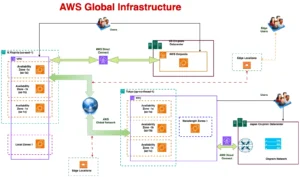
AWS operates 33 geographic regions with 105 availability zones in 2026, plus over 500 CloudFront Points of Presence (PoPs). This infrastructure supports:
- Multi-region architectures for disaster recovery and compliance
- Data residency requirements for regulated industries
- Low-latency access across global user populations
- High availability through multiple physically separated data centers within regions
No cloud provider matches AWS’s geographic coverage, critical for multinational enterprises.
Mature Enterprise Capabilities
Two decades of development have produced enterprise-grade features:
- Comprehensive compliance certifications (SOC, ISO, PCI DSS, HIPAA, FedRAMP, and dozens more)
- AWS Organizations for multi-account governance and consolidated billing
- Service Control Policies (SCPs) for organizational guardrails
- Control Tower for automated multi-account setup
- Enterprise Support with Technical Account Managers
- 99.99% or higher SLAs for critical services
- Reserved Instances and Savings Plans for cost optimization
Extensive Partner Ecosystem
AWS’s market leadership has created the largest cloud ecosystem:
- AWS Marketplace with 12,000+ software listings
- Hundreds of consulting partners specializing in AWS migrations
- Deep integrations with enterprise software (SAP, Oracle, Microsoft)
- Largest pool of AWS-certified professionals globally
- Abundant community resources, training materials, and third-party tools
Use Cases for AWS
Enterprise Migrations and Hybrid Cloud:
- Lift-and-shift migrations from on-premises data centers
- Hybrid architectures with AWS Outposts and Direct Connect
- Windows workloads with deep Microsoft technology integration
- SAP HANA deployments requiring certified infrastructure
E-Commerce and High-Transaction Applications:
- Global retail platforms leveraging DynamoDB for shopping carts
- Payment processing with PCI DSS compliance
- Media streaming with CloudFront CDN
- Gaming backends requiring low latency worldwide
DevOps and CI/CD Pipelines:
- Containerized microservices on ECS or EKS
- Serverless architectures with Lambda and API Gateway
- Infrastructure as code with CloudFormation or CDK
- Automated deployment pipelines with CodePipeline
Data Lakes and Analytics:
- Centralized data storage in S3 data lakes
- ETL processing with AWS Glue
- Interactive queries with Athena
- Business intelligence with QuickSight
What is GCP (Google Cloud Platform)?
Google Cloud Platform is Google’s suite of cloud computing services, leveraging the same infrastructure that powers Google Search, YouTube, Gmail, and Maps. Launched publicly in 2008 with App Engine, GCP has evolved into a comprehensive cloud platform distinguished by engineering excellence in data analytics, machine learning, containerization, and networking innovation.

Key Features of GCP
Technical Innovation and Performance
GCP’s heritage as Google’s internal infrastructure platform delivers technical advantages:
- Live Migration: Virtual machines migrate between hosts without downtime during maintenance
- Custom Machine Types: Configure VMs with precise CPU and memory combinations (not fixed instance sizes)
- Sustained Use Discounts: Automatic price reductions for long-running workloads (no upfront commitment required)
- Premium Network Tier: Traffic routes across Google’s private global network, not the public internet
- Preemptible VMs: 80% cost reduction for interruptible workloads
These innovations reflect Google’s operational experience running planetary-scale services.
World-Class Data and Analytics
Google pioneered modern big data technologies (MapReduce, Bigtable, Spanner), and GCP productizes these innovations:
- BigQuery: Serverless, petabyte-scale data warehouse with SQL interface and sub-second query performance
- Cloud Spanner: Globally distributed, horizontally scalable relational database with strong consistency
- Pub/Sub: Real-time messaging service processing billions of events daily
- Dataflow: Managed Apache Beam for stream and batch processing
- Looker: Enterprise business intelligence and embedded analytics
Organizations choosing GCP often cite BigQuery as a primary driver—its performance and ease of use transform data analytics workflows.
AI and Machine Learning Leadership
Google’s AI research heritage (TensorFlow, TPUs, Transformer architecture) makes GCP particularly compelling for ML workloads:
- Vertex AI: Unified ML platform for building, deploying, and scaling models
- TPUs (Tensor Processing Units): Custom silicon optimized for TensorFlow training and inference
- AutoML: Automated machine learning for developers without ML expertise
- Pre-trained APIs: Vision, Natural Language, Translation, Speech-to-Text with state-of-the-art models
- TensorFlow Enterprise: Production-grade TensorFlow with long-term support
GCP leads AWS in ease of ML model deployment and provides superior performance for TensorFlow workloads.
Kubernetes and Container Leadership
Google created Kubernetes and operates it at unprecedented scale internally:
- Google Kubernetes Engine (GKE): Most advanced managed Kubernetes service with Autopilot mode for hands-free operation
- Anthos: Hybrid and multi-cloud platform built on Kubernetes for consistent operations
- Cloud Run: Serverless container platform with automatic scaling to zero
- Artifact Registry: Unified repository for containers and language packages
Organizations adopting containerized architectures often find GCP’s Kubernetes expertise compelling.
Pricing Transparency and Flexibility
GCP’s pricing philosophy emphasizes simplicity and fairness:
- Per-Second Billing: No rounding to hourly increments (AWS rounds to the hour for some services)
- Sustained Use Discounts: Automatic discounts (up to 30%) without Reserved Instances
- Committed Use Discounts: 1 or 3-year commitments for 25-55% savings (more flexible than AWS Reserved Instances)
- No Data Transfer Fees Within Regions: Free egress between zones in same region
Use Cases for GCP
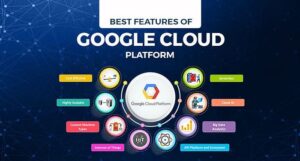
Data Analytics and Business Intelligence:
- Real-time analytics dashboards with BigQuery and Looker
- Data warehousing migrations from Teradata, Oracle, or Redshift
- Log analytics processing billions of events
- Ad-hoc SQL queries against petabyte-scale datasets
AI/ML Model Development and Deployment:
- Computer vision applications using Vision API
- Natural language processing with NLP API
- Custom TensorFlow model training on TPUs
- AutoML for domain-specific models without ML expertise
Cloud-Native Application Development:
- Microservices on Google Kubernetes Engine
- Serverless APIs with Cloud Functions or Cloud Run
- Progressive web applications on Firebase
- Container-first development workflows
Gaming and Real-Time Applications:
- Multiplayer game backends with low-latency networking
- Real-time collaboration tools (Google Workspace integration)
- Live streaming with Media CDN
- IoT data ingestion with Pub/Sub
GCP vs AWS: Key Differences
Understanding the architectural, operational, and philosophical differences between Google Cloud Platform vs Amazon Web Services clarifies where each excels.
Compute Services Comparison
AWS EC2 vs Google Compute Engine
Both provide virtual machines, but with different approaches:
AWS EC2:
- 500+ instance types across 7 families (general, compute, memory, storage, GPU, inference, HPC)
- Fixed instance configurations (though wide variety available)
- Spot Instances for up to 90% discount (interruptible)
- Bare metal instances available (i3.metal, etc.)
- Mature feature set with placement groups, dedicated hosts, capacity reservations
Google Compute Engine:
- Custom machine types: Configure any CPU/memory combination
- Sustained use discounts automatically applied (up to 30% without commitment)
- Preemptible VMs for 80% discount (24-hour maximum runtime)
- Live migration during maintenance (zero downtime)
- Simpler instance family structure
Practical Example:
Workload: Application server requiring 8 vCPUs and 48GB RAM
- AWS: Choose r5.2xlarge (8 vCPU, 64GB RAM) – overpaying for 16GB unused memory
- GCP: Configure custom machine (8 vCPU, 48GB RAM) – pay only for resources needed
Winner: GCP for flexibility and automatic discounts; AWS for specialized instances (bare metal, GPUs)
Serverless Compute: Lambda vs Cloud Functions/Cloud Run
AWS Lambda:
- Maximum 15-minute execution time
- 10GB memory maximum
- Extensive event source integrations (S3, DynamoDB, SQS, EventBridge, etc.)
- Lambda@Edge for CloudFront edge computing
- Larger cold start times (100-500ms typical)
GCP Cloud Functions:
- Maximum 9-minute execution time (Gen 2)
- 16GB memory maximum
- Event sources: Pub/Sub, Cloud Storage, Firestore, HTTP
- Faster cold starts due to architecture improvements
- Simpler pricing model
GCP Cloud Run:
- Container-based serverless (not function-based)
- Maximum 60-minute execution time
- Support for any programming language/runtime
- WebSockets and HTTP/2 support
- Scale to zero with sub-second cold starts
Winner: AWS Lambda for event-driven integrations; GCP Cloud Run for containerized serverless applications
Storage and Database Comparison
Object Storage: S3 vs Cloud Storage
AWS S3:
- Industry standard with extensive third-party integration
- 11 nines of durability (99.999999999%)
- Intelligent tiering for automatic cost optimization
- Advanced features: Object Lock, S3 Batch Operations, S3 Select
- 100+ storage classes for different access patterns
Google Cloud Storage:
- Comparable durability (11 nines)
- Simpler storage class structure (Standard, Nearline, Coldline, Archive)
- No data retrieval fees within same region
- Automatic object versioning
- Turbo replication for faster cross-region replication
Cost Comparison (1TB storage, 1TB egress monthly):
- AWS S3 Standard: ~$23 storage + ~$90 egress = $113/month
- GCP Cloud Storage Standard: ~$20 storage + ~$120 egress = $140/month
Winner: Comparable, with S3 having broader ecosystem support
Relational Databases: RDS vs Cloud SQL
AWS RDS:
- Engine support: Aurora (MySQL/PostgreSQL), PostgreSQL, MySQL, MariaDB, Oracle, SQL Server
- Aurora Serverless for auto-scaling
- Read replicas across regions
- Automated backups with point-in-time recovery
- Performance Insights for query analysis
Google Cloud SQL:
- Engine support: PostgreSQL, MySQL, SQL Server
- Automatic storage scaling without downtime
- High availability with automatic failover (99.95% SLA)
- Integrated with BigQuery for analytics
- Query Insights for performance analysis
AWS Aurora vs Cloud Spanner:
For globally distributed applications:
- Aurora Global Database: Multi-region with read replicas, 1-second RPO
- Cloud Spanner: True globally distributed database with strong consistency, 99.999% availability SLA, external consistency
Winner: AWS for variety (more engines); GCP for global consistency (Spanner) and PostgreSQL integration
NoSQL Databases: DynamoDB vs Firestore/Bigtable
AWS DynamoDB:
- Fully managed key-value and document database
- Single-digit millisecond performance
- Auto-scaling with on-demand or provisioned capacity
- Global tables for multi-region replication
- Transactions, streams, TTL support
Google Firestore:
- Document database with real-time sync
- Optimized for mobile/web applications
- Offline support with automatic sync
- Generous free tier
- Strong consistency within regions
Google Bigtable:
- Wide-column NoSQL (HBase API compatible)
- Sub-10ms latency for time-series and IoT data
- Automatic replication and scaling
- Powers Google Search, Maps, Gmail
Winner: DynamoDB for general-purpose NoSQL; Firestore for mobile apps; Bigtable for massive-scale time-series
Machine Learning and AI Comparison
AWS SageMaker vs GCP Vertex AI
AWS SageMaker:
- End-to-end ML platform with notebooks, training, deployment
- SageMaker Studio IDE for ML development
- Built-in algorithms and model zoo
- Feature Store for feature management
- Model Monitor for drift detection
- Autopilot for automated model development
- Broad framework support: TensorFlow, PyTorch, MXNet, XGBoost, scikit-learn
GCP Vertex AI:
- Unified ML platform combining AI Platform and AutoML
- Workbench for Jupyter-based development
- AutoML for no-code model training
- Vertex AI Pipelines (Kubeflow-based)
- Feature Store integration
- Explainable AI for model interpretability
- Superior TensorFlow integration and TPU support
Specialized AI Services Comparison:
| AI Capability | AWS Service | GCP Service |
| Computer Vision | Rekognition | Vision API (superior accuracy) |
| Natural Language | Comprehend | Natural Language API |
| Speech-to-Text | Transcribe | Speech-to-Text (better multilingual) |
| Translation | Translate | Translation API (128 languages) |
| Custom Training Hardware | GPUs (P4, G5), Inferentia, Trainium | GPUs, TPUs (faster for TensorFlow) |
Winner: GCP for TensorFlow/TPU workflows and ease of deployment; AWS for framework diversity and enterprise features
Networking Architecture
GCP’s Premium Network Tier:
Google Cloud’s networking represents a fundamental architectural advantage:
- Premium Tier: Traffic enters Google’s network at nearest PoP and traverses private global network, minimizing public internet exposure
- Standard Tier: Traditional internet routing (comparable to AWS)
- Cold Potato Routing: Traffic stays on Google’s network longer, improving performance and security
AWS Global Infrastructure:
- Regional VPCs with Transit Gateway for inter-region connectivity
- CloudFront CDN with 500+ PoPs
- Global Accelerator for anycast routing
- Direct Connect for dedicated private connectivity
Performance Impact:
Independent testing shows GCP’s Premium Tier delivers 30-50% lower latency for global workloads compared to standard internet routing used by AWS default networking.
Winner: GCP for global network performance;
for hybrid connectivity options
Pricing Models
Pricing Philosophy Differences:
| Pricing Aspect | AWS | GCP |
| Billing Increment | Hourly for some services | Per-second for compute |
| Automatic Discounts | No (requires Reserved Instances) | Yes (Sustained Use Discounts up to 30%) |
| Commitment Discounts | Reserved Instances (1-3 year, upfront payment options) | Committed Use Discounts (more flexible cancellation) |
| Data Transfer Within Region | Charged between AZs | Free between zones |
| Pricing Complexity | More complex (many variables) | Simpler (fewer variables) |
Cost Example: Medium-Size Application
Architecture: 10 VMs (4 vCPU, 16GB RAM each), 5TB storage, 2TB egress monthly
AWS Estimate:
- EC2 On-Demand (10× m5.xlarge): ~$1,400/month
- EBS Storage (5TB): ~$500/month
- Data Transfer: ~$180/month
- Total: ~$2,080/month
GCP Estimate:
- Compute Engine (10× custom 4 vCPU, 16GB with sustained use discount): ~$850/month
- Persistent Disk (5TB): ~$400/month
- Data Transfer: ~$240/month
- Total: ~$1,490/month (28% cheaper)
Winner: GCP generally offers 20-35% cost savings for compute-intensive workloads due to automatic discounts
When to Choose AWS
AWS remains the optimal choice for specific organizational profiles and use cases.
Ideal Scenarios for AWS
- Comprehensive Enterprise Cloud Strategy
Organizations requiring the broadest possible service portfolio benefit from AWS:
- 200+ services covering every cloud computing category
- Mature enterprise features (Organizations, Control Tower, Service Catalog)
- Extensive compliance certifications for regulated industries
- Proven track record with Fortune 500 migrations
- Windows and Microsoft Workloads
AWS provides superior Windows ecosystem support:
- Deep Active Directory integration with AWS Directory Service
- SQL Server on RDS with license-included options
- .NET workload optimization
- Microsoft licensing mobility and BYOL support
- AWS Marketplace with extensive Microsoft ISV solutions
- Startup Ecosystem and Funding
AWS dominates startup infrastructure:
- AWS Activate program with up to $100,000 credits
- Preferred by most venture capital firms
- Largest talent pool of AWS-trained engineers
- Y Combinator, Sequoia, Andreessen Horowitz partnerships
- Maximum Geographic Coverage
Multinational enterprises requiring data residency benefit from AWS’s 33 regions across 6 continents—more than any competitor.
- IoT and Edge Computing
AWS IoT services represent the most mature edge platform:
- IoT Core for device connectivity
- Greengrass for edge computing
- FreeRTOS for microcontrollers
- IoT Device Management at scale
When to Choose GCP
Google Cloud Platform excels for organizations prioritizing specific technical capabilities and development philosophies.
Ideal Scenarios for GCP
- Data Analytics and Business Intelligence
Organizations with data-intensive workloads find GCP transformative:
- BigQuery’s serverless architecture and query performance
- Seamless integration between analytics services
- Superior data engineering tools (Dataflow, Pub/Sub)
- Looker for enterprise BI
- Cost-effective data warehousing (often 50% cheaper than Redshift)
- AI/ML-First Applications
Teams building machine learning into core products benefit from GCP’s ML infrastructure:
- Vertex AI’s unified ML platform
- TPUs for TensorFlow training (5-10× faster than GPUs)
- AutoML for rapid model development
- Pre-trained APIs with industry-leading accuracy
- TensorFlow Enterprise support
- Container-Native Organizations
Companies embracing containerization find GCP’s Kubernetes expertise invaluable:
- GKE Autopilot for hands-free Kubernetes
- Anthos for multi-cloud and hybrid Kubernetes
- Cloud Run for serverless containers
- Artifact Registry for unified package management
- Cost Optimization Priority
Organizations focused on FinOps appreciate GCP’s transparent pricing:
- Automatic sustained use discounts (no commitment required)
- Custom machine types prevent overprovisioning
- Per-second billing (not hourly rounding)
- Free inter-zone data transfer within regions
- Committed Use Discounts with flexible sizing
- Developer Experience and Velocity
Teams valuing developer productivity choose GCP for:
- Simpler, more intuitive console UI
- Superior command-line tools (gcloud CLI)
- Better documentation and API consistency
- Faster iteration with managed services
- Firebase integration for mobile/web
GCP vs AWS: Decision Matrix
| Evaluation Criteria | Choose AWS If… | Choose GCP If… |
| Service Breadth | You need comprehensive service catalog | You need best-in-class core services |
| Market Position | You want industry-standard platform | You want technical innovation leadership |
| Pricing | Predictable Reserved Instance pricing acceptable | You want automatic discounts and transparency |
| Data Analytics | Standard SQL analytics sufficient | Petabyte-scale BigQuery performance needed |
| Machine Learning | You use diverse ML frameworks | TensorFlow/TPU performance critical |
| Containers | ECS/EKS meets your Kubernetes needs | You want cutting-edge Kubernetes (GKE) |
| Windows Workloads | Extensive Microsoft stack | Minimal Windows requirements |
| Global Reach | You need maximum regional coverage | 25+ regions sufficient |
| Ecosystem | Largest partner/talent pool matters | Engineering excellence matters more |
| Compliance | Maximum certifications required | Standard compliance sufficient |
Frequently Asked Questions (FAQ)
Q: Which is cheaper: GCP vs AWS?
A: GCP is generally 20-35% cheaper for compute-intensive workloads due to sustained use discounts, per-second billing, and custom machine types. AWS can be cheaper for specific workloads using Reserved Instances effectively. Use GCP’s pricing calculator and AWS Cost Explorer to model your specific architecture.
Q: Is GCP easier to use than AWS?
A: Yes, most developers find GCP’s console more intuitive, documentation clearer, and CLI (gcloud) more consistent than AWS’s complex interface and aws CLI. However, AWS’s larger community means more tutorials and troubleshooting resources are available.
Q: Which has better machine learning capabilities?
A: GCP leads in ML ease-of-use, TensorFlow optimization, and TPU performance. AWS SageMaker offers more enterprise features and framework diversity. Choose GCP for TensorFlow/PyTorch workflows; choose AWS for MLOps maturity and variety.
Q: Can I use both GCP and AWS together?
A: Yes, multi-cloud strategies are common. Use GCP for data analytics (BigQuery) and ML while running core infrastructure on AWS, or use Anthos for consistent Kubernetes management across both platforms. However, multi-cloud increases complexity and cross-cloud data transfer costs.
Q: Which cloud has better security?
A: Both offer excellent security with comparable certifications. AWS has more compliance certifications due to market maturity. GCP benefits from Google’s security research and infrastructure. Both meet enterprise security standards—choose based on specific compliance needs.
Conclusion: Making Your GCP vs AWS Decision
The GCP vs AWS decision ultimately depends on your organization’s priorities: breadth versus depth, ecosystem maturity versus technical innovation, and service variety versus engineering excellence. With guidance from GoCloud, organizations can evaluate both platforms, design hybrid or optimized cloud architectures, and implement solutions that align with business goals and technical requirements.