


GPT-5.5 represents the latest frontier in large language models, offering unprecedented capabilities for natural language understanding, reasoning, and generation. However, deploying cutting-edge AI models across enterprise infrastructure requires more than raw capability—it demands architectural excellence, security hardening, and cost discipline. Amazon Bedrock transforms GPT-5.5 deployment from a DevOps nightmare into a managed, scalable, compliant cloud service.
This guide explores how enterprise cloud architects, CTOs, and DevOps engineers can leverage GPT-5.5 on Amazon Bedrock to build production-grade AI applications. We’ll move beyond basic setup and dive into real-world architecture decisions, implementation patterns, security frameworks, and cost optimization strategies that separate successful deployments from abandoned projects.
Whether you’re building customer-facing AI products, internal automation workflows, or enterprise analytics platforms, this article provides the technical depth required to make informed architectural decisions and execute flawlessly.
Section 1: Understanding GPT-5.5 on Amazon Bedrock
What Makes GPT-5.5 Different
GPT-5.5 represents significant advances in model architecture, training efficiency, and inference optimization. Unlike previous iterations, GPT-5.5 introduces multi-modal reasoning capabilities, improved context understanding up to 200K tokens, reduced hallucination rates through reinforcement learning from human feedback (RLHF), and dramatically faster inference performance.
For enterprise applications, these improvements translate directly into business value: better accuracy for document analysis, faster response times for customer-facing AI systems, reduced computational costs per token processed, and more reliable outputs for mission-critical workflows.
Why Amazon Bedrock
Amazon Bedrock provides a fully managed API to GPT-5.5 and other frontier models without requiring you to manage underlying inference infrastructure. This fundamentally changes the deployment calculus for enterprise organizations.
| Capability | Traditional Self-Hosted | Amazon Bedrock |
| Infrastructure Management | You manage EC2, GPU allocation, scaling, patching | AWS manages everything; you use API |
| Scaling | Complex load balancing and provisioning code | Automatic—handles millions of concurrent requests |
| Time to Production | 2-6 months (infrastructure, security, compliance) | Days (API access + application logic) |
Section 2: Architecture Patterns and Integration Design
Reference Architecture for Production Deployments
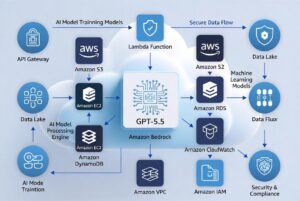
A production-grade GPT-5.5 implementation on Amazon Bedrock follows a distributed architecture that separates concerns across multiple layers: API gateway, request routing, application logic, caching, monitoring, and compliance. This layered approach ensures scalability, security, and operational visibility.
The recommended architecture includes:
- API Gateway (Amazon API Gateway): Enforces request throttling, authentication, and transforms payloads before routing to application servers
- Application Tier (ECS/Fargate or Lambda): Handles business logic, prompt engineering, output validation, and response formatting before calling Bedrock
- Bedrock API Layer: Manages model invocation, handles inference throughput, tracks token usage, and returns structured responses
- Caching Strategy (ElastiCache/DynamoDB): Reduces API calls by caching deterministic responses and context histories
- Observability Stack (CloudWatch, X-Ray, DataDog): Provides end-to-end tracing, performance metrics, and cost tracking per request
- Security Boundary (IAM, VPC endpoints, encryption): Isolates sensitive data and enforces least-privilege access
Synchronous vs. Asynchronous Request Patterns
The choice between synchronous and asynchronous patterns fundamentally shapes your architecture. Synchronous patterns (direct request-response) work well for real-time applications with <30 second latency requirements. However, GPT-5.5 inference often takes 5-15 seconds, making asynchronous patterns preferable for batch processing, report generation, and background enrichment tasks.
For synchronous scenarios, implement request/response streaming using Bedrock’s native streaming API to progressively return tokens as they’re generated, improving perceived latency. For asynchronous workflows, queue requests with SQS, process through Lambda workers, and store results in DynamoDB or S3 for retrieval.
Multi-Model Orchestration and Fallback Strategies
Production systems rarely depend on a single model. Implement model orchestration that routes requests based on complexity, cost thresholds, and latency requirements. Route simple classification tasks to faster models like Claude Instant, reserve GPT-5.5 for complex reasoning, and implement fallback chains that gracefully degrade when Bedrock capacity is constrained.
Build a routing layer that evaluates prompt complexity and routes accordingly. For example, queries matching simple templates (FAQ responses, status checks) skip Bedrock entirely and hit DynamoDB. Complex analytical requests go to GPT-5.5. If Bedrock reaches rate limits, fallback to cached similar responses or queue for later processing.
Section 3: Implementation and Deployment Workflow
Step-by-Step Bedrock Integration
Integrating GPT-5.5 into your application requires careful attention to SDK setup, credential management, error handling, and retry logic. The AWS SDK for Python (boto3) provides the simplest integration path, though Node.js, Go, and Java SDKs are equally supported.
Basic Python integration pattern:
Import boto3, initialize a Bedrock client with proper AWS credentials, construct your message with system prompts and user input, invoke the model with temperature/max_tokens parameters, parse the response, and implement exponential backoff retry logic for throttling. Always validate output before exposing to users, implement logging for all API calls including tokens consumed, and monitor latency metrics per request type.
Prompt Engineering for Production Quality
Prompt quality directly determines model output quality, token efficiency, and cost. Production prompts require systematic engineering rather than ad-hoc text. Implement prompt versioning in your codebase, test variations against your actual dataset, measure accuracy improvements quantitatively, and gradually roll out improvements.
Use system prompts to define model behavior, role, and constraints. Provide examples of expected input/output patterns (few-shot learning). Structure inputs clearly with delimiters and explicit instructions. Request structured output (JSON schemas) to simplify downstream parsing. Version your prompts alongside your code—treat prompt iterations as seriously as feature releases.
Handling Latency, Rate Limits, and Failures
Bedrock enforces rate limits based on account tier. Standard accounts start at 100 requests per minute. As inference latency ranges from 5-30 seconds depending on output length, you’ll quickly hit these limits under realistic load. Implement token bucket-based rate limiting client-side before hitting Bedrock, allowing burst traffic while staying within sustained limits.
Implement comprehensive error handling for:
- ThrottlingException: Implement exponential backoff with jitter; queue requests for deferred processing
- ValidationException: Indicates malformed requests; log prompt, model, and parameters for debugging
- ModelNotReadyException: Bedrock is updating model; implement graceful degradation
- Connection timeouts: Implement circuit breaker pattern with fallback responses
- AccessDeniedException: Verify IAM permissions immediately, don’t retry
Section 4: Real-World Use Cases and Applications
Enterprise Search and Knowledge Retrieval
Combine GPT-5.5 on Bedrock with vector databases (Amazon OpenSearch with vector search) to create semantic search systems that understand intent rather than keywords. Index your organization’s documents, policies, and knowledge bases as embeddings. When users search, retrieve relevant documents and use GPT-5.5 to synthesize comprehensive answers from multiple sources with proper citations.
This architecture reduces support ticket volume, improves onboarding for new employees, and ensures answers reflect your organization’s actual policies rather than generic information. Implement feedback loops where users rate answer quality, retraining retrieval rankings to emphasize documents that generated positive feedback.
Code Generation and Developer Productivity
GPT-5.5’s advanced reasoning makes it excellent for code generation, refactoring suggestions, and architecture planning. Integrate Bedrock with your CI/CD pipeline to automatically review pull requests, suggest optimizations, and flag potential security issues. Use Bedrock to generate boilerplate code from specifications, reducing manual effort for routine implementation work.
Implement guard rails that prevent deploying AI-generated code without human review. Create audit trails showing what suggestions were accepted/rejected. Measure productivity improvements by tracking time-to-merge, lines of code generated per developer per week, and reduction in security findings from code review.
Customer Support Automation with Quality Assurance
Deploy GPT-5.5 in a tiered support system where straightforward inquiries are resolved automatically, complex issues are escalated to human agents with AI-generated context, and all AI-generated responses are reviewed before going live. Store conversation histories in DynamoDB, implement context windows that carry forward conversation state, and track resolution rates by inquiry type to identify opportunities for improvement.
Use sentiment analysis to escalate frustrated customers immediately. Implement feedback loops where customers rate AI response quality, continuously improving prompts based on negative feedback. Route low-confidence responses (where model expresses uncertainty) to human specialists rather than making incorrect statements.
Section 5: Performance Optimization and Scaling
Token Optimization Strategies
Cost scales linearly with tokens. A 1000-token output costs approximately 5x more than a 200-token output. Optimize by requesting concise outputs, implementing output length limits in your prompts, stripping unnecessary context from input payloads, and caching responses where possible. Every 1000 tokens saved reduces costs by approximately $0.003 per request, which compounds significantly at scale.
Profile your actual token consumption by logging input/output tokens for all requests. Identify high-token categories and optimize those prompts first. For example, if document summarization consumes 50,000 tokens daily, optimizing that workflow to use 30,000 tokens saves ~$0.60/day or $219/year per unit of scale—trivial individually but significant across thousands of daily invocations.
Caching and Context Reuse
Implement intelligent caching at multiple layers. Cache deterministic responses (common questions, status checks) in ElastiCache with exact match or semantic similarity matching. For multi-turn conversations, store conversation context in DynamoDB rather than resubmitting full histories to Bedrock. AWS introduced Prompt Caching, which caches context for follow-up questions, reducing costs by 90% for repeated analysis of the same document.
Implement cache invalidation strategies based on time-to-live (TTL) and content freshness. For real-time data (stock prices, current events), bypass caching entirely. For slowly-changing data (company policies, product documentation), cache aggressively with weekly refreshes.
Batch Processing for Throughput
Bedrock excels at batch processing, where you queue thousands of requests and process them asynchronously. Use SQS for reliable queueing, Fargate for scalable workers, and store results in S3 for retrieval. Batch processing costs 20-30% less per token than real-time APIs due to reduced latency buffers. For overnight analytics or background enrichment, batch processing is dramatically more cost-effective than synchronous invocation.
Section 6: Security, Compliance, and Data Privacy
Data Privacy and Bedrock’s No-Retention Policy
By default, Bedrock does not retain, log, or use your prompts/responses for model training. This satisfies data privacy requirements for most regulated industries. Verify this applies to your account and document it in your security compliance framework. However, you remain responsible for sanitizing sensitive data before sending to Bedrock—implement redaction for PII (names, emails, account numbers) using Amazon Comprehend or pattern-based rules.
Implement request/response logging in CloudWatch with automatic encryption using AWS KMS. Store request IDs that match CloudWatch logs to DynamoDB along with user ID and timestamp, enabling audit trails. Implement automated data retention policies that delete logs after compliance-required periods (typically 1-3 years for regulated industries).
IAM Least Privilege and Access Control
Create granular IAM policies that restrict Bedrock API calls to specific models, regions, and principal IDs. Never use root credentials or overly broad policies. Implement resource-based policies and session tokens with limited validity (15 minutes for web applications, 1 hour for service-to-service). Separate production and development Bedrock access with distinct IAM roles and CloudTrail logging.
Rotate credentials quarterly. Use AWS Secrets Manager to manage API keys. Implement detection rules in EventBridge that alert on unusual API patterns (100+ requests per second, access from unexpected regions, failed authentication attempts) and automatically trigger incident response workflows.
Encryption and VPC Isolation
Use VPC endpoints to route Bedrock API calls through private networks rather than the internet. Encrypt data in transit with TLS 1.2+. Encrypt sensitive data at rest using AWS KMS with customer-managed keys. Implement network ACLs and security groups that restrict outbound traffic from application servers to only required AWS services and endpoints.
Section 7: Cost Optimization and Budget Management
Pricing Models and Cost Projections
Bedrock uses a simple per-token pricing model: you pay for input tokens processed and output tokens generated. GPT-5.5 pricing is approximately $0.003 per 1K input tokens and $0.012 per 1K output tokens (actual rates vary by region and model). A 500-token request generating 500-token response costs roughly $0.009. At 1,000 daily requests, this translates to ~$270/month or $3,240/year.
Build cost projection models by multiplying expected daily request volume by average token consumption (tracked via CloudWatch metrics) by per-token rates. Include 20% overhead for peak loads and emerging features. Set CloudWatch alarms that trigger when monthly costs exceed 110% of baseline, enabling rapid cost investigation and optimization.
Cost Allocation and Chargeback Models
For organizations with multiple teams accessing Bedrock, implement cost allocation by tagging requests with project/team identifiers and using Cost Allocation Tags in AWS Billing. Build dashboards showing costs per team per day. Implement charge-back models that incentivize optimization—teams pay for their actual usage, creating natural pressure to reduce token consumption.
This drives behavioral change: teams become motivated to optimize prompts, implement caching, and batch process non-urgent requests. Teams using Bedrock heavily invest in token optimization, while teams with occasional needs shift toward on-demand models rather than prepaid commitments.
Cost Reduction Opportunities
- Use Claude Instant for simple tasks (50% cost reduction vs GPT-5.5)
- Implement prompt caching for repeated document analysis (up to 90% savings)
- Batch process non-urgent requests during off-peak hours (20-30% cost reduction)
- Cache common responses in ElastiCache/DynamoDB (avoid Bedrock calls entirely)
- Implement request filtering: reject obviously malformed/invalid requests before invoking Bedrock
- Negotiate volume pricing with AWS for predictable, high-volume workloads (10M+ monthly tokens)
Section 8: Best Practices from Cloud Architects
Production-Grade Monitoring and Observability
Implement comprehensive monitoring across request lifecycle: API gateway latency, application processing time, Bedrock invocation time, output validation time, and cache hit rates. Use CloudWatch for metrics, X-Ray for distributed tracing, and DataDog or New Relic for cross-system observability. Create dashboards showing latency percentiles (p50, p95, p99) separately—an average latency of 8 seconds hides cases where 1% of requests take 45 seconds.
Instrument code to capture tokens consumed, model used, user ID, request type, and outcome (success/failure/timeout). Build attribution models showing which features consume most tokens. Set up alerts that fire when error rates exceed 1% or latency p95 exceeds SLA targets. Maintain runbooks for common failure modes.
Testing and Quality Assurance
AI systems require different testing approaches than traditional software. Implement prompt testing suites with expected outputs and quality metrics. Test against adversarial prompts (injection attacks, requests for harmful content). Create synthetic datasets matching your actual use cases and measure accuracy, hallucination rate, and output format compliance. Implement A/B testing where 5% of traffic receives a new prompt variation, measuring quality improvements before full rollout.
Establish quality gates: AI-generated content only goes live after automated validation (format correctness, PII detection, toxicity scoring). Critical applications require human review of AI responses before user exposure. Track quality metrics continuously—if accuracy drops below thresholds, automatically rollback to previous prompt versions or degrade gracefully.
Incident Response and Resilience
Define Bedrock-specific incidents: model timeout (Bedrock slow/throttled), content policy violations (Bedrock rejects requests), hallucinations affecting users, and cost spikes. Create runbooks for each: timeout incidents trigger circuit breakers and fallback responses; policy violations log details for prompt refinement; hallucinations trigger manual review and roll-back. Implement chaos engineering that simulates Bedrock unavailability, ensuring your fallback logic actually works.
Section 9: Integration with AWS Ecosystem
Bedrock + Amazon OpenSearch for Semantic Search
OpenSearch vector search enables semantic retrieval: convert documents to embeddings, store in OpenSearch, and search by semantic similarity rather than keyword matching. Combine with Bedrock to generate comprehensive answers from retrieved documents. This architecture powers enterprise search, documentation systems, and customer support automation.
Implement feedback loops: when users rate answer quality, update retrieval rankings to prefer documents associated with positive feedback. Monitor retrieval precision—if users consistently find answers unsatisfactory, adjust embedding model, retrieval parameters, or document chunking strategy.
Bedrock + Lambda for Serverless AI Applications
Lambda handles brief, bursty workloads perfectly. For synchronous use cases (chatbots, real-time analysis), invoke Bedrock directly from Lambda. Cold start latency (1-2 seconds) is acceptable for most applications. For long-running workloads, use Step Functions to orchestrate Lambda execution, storing intermediate results in DynamoDB and avoiding Lambda timeout issues.
Reserve sufficient Lambda memory (2048MB+) to minimize cold start time. Use Lambda Provisioned Concurrency for always-on services. Implement Lambda@Edge for content delivery near users, reducing request latency.
Bedrock + S3 + Lambda for Batch Document Processing
Upload documents to S3, trigger Lambda on S3 Put events, process documents through Bedrock (summarization, entity extraction, classification), and store results in DynamoDB or back to S3. This architecture scales to millions of documents. Use S3 batch operations to process historical document backlog. Implement object tagging to track processing status (pending, processing, completed, failed) and retry failed documents.
Section 10: Comparative Analysis and Alternative Approaches
Bedrock vs. OpenAI API vs. Self-Hosted Models
Each approach has distinct trade-offs. OpenAI API offers simplicity but lacks VPC integration and carries vendor lock-in. Self-hosted models require infrastructure management but enable full customization. Bedrock provides managed infrastructure with AWS integration, making it ideal for enterprises already in AWS.
For teams prioritizing speed-to-market and minimal infrastructure overhead, Bedrock wins. For teams with specialized privacy/performance requirements or existing ML infrastructure, self-hosted or alternative cloud providers might be preferable. For teams requiring cutting-edge models with minimal integration, OpenAI API is appropriate despite higher costs and vendor constraints.
| Factor | Bedrock | OpenAI API | Self-Hosted |
| Cost/1K tokens | $0.003-0.012 | $0.005-0.015 | $100-500/month per GPU |
| VPC Integration | ✓ VPC endpoints | ✗ Internet only | ✓ Full control |
| Scaling | Automatic to millions/min | Automatic to millions/min | Requires cluster management |
Conclusion: From Evaluation to Production Excellence
GPT-5.5 on Amazon Bedrock represents a fundamental shift in how enterprises deploy frontier AI. The combination of cutting-edge capabilities and managed infrastructure removes traditional barriers to AI adoption. However, success requires more than API calls—it demands architectural thinking, security discipline, cost consciousness, and systematic optimization.
Start with clear use case definition: identify problems your organization faces that AI can solve. Implement proof-of-concept projects before enterprise-wide deployment, measuring accuracy, cost, and user satisfaction. Build observability from day one—understand what your system does, why it fails, and where costs accumulate.
Invest in prompt engineering and output validation. Treat AI systems as fundamentally different from traditional software—they require different testing strategies, quality metrics, and failure modes. Implement feedback loops that continuously improve performance.
Prioritize security and compliance from inception. Bedrock’s architecture enables secure deployment, but you must implement proper access controls, data sanitization, audit logging, and encryption. Organizations that integrate AI security into architectural decisions maintain compliance while innovating rapidly.
As your deployment scales, invest in cost optimization—the highest-impact improvements come from architectural changes (caching, batch processing, model selection) rather than parameter tuning. Organizations that optimize token consumption reduce per-request costs by 50-80%.
The organizations that will win with AI are those that combine technological capability with operational discipline. GPT-5.5 on Amazon Bedrock provides the technological foundation. This guide provides the operational framework. Together, they enable enterprises to deploy frontier AI systems that deliver measurable business value while maintaining security, compliance, and cost efficiency.