

One of the most common mistakes founders make when learning how to find investors for startups is approaching the wrong investor at the wrong stage. An early-stage angel receiving a Series A pitch deck, or a growth-stage fund reviewing a pre-revenue startup, is unlikely to invest. These mismatches don’t just lead to rejection — they waste valuable time and energy that can significantly slow down a fundraising process
Match your stage to your target before you send a single email :
| Stage | Typical Raise | Proof Required | Right Investor Type |
| Pre-seed | $250K–$2M | Founding team + concept or MVP | Friends/family, angels, micro-VCs, accelerators |
| Seed | $1M–$5M (median $3.8M in Q3 2025) | MVP + early traction or LOIs | Seed VCs, angel groups, syndicates |
| Seris A | $5M–$30M | $1M+ ARR, repeatable GTM, unit economics | Institutional VCs (lead + follow-on) |
Median SAFE valuation caps at pre-seed reached $10M–$15M in 2025 (Carta). The median seed round was $3.8M in Q3 2025 (PitchBook). Build your fundraising story around where you actually are — not where you plan to be.
How to Find Investors: 8 Options for Startup Funding :
1. Friends and Family :
Friendsand family funding is the original pre-seed round — and still one of the most accessible. Unlike institutional investors, friends and family rarely require board seats, formal diligence, or market benchmarks. They fund the founder.
How to structure it properly:
- Always use a written agreement — even with your parents
- Define the instrument: loan (with explicit interest rate + repayment terms) or equity (SAFE note is the cleanest vehicle)
- Be radically transparent about risk — make it clear this is a high-risk asset, not a favor returned
- eep the cap table implications in mind: SAFE notes convert at future rounds and affect dilution
The relationship risk is real. Mixing money and relationships without documentation destroys both. Never accept informal cash handshakes.
2. Equity Financing :
Equity financing — raising capital in exchange for an ownership stake — is the foundational model for most startup funding beyond friends and family. It encompasses angels, VCs, and equity crowdfunding. The key trade-off is dilution: every equity round reduces your ownership percentage. Model your cap table before every raise.
3. Venture Capitalists :
VCs manage institutional funds and deploy capital in exchange for equity, usually in rounds of $1M+ at seed and $5M+ at Series A and beyond. They bring portfolio network effects, brand credibility, and — at the best firms — operational support and warm intros to future investors.
The critical filter: VCs have fund-level return requirements (targeting 3–10× fund returns). They invest in companies that could plausibly reach $100M+ in revenue. If your business is local, lifestyle-oriented, or not designed for venture-scale growth, VC funding is the wrong tool — and you’ll waste months learning that the hard way.
4. Angel Investors :
Angels are high-net-worth individuals investing their own capital in early-stage startups — typically at pre-seed or seed. Unlike VCs, they move faster, require less formal diligence, and are often motivated by more than financial return: they want to contribute to a community that supported them.
Professional angels make 3–4 investments per year, with typical check sizes of $10K–$100K. Angel groups and syndicates pool capital through an SPV (Special Purpose Vehicle) for coordinated investments of $100K–$500K+. The Angel Capital Association maintains a directory of accredited angel groups across the U.S.
5. Incubators :
Incubators are programs — private or nonprofit — that support the very earliest stage of company formation: idea validation, team-building, initial product development, and network access. Most incubators do not provide direct funding; they provide resources, mentorship, and introductions. Think of them as the scaffolding around a raw idea.
Best for: Founders in the 0-to-1 stage who need structured support before they’re fundraise-ready.
6. Accelerator Programs :
Accelerators are fixed-term (typically 3–6 months), intensive programs designed to compress years of growth into one sprint. Unlike incubators, they work with companies that already have a product and early traction — and they provide direct capital investment in exchange for equity.
Y Combinator — the most competitive and prestigious accelerator globally — culminates in Demo Day, where the latest batch of companies pitch to a curated audience of top investors and press. YC’s network is one of the strongest warm-intro pipelines in the startup ecosystem.
The trade-off: Accelerators take equity (YC typically takes ~7% for its standard deal). The network, brand credibility, and investor access they provide almost always justify the dilution for early-stage founders who get in.
7. Crowdfunding Platforms :
Crowdfunding provides capital from a large pool of small contributors — either in exchange for early product access (rewards crowdfunding via Kickstarter or Indiegogo) or equity (via Regulation CF platforms like Wefunder or Republic). It’s simultaneously a fundraising mechanism, a marketing channel, and a market validation engine.
8. Traditional Business Loans :
Debt financing via SBA loans, bank term loans, or fintech lenders doesn’t require equity. It’s repaid with interest. It works best for capital-efficient startups with predictable revenue or tangible assets. It does not work for pre-revenue companies with no collateral or credit history.
Where to Find Startup Investors (Channels + Tools)
Warm Intros + Founder Networks :
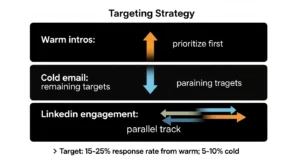
A warm introduction from a trusted mutual contact converts 5–10× better than cold outreach. The founder network is your highest-leverage sourcing channel.
How to generate warm intros systematically:
- List your 20 closest professional connections — advisors, former colleagues, other founders, attorneys, accountants
- For each one: “Who in your network has invested in [your category] at [your stage]?” — be specific
- Use LinkedIn to map 2nd-degree connections to target investors; ask for a “double opt-in” intro (where the introducer checks with the investor first before sending)
- Join founder communities — Indie Hackers, On Deck, local startup communities, alumni networks — where peer referrals happen organically
- Build relationships with startup-focused attorneys and accountants who sit at the intersection of dozens of investor relationships
Tools:
- AngelList — the primary directory for angels, syndicates, and early-stage VC funds
- Crunchbase / PitchBook — research investor portfolios, check sizes, and sector thesis
- LinkedIn Sales Navigator — map 2nd-degree investor connections at target firms
- Intro platforms — Lunchclub, Intro.co, Flowlie for structured warm introductions
Online Platforms + LinkedIn Strategy :
The right way to use LinkedIn for investor outreach:
- Engage before you ask. Comment thoughtfully on investors’ posts for 2–4 weeks before you ever send a message. Make yourself a recognizable name on their feed.
- Connection request message: One sentence max — who you are, why you’re reaching out, no pitch yet
- First DM: One paragraph. Problem you solve, traction proof point, specific reason you’re reaching out to them. End with a single yes/no question: “Would a 20-minute call make sense?”
- Never attach your deck in cold outreach. Decks in cold messages signal inexperience. Get the reply first, send materials on request.
Demo Days, Meetups, and Conferences :
Conferences are inefficient at scale but unbeatable for serendipitous relationship formation. The founder who meets a VC at a panel and follows up the next day with a specific, personalized note gets the meeting. The founder who submits a cold application gets the auto-response.
Highest-ROI events for investor meeting:
- YC Demo Day (for YC alums and observers) — the densest single-day concentration of investor capital in the world
- Venture Atlanta — premier annual startup conference in the Southeast; 100+ investors attend
- SaaStr Annual / Web Summit / TechCrunch Disrupt — strong for sector-specific VC meetings
- Angel Investment Summit (SVB) — curated angel-focused networking
- Local startup meetups (Eventbrite, Meetup.com) — surprisingly high conversion for early-stage because the competition is lower and relationships form faster
At every event: Bring business cards. Have your 30-second pitch cold. Follow up within 24 hours with a personalized, specific reference to your conversation. Never pitch at a cocktail party — get permission first.
How to Find the Right Angel Investor for Your Startup :
What an Angel Investor Is :
An angel investor is typically a high-net-worth individual who provides personal capital to early-stage startups in exchange for an ownership stake — usually equity or a SAFE note. They must meet the SEC’s definition of an accredited investor: earning $200K+ annually or holding a net worth above $1M excluding their primary residence.
Types of Angels (Generalists vs Specialists)
Generalist angels invest across a wide variety of industries. They are typically former founders who’ve had successful exits and are reinvesting in the ecosystem. Their primary value-add is navigating the startup landscape and sharing hard-won pattern recognition across company-building pitfalls.
Specialist angels have deep subsector expertise — a former aerospace executive investing in space tech, or a healthcare operator investing in digital health. Their value-add is domain-specific: opening doors to industry contacts, validating technical approaches, and providing introductions to key enterprise buyers or strategic partners.
The ideal early-stage angel syndicate includes both types: generalists for company-building wisdom, specialists for industry credibility and domain-specific intros.
What to Look For (Track Record, Value-Add, Check Size, Involvement)
Not all investor capital is equal. Before you close an investor, evaluate:
- Track record: How many investments have they made? Any notable exits? A portfolio with 10+ investments signals that they understand the risks and won’t panic at the first negative quarter.
- Check size fit: An investor whose typical check is $5K writing $50K into your round is likely overextended. An investor whose typical check is $500K writing $25K is a weak signal. Find investors whose natural check size matches your ask.
- Involvement level: Do you want an active advisor or a passive check-writer? Get explicit clarity. Mismatched expectations on involvement are a leading cause of founder-investor conflict.
- Value-add specificity: “I can help with introductions” is vague. “I have direct relationships with the VP of Engineering at three of your target enterprise customers” is specific and verifiable.
Due Diligence on Investors (Research, References, Accreditation)
Founders do diligence on investors — this is standard practice, not presumptuous.
The three-step investor diligence process:
- Research: Review their public investment history on Crunchbase or AngelList. What’s their portfolio? Any known failures or founder complaints in public forums?
- References: Ask to speak with 2–3 founders from their portfolio. Specifically ask: “How were they when things got hard? Did they add value beyond writing the check? Did they always return your calls?”
- Accreditation verification: Confirm they meet the SEC’s accredited investor standard. This is not just a formality — selling securities to non-accredited investors creates legal exposure.
Investor Types Comparison Table :
| Investor Type | Typical Check Size | Stage | What They Care About | Key Trade-offs |
| Friends & Family | $5K–$50K | Pre-idea to pre-seed | Trust in the founder | Relationship risk; informal terms |
| Angel (individual) | $10K–$100K | Pre-seed to seed | Team + market + early signal | Variable value-add; slower at scale |
| Angel group / SPV | $100K–$500K | Seed | Diligence, sector fit | Collective decision-making = slower |
| Micro-VC / Pre-seed fund | $100K–$500K | Pre-seed to seed | Thesis fit, founder quality | More process than angels |
| Seed VC | $500K–$3M | Seed | Traction, GTM clarity | Equity + board seat; higher bar |
| Series A VC | $5M–$30M | Series A+ | Revenue, unit economics, market | Significant dilution; formal governance |
| Strategic investor | Varies | Any | Market access, partnership value | May slow future M&A options |
| Crowdfunding (Reg CF) | $10–$50K avg | Pre-seed to seed | Story, community, product | Cap table complexity; compliance burden |
Outreach That Gets Replies :
Cold Email Framework (Subject Lines + Structure)
Cold email to investors has a notoriously low baseline response rate — but a well-crafted, personalized email to the right investor at the right stage can achieve 10–15% response rates.
Subject line formula (under 50 characters):
- [Stage] [Sector] startup | $X ARR, growing Y%
- Ref: [Mutual contact name] (if you have a reference)
- Pre-seed AI infra | 3x MoM growth
Body structure (4 sentences maximum):
Sentence 1 — Hook: “[Mutual name] suggested I reach out — we’re building [one-line description] and just hit [specific traction metric].”
Sentence 2 — Why you: “I noticed you led [specific investment in their portfolio] — [specific reason that deal is relevant to yours].”
Sentence 3 — The ask: “I’d love 20 minutes to share what we’re seeing in the market and hear your perspective on [specific question relevant to their thesis].”
Sentence 4 — Call to action: “Would a brief call in the next week or two work?”
Do not attach a deck to a cold email. Do not include your full company bio. Do not open with “I hope this email finds you well.”
Outreach Personalization Checklist :
| Element | What Good Looks Like | Common Mistake |
| Signal | Reference a specific investment, post, or thesis point | “I found you on LinkedIn” |
| Proof | One concrete traction metric ($ARR, growth rate, user count) | Generic “we’re building a great team” |
| Stage/sector fit | Explicitly matches their stated investment focus | Pitching a growth fund pre-revenue |
| Ask | One clear question or yes/no request | “I’d love to share more” (too vague) |
| Attachment | None in cold email — send on request only | Attaching a full 18-slide deck |
| Follow-up cadence | One follow-up 5–7 business days later; max 2 total | Daily follow-ups or none at all |
| Subject line | Under 50 chars; contains stage + traction signal | “Exciting opportunity for you” |
Investor Meeting Process (What Happens After “Yes”)
The investor meeting sequence is predictable. Know the stages before you enter them.
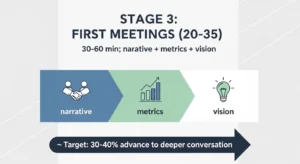
Step 1: First Meeting (30–60 minutes)
The goal is not to close — it’s to create enough conviction for a second meeting. Investors are asking: Who are you? What problem do you solve? Why you, why now, why this market? Come with a concise narrative, not a feature tour. Know your top 3 metrics cold.
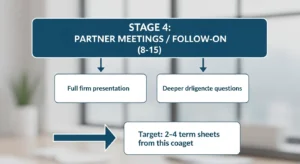
Step 2: Partner Meeting (60–90 minutes)
For VC firms: if the partner you met is interested, they’ll bring you in front of the full investment committee. This is where your pitch needs to withstand adversarial questioning from multiple partners simultaneously. Prepare to defend your market size, unit economics, competitive moat, and hiring plan.
Step 3: Term Sheet
A non-binding document outlining key economic and governance terms: valuation, investment amount, board composition, liquidation preference, anti-dilution provisions. See our pitch deck guide for how to position your story before this stage. For a deep dive on term sheet mechanics .
Step 4: Due Diligence (2–8 weeks)
Angels conduct lighter diligence (1–4 weeks). Institutional VCs conduct deeper diligence (4–8 weeks): reference checks on founders, customer calls, technical audits, financial model reviews, legal document review. Have your data room organized before you receive a term sheet — not after.
Step 5: Close
Definitive documents, signatures, and wire. For Reg CF equity raises, final compliance filings. For SAFE notes, a simple two-page document. Build a 30-day closing timeline into your plan. Closings always take longer than expected.
How GoCloud Supports Investor Outreach and Startup Operations :
Managing multiple investor conversations, tracking documents, and maintaining secure data for due diligence requires reliable cloud infrastructure. GoCloud provides startups with scalable, secure, and high-performance cloud solutions, enabling founders to:
- Track investor interactions across outreach channels
- Store pitch decks, term sheets, and financials securely
- Scale analytics dashboards for traction metrics
- Maintain uptime during live investor meetings or Demo Days
By offloading technical overhead, GoCloud allows founders to focus on fundraising strategy rather than operational bottlenecks.
Steps to Maximize Investor Networking (Checklist)
- ☐ Attend 2–3 targeted industry events per quarter where your investor personas actually appear — not generic tech events
- ☐ Update your LinkedIn before any outreach sprint — a bare or generic profile undermines warm contacts you’ve generated
- ☐ Build and maintain a CRM of every investor conversation: date, stage, sentiment, next step — Notion or Airtable works
- ☐ Join one founder peer group (local or online) where deal flow and investor intros are shared organically
- ☐ Prepare a 2-minute verbal pitch you can deliver without a deck at any moment — elevators, coffee lines, conference hallways
- ☐ Send 5+ warm intro requests per week during active fundraising sprints — volume matters because most conversations won’t convert
- ☐ Follow up within 24 hours after every meeting with a specific, personalized note referencing one moment from the conversation
- ☐ Ask for referrals explicitly — even when an investor passes, ask: “Is there anyone else you think we should be talking to?”
- ☐ Build VC relationships 6+ months before you need them — relationships formed under capital pressure close at lower rates and worse terms
Visual Reference: Investor Sourcing Funnel
STAGE 1: LIST (100–150 targets)
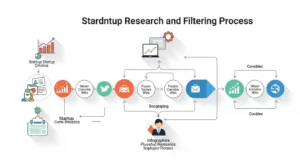
STAGE 2: OUTREACH (60–80 contacts)
STAGE 3: FIRST MEETINGS (20–35)
STAGE 4: PARTNER MEETINGS / FOLLOW-ON (8–15)
STAGE 5: TERM SHEET → CLOSE (1–3)

FAQs :
Q1: How do I find investors for my startup with no connections?
Start with your existing network — professors, former colleagues, local business owners — and ask for introductions. Join accelerators and incubators that provide structured investor access. Attend startup events. Build on LinkedIn over 4–6 weeks before outreach. Cold email works — but at lower conversion rates. Your first investor will be the hardest; each subsequent one gets easier because you have a reference.
Q2: What is the difference between angel investors and venture capitalists?
Angels invest personal capital, typically $10K–$100K per deal, at pre-seed and seed stages. They move faster and accept more risk. VCs manage institutional funds and write larger checks ($500K to $30M+), with more formal processes, board governance, and return expectations.
Q3: How do I approach investors cold?
Use a 4-sentence email: hook with traction, show you’ve done research on their portfolio, make a single specific ask (20-min call), and end with a yes/no question. Subject line under 50 characters with stage + traction signal. No deck in the first email. Follow up once, 5–7 days later.
Q4: What is an accredited investor and why does it matter?
An accredited investor, per the SEC, earns $200K+ annually or has a net worth exceeding $1M excluding their primary residence. Most private placements — including SAFE notes and seed equity — can only legally be sold to accredited investors. Always verify before accepting a check.
Q5: Is Y Combinator worth applying to?
For most early-stage founders, yes. YC provides structured pre-seed capital, world-class cohort peer learning, and — most importantly — a permanent warm-intro credential for future investors. The equity cost (~7%) is justified by the network access for most teams who get in. Applications for Spring 2026 are open.
Conclusion :
Finding investors is essentially a sales process. Successful founders treat it with discipline by building a targeted list of investors, conducting consistent outreach, and refining their pitch based on feedback. In a 30-day sprint, start by researching 50–100 relevant investors and preparing your pitch deck, then send warm introductions and targeted cold emails while attending startup events. As meetings begin, follow up regularly, adjust your messaging, and ask every investor for referrals to expand your network. With organized outreach and reliable tools like GoCloud supporting your startup’s digital infrastructure and operations, founders can build a strong pipeline of investor conversations that create momentum for future funding rounds.