

How to Get Grants for Startup Getting grants for a startup is one of the most overlooked funding strategies in the entrepreneurial ecosystem. While most founders focus on venture capital, angel investors, or bootstrapping, grants offer something uniquely valuable: capital that does not require you to give up equity, take on debt, or answer to investors. Grant funding is non-dilutive, meaning you keep one hundred percent ownership of your company while accessing capital to build, hire, and grow.
The challenge is that the grant landscape is complex, competitive, and often poorly understood. Founders who have never applied for grants assume the process is too bureaucratic, too slow, or only available to nonprofits and academic researchers. None of these assumptions are correct. Technology startups, hardware companies, biotech ventures, clean energy businesses, and social impact enterprises all have access to grant programs specifically designed for them.
This guide breaks down how to get grants for your startup step by step. We cover the major categories of grants available, how to identify the right programs for your business, how to write a winning application, and how to manage grant funding once you receive it. Whether you are a first-time founder or an experienced entrepreneur exploring non-dilutive funding for the first time, this playbook will give you a practical, actionable strategy.
Understanding the Startup Grant Landscape in 2026
Federal Government Grants :
The United States federal government is the largest source of startup grant funding in the world. The two most important programs for technology startups are the Small Business Innovation Research program, commonly known as SBIR, and the Small Business Technology Transfer program, known as STTR. Together, these programs distribute over four billion dollars annually to small businesses developing innovative technologies.
SBIR and STTR grants are structured in three phases. Phase I grants typically range from fifty thousand to two hundred seventy-five thousand dollars and fund feasibility research over six to twelve months. Phase II grants range from five hundred thousand to one and a half million dollars and fund full development over up to two years. Phase III is the commercialization phase, which does not receive direct grant funding but positions companies for government contracts and private investment.
Eleven federal agencies participate in the SBIR program, including the Department of Defense, the National Institutes of Health, the National Science Foundation, the Department of Energy, and NASA. Each agency has its own focus areas, application timelines, and evaluation criteria, but the core structure is consistent across all of them.
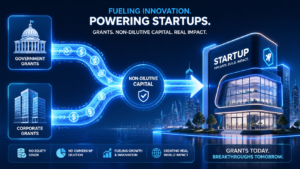
State and Local Government Grants :
Every state in the US operates economic development programs that include grant funding for startups. These programs vary significantly in size and focus. Some states offer matching grants that supplement federal SBIR awards. Others provide direct grants for companies in priority sectors like clean energy, advanced manufacturing, agriculture technology, or cybersecurity.
State grants are often less competitive than federal programs because fewer founders know about them. They also tend to have simpler application processes and faster award timelines. The trade-off is that award amounts are typically smaller, ranging from ten thousand to two hundred thousand dollars, and they may come with geographic requirements like maintaining your headquarters or operations in the state.
Municipal and county-level programs add another layer of opportunity. Many cities run startup grant programs, particularly for businesses that create local jobs, serve underserved communities, or operate in designated innovation districts. These grants are typically smaller, from five thousand to fifty thousand dollars, but they are less competitive and can be valuable for early-stage companies.
Private Foundation and Corporate Grants :
Private foundations, corporate accelerators, and industry organizations operate grant programs that are often overlooked by startup founders. These include programs like the Google for Startups Cloud Program which provides cloud credits, the Stripe Atlas program for incorporation support, the AWS Activate program for cloud infrastructure credits, and foundation grants from organizations like the Kauffman Foundation and the Knight Foundation.
Corporate grants often come with additional benefits beyond funding. They may include mentorship, technical support, access to enterprise customers, and introductions to investors. The application process is typically less formal than government grants, but the programs are often more selective and may require alignment with the sponsoring organization’s strategic priorities.
International Grant Programs :
Founders outside the United States have access to significant grant programs in their own countries and regions. The European Union’s Horizon Europe program distributes billions of euros annually for innovation projects. The UK’s Innovate UK provides grants and loans for technology companies. Canada’s Industrial Research Assistance Program offers funding and advisory services for technology SMEs. And many countries in Asia, the Middle East, and Africa operate startup grant programs as part of their economic diversification strategies.
International grants may have different structures, such as requiring co-funding, restricting the use of funds to specific cost categories, or mandating collaboration with research institutions. Understanding these requirements before applying saves significant time and prevents disqualification.
How to Identify the Right Grant Programs for Your Startup :
Mapping Your Startup to Grant Categories :
Not every grant is right for every startup. The first step is to understand which categories of grants align with your business. Consider four dimensions: your technology domain, which determines which federal agencies and programs are relevant. Your company stage, because some grants are restricted to pre-revenue companies while others require existing customers or revenue. Your geographic location, which determines eligibility for state and local programs. And your social impact, because many grants prioritize businesses led by underrepresented founders, businesses in underserved communities, or companies addressing social and environmental challenges.
Create a matrix that maps these four dimensions to specific grant programs. This exercise will narrow the field from hundreds of potential programs to a manageable list of ten to twenty that are worth pursuing. Prioritize programs where your startup has a strong natural fit rather than stretching to meet eligibility criteria that do not align with your actual business.
Research Tools and Databases :
Several databases and tools can help you identify relevant grant programs. Grants.gov is the central repository for all federal grant opportunities. SBIR.gov provides a searchable database of all SBIR and STTR solicitations across federal agencies. GrantWatch and Foundation Directory Online cover private foundation grants. State economic development agency websites list state-level programs, and startup ecosystem organizations like your local startup community, chamber of commerce, or Small Business Development Center can provide personalized guidance.
Set up alerts on Grants.gov and SBIR.gov for keywords related to your technology domain. Grant solicitations are published on predictable schedules, and knowing the timeline for your target programs allows you to prepare applications months in advance rather than rushing to meet a deadline you discovered at the last minute.
Evaluating Grant Program Fit and ROI :
Before investing time in a grant application, evaluate whether the program offers a reasonable return on your time investment. Consider the award amount relative to the application effort. A fifty thousand dollar grant that requires a twenty-page technical proposal and two months of preparation may not be worth it for a company that could generate the same revenue from customer sales in the same time period. A five hundred thousand dollar SBIR Phase II grant that requires a similar effort is almost certainly worth pursuing.
Evaluate the success rate of each program. SBIR Phase I awards have success rates between fifteen and twenty-five percent depending on the agency, which is significantly better than the three to five percent acceptance rate for venture capital pitches. State and local programs often have even higher success rates because they receive fewer applications.
How to Write a Grant Application That Gets Funded
Understanding What Reviewers Look For :
Grant applications are evaluated by review panels that score proposals against published criteria. Unlike venture capital pitches where chemistry and narrative matter as much as substance, grant reviews are systematic and criteria-driven. This works in your favor because it means you can optimize your application for exactly what the reviewers are looking for.
Most grant programs evaluate proposals on four dimensions: the significance and innovation of the proposed work, the technical approach and feasibility of the plan, the qualifications of the team, and the potential for commercial impact or societal benefit. Each dimension receives a separate score, and the total determines your ranking against competing proposals.
Crafting a Compelling Technical Narrative :
Your technical narrative should tell a clear story: here is the problem, here is why existing solutions are inadequate, here is our innovative approach, and here is why we are uniquely qualified to execute it. Avoid jargon that might confuse non-specialist reviewers. Write for an intelligent reader who may not have deep expertise in your specific technical domain.
Be specific about your innovation. Vague claims like leveraging artificial intelligence or next-generation platform do not score well. Instead, describe exactly what your technology does differently, why that difference matters, and what evidence you have that your approach will work. Preliminary data, prototype results, customer validation, and letters of support from potential users all strengthen your technical narrative.
Quantify everything you can. Instead of saying your solution is faster, say your solution reduces processing time by sixty percent based on preliminary testing with ten beta customers. Instead of saying there is a large market opportunity, say the addressable market for your solution is two point three billion dollars based on the following analysis. Specific numbers demonstrate rigor and build reviewer confidence.
Budget Preparation and Justification :
Your budget must be detailed, justified, and aligned with your proposed work plan. Every line item should map directly to a specific activity in your technical plan. Reviewers will scrutinize budgets for reasonableness, and budgets that appear inflated or disconnected from the proposed work will hurt your score.
Common budget categories include personnel costs, which typically comprise fifty to seventy percent of a grant budget. Equipment and supplies, which should be justified by specific project needs. Subcontractor costs for specialized work you cannot perform in-house. Travel costs for conferences, customer meetings, or fieldwork. And indirect costs, which cover overhead like rent, utilities, and administrative support at a negotiated or de minimis rate.
A common mistake is under-budgeting to appear cost-efficient. Reviewers know what things cost, and a budget that underestimates personnel time or omits essential expenses signals that you have not thought through the project carefully. Request what you actually need and justify every dollar.
Managing Grant Funding After You Receive an Award
Compliance and Reporting Requirements :
Receiving a grant is just the beginning. Grant awards come with compliance obligations that you must understand and follow meticulously. These typically include quarterly or semi-annual progress reports, financial reports that account for every dollar spent, restrictions on how funds can be used, requirements to maintain records for three to seven years after the grant period ends, and audit provisions that allow the granting agency to review your books.
Set up a dedicated accounting system or separate account for grant funds from day one. Commingling grant funds with operating revenue makes compliance tracking exponentially harder and can result in disallowance of expenses, repayment requirements, or disqualification from future grants. If you are managing multiple grants simultaneously, track each one separately with clear documentation of which expenses are charged to which grant.
Intellectual Property Considerations :
For federal grants like SBIR and STTR, you generally retain ownership of intellectual property developed with grant funding. However, the government receives certain rights, including a royalty-free license to use the technology for government purposes and march-in rights that allow the government to require licensing if you fail to commercialize the technology within a reasonable timeframe.
These IP provisions are standard and should not discourage you from applying. They are far more favorable than the terms typical of venture capital investments, where investors may negotiate co-ownership or broad licensing rights as a condition of funding. Understand the IP terms of each grant program and consult with an IP attorney if you have specific concerns about how they interact with your existing patents or trade secrets.
Using Grants Strategically to Leverage Additional Funding :
Grants are most powerful when used as a launchpad for additional funding. A federal SBIR award signals to investors, customers, and partners that your technology has been vetted and validated by expert reviewers. Many venture capitalists view SBIR awards favorably because they demonstrate technical feasibility and reduce their investment risk.
Use your grant-funded milestones to build a track record that strengthens future applications and fundraising efforts. A Phase I award that successfully demonstrates feasibility positions you for a Phase II award at three to five times the funding level. A Phase II award that produces a working prototype positions you for Phase III contracts and private investment on favorable terms.
Grant Type Comparison for Startup Founders :
| Grant Type | Amount | Timeline | Competition | Equity | Best For |
| SBIR Phase I | $50K-$275K | 6-12 months | Moderate | 0% | Deep tech |
| SBIR Phase II | $500K-$1.5M | 12-24 months | Moderate | 0% | R&D stage |
| State Grants | $10K-$200K | 3-12 months | Low-Med | 0% | Local startups |
| Corporate | $10K-$100K+ | 1-6 months | Varies | 0% | Tech startups |
| Foundation | $5K-$250K | 3-12 months | Moderate | 0% | Social impact |
A Realistic Timeline for Getting Your First Startup Grant
Months 1-2: Research and Preparation
Use the first two months to identify target grant programs, understand their requirements and timelines, and begin gathering the materials you will need for applications. Register on Grants.gov and SAM.gov, which is required for all federal grants. Obtain a DUNS number and Unique Entity Identifier if you do not already have them. These registrations can take two to four weeks to process, so start early to avoid missing application deadlines because of administrative delays.
During this preparation phase, connect with your local Small Business Development Center. These federally funded centers provide free grant writing assistance and can review your application before submission. Many SBDC advisors have extensive experience with SBIR applications and can share insights about what specific agencies look for in winning proposals. This resource alone can significantly improve your success rate on your first application.

Months 2-4: Application Development
Write your first grant application. Budget at least forty to sixty hours of focused work for a competitive SBIR application. This includes drafting the technical narrative, preparing the budget, gathering supporting materials like letters of support and team biosketches, and revising the application based on feedback from mentors, advisors, or grant writing consultants. Do not underestimate the time required for formatting, compliance checks, and final review before submission.
Have at least two people review your application before submission. Ideally, one should be a domain expert who can evaluate your technical approach and confirm that your innovation claims are defensible, and one should be a generalist who can assess clarity and readability. Fresh eyes will catch issues you have become blind to after working on the application for weeks. Many winning applicants go through three or more revision cycles before submitting.
Months 4-8: Review and Decision
After submission, review periods vary by program. SBIR applications typically take three to six months for review and award decisions. State programs may be faster, with decisions in one to three months. Use this waiting period to continue building your business, pursuing other funding sources, and preparing applications for additional grant programs. Never pause your business operations while waiting for a grant decision.
If your application is declined, request reviewer feedback. Most SBIR agencies provide detailed reviewer scores and comments that tell you exactly where your application was strong and where it fell short. Use this feedback to strengthen your next application. Many successful SBIR recipients were declined on their first attempt and funded on their second or third submission after incorporating reviewer feedback. The feedback loop is one of the most valuable aspects of the SBIR process.
Grant Opportunities by Startup Sector
Technology and Software Startups :
Software startups have access to grants from the National Science Foundation, which funds computer science and information technology innovation, and the Department of Defense, which funds cybersecurity, artificial intelligence, and data analytics technologies through its SBIR program. The NSF also operates the I-Corps program, which provides fifty thousand dollars in grants specifically for customer discovery and market validation of technology innovations emerging from research.
Cloud platform providers offer significant credit programs that function similarly to grants. AWS Activate provides up to one hundred thousand dollars in cloud credits for eligible startups. Google Cloud for Startups offers up to two hundred thousand dollars in credits over two years. Microsoft for Startups provides up to one hundred fifty thousand dollars in Azure credits. While these are credits rather than cash grants, they directly offset infrastructure costs that would otherwise consume your capital.
Clean Energy and Climate Tech Startups :
The Department of Energy operates one of the largest SBIR programs, funding innovations in renewable energy, energy storage, grid modernization, and carbon capture. The DOE also runs the ARPA-E program, which provides grants of up to several million dollars for transformational energy technologies that are too early for private investment. State clean energy funds provide additional grant opportunities, with programs in California, New York, Massachusetts, and other states offering significant funding for clean technology development and deployment.
Climate tech has become a priority area for both government and private grant programs. Foundations like the Bezos Earth Fund, Bloomberg Philanthropies, and the ClimateWorks Foundation all offer grants or grant-like funding for startups developing solutions to climate change. The Inflation Reduction Act has also created new funding mechanisms and tax credits that benefit clean energy startups.
Healthcare and Biotech Startups :
The National Institutes of Health is the single largest funder of biomedical research through the SBIR program, distributing over one billion dollars annually to small businesses developing health-related technologies. NIH SBIR grants cover a wide range of areas including medical devices, diagnostics, therapeutics, digital health, and health IT. The FDA also operates grant programs for medical device development and regulatory science.
Healthcare startups should also explore grants from disease-specific foundations, hospital innovation programs, and state health technology initiatives. Many academic medical centers run internal grant programs that fund development of technologies emerging from clinical collaborations, and these programs often come with built-in pilot sites for testing and validation.
Social Impact and Diverse Founder Programs :
An expanding category of grant programs specifically targets underrepresented founders and social impact businesses. These include the Minority Business Development Agency grants, SBA programs for women-owned and veteran-owned businesses, and a growing number of foundation grants focused on economic inclusion and equitable innovation. Organizations like the Kapor Center, Hello Alice, and the National Urban League operate grant programs ranging from ten thousand to one hundred thousand dollars for diverse founders building technology businesses.
Social impact grants evaluate applications not only on commercial potential but also on the measurable positive impact the business will create for communities, populations, or environmental outcomes. If your startup addresses a social challenge while building a sustainable business, these programs can provide meaningful early-stage capital and connections to impact-focused investors for future funding rounds.
Frequently Asked Questions
- Do I have to pay back startup grants?
No. Grants are non-dilutive and non-repayable funding. Unlike loans, you do not owe the money back, and unlike equity investments, you do not give up ownership. However, grants come with compliance requirements, and misuse of funds can result in repayment obligations.
- Can for-profit startups apply for grants?
Yes. Many grant programs are specifically designed for for-profit small businesses. The SBIR and STTR programs require applicants to be for-profit businesses with fewer than five hundred employees. State and corporate grant programs also commonly fund for-profit startups.
- How competitive are startup grants?
Success rates vary by program. SBIR Phase I awards have success rates of fifteen to twenty-five percent, which is significantly better than venture capital funding rates. State and local programs often have higher success rates due to fewer applicants. Corporate and foundation grants vary widely.
- Can I apply for multiple grants simultaneously?
Yes, and you should. Diversifying your grant applications across multiple programs increases your overall probability of receiving funding. However, be transparent about other funding sources in your applications, as most programs require disclosure of related active grants.
- How long does it take to receive grant funding?
From initial application to receiving funds, expect three to twelve months depending on the program. Federal SBIR grants typically take six to nine months from submission to award. State and corporate programs may be faster, with some awarding funds within one to three months of application.
Conclusion: Building Your Grant Strategy Into Your Funding Mix
Learning how to get grants for your startup is not about replacing other funding sources. It is about adding a powerful, non-dilutive capital source to your funding mix. Grants work alongside bootstrapping revenue, angel investment, and venture capital to provide a diversified funding strategy that reduces risk and preserves equity.
As you build this mix, partners like GoCloud can help you stay cost-efficient on the infrastructure side, ensuring that any capital you secure whether from grants or revenue—is used as effectively as possible.
Start by identifying two to three grant programs that align with your technology, your stage, and your geography. Invest the time to write a strong application that addresses reviewer criteria directly. Submit, learn from the feedback, and iterate. The founders who succeed at grant funding are the ones who treat it as a systematic process rather than a one-time lottery ticket.
The grant landscape is expanding as governments and corporations increase their investment in innovation. Programs like SBIR continue to grow their budgets. New state and municipal programs launch every year. Corporate grant programs are becoming more accessible and more generous. With the right approach—and by keeping your operational costs optimized through solutions like GoCloud you can make the most of this growing pool of non-dilutive capital.