
Luxia (AI / No-Code – Amazon ECS + CI/CD + Multi-Account)
Luxia Managed AWS Multi-Account Governance and Operations
Executive Summary
About the Customer
About LUXIA

Luxia offers artificial intelligence–driven solutions for data, document, and process automation. Their aim is to provide secure, adaptive, and no-code AI technologies that integrate seamlessly with existing enterprise systems. The applications Luxia delivers help companies streamline workflows, reduce operational costs, and enhance efficiency across multiple industries.
Customer Challenge
Lack of centralized governance -
Lack of centralized governance and standardized account management across production and non-production environments.
Limited operational visibility –
Limited operational visibility, monitoring, and incident response processes, increasing risk during high-traffic events and rapid feature releases.
Manual infrastructure management –
Manual infrastructure management, patching, backup oversight, and change control processes that were resource-intensive and operationally risky.
Challenges Impact –
If left unaddressed, these challenges would have impacted Luxia’s ability to scale securely, maintain compliance across environments, optimize cloud costs, and operate under a structured managed services framework aligned with AWS best practices.
Why Amazon
Web Services
Why Luxia
Chose GoCloud
GoCloud’s Solution
Services Used
AWS Control Tower →
Provides a secure, governed landing zone with standardized account setup and guardrails.
Amazon VPC (isolated per environment) →
Strong network isolation for dev, staging, and production
AWS Config →
Continuously monitors configurations and enforces compliance rules.
AWS Security Hub →
Unified view of security posture with automated compliance checks.
Elastic Load Balancer (ELB) →
Distributes traffic securely across services for high availability and resilience.
AWS ECS Fargate →
Runs containerized applications without managing servers, improving scalability and reducing operational overhead.
AWS Cloud Map →
Provides service discovery for ECS tasks and microservices, enabling seamless communication without hardcoding endpoints.
Amazon RDS (Aurora PostgreSQL, Multi-AZ) →
High availability, automated failover, and scalability for critical databases.
AWS ALB (Application Load Balancer) →
Efficient traffic distribution with SSL termination and health checks.
Auto Scaling (ECS ) →
Automatically adjusts compute capacity based on demand, optimizing cost and performance.
Amazon S3 + CloudFront →
Amazon S3 + CloudFront → Secure, fast, and cost-efficient content delivery with global caching
AWS CodePipeline →
Automated CI/CD pipeline ensuring faster and reliable deployments.
ChromaDB on EC2 →
Vector search capabilities powering AI/ML-driven features.
CloudWatch →
Real-time monitoring, alerting, and centralized logging for system health visibility.
AWS CloudFormation →
Automated provisioning and management of the infrastructure, ensuring consistency, repeatability, and scalability.
AWS IAM Access Analyzer →
Continuously analyzes IAM policies and resource permissions to identify unintended public or cross-account access, improving security and policy governance
Amazon Inspector →
utomatically scans Amazon EC2 instances and Amazon ECR images to detect software vulnerabilities and configuration issues for improved workload security.
Architecture Diagram
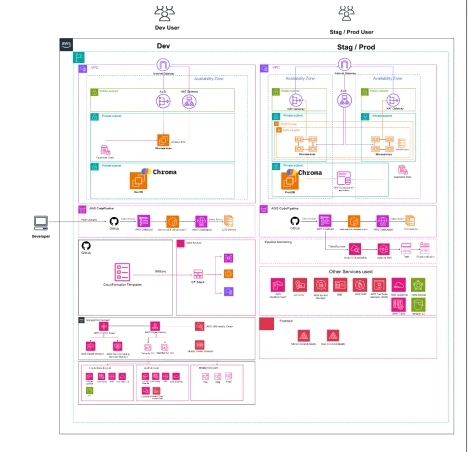
Workflow
For Luxia, a multi-account setup was created using AWS Control Tower, with separate
Dev, Stage, and Prod environments to ensure proper isolation, governance, and security.
Each environment runs within a dedicated Amazon VPC spanning multiple Availability
Zones (AZs) to provide fault tolerance and high availability.
For Luxia, a multi-account setup was created by using AWS Control Tower, details of
which are as follows:
• 2 Organizational Units (OUs) – Members OU (Develop, Staging, Production) and Security OU (Audit, Log Archive).
• 3 Shared Accounts – Management, Audit (for centralized monitoring), and Log Archive (for compliance and log aggregation).
• A cloud-native directory with preconfigured groups and AWS IAM Identity Center (SSO) access.
• 20 preventive guardrails to enforce security and governance policies and 2 detective guardrails to detect configuration violations.
Core OU: Contains Audit and Log Archive accounts. The Audit account consolidates security findings, while Log Archive aggregates CloudTrail and Config logs from all accounts.
Members OU: Hosts Development, Staging, and Production accounts, each with workload isolation and environment-specific policies.
Root OU: Parent for all accounts, ensuring policies applied at the root cascade to every OU and account
Guardrails and Policies:
• Preventive guardrails (SCPs) restrict unsafe configurations (e.g., blocking public S3 buckets, enforcing strong IAM policies).
• Detective guardrails use AWS Config rules to continuously monitor compliance.
• All workloads and environments are accessed only via AWS SSO, eliminating multiple IAM credentials and ensuring federated identity.
Workloads & Applications:
• Dev & Stage: Application workloads run on Amazon ECS Fargate, with deployments automated through AWS CodePipeline. Pipelines connect directly to GitHub, so code pushes trigger build, test, and deploy steps for faster iteration.
• Production: ECS Fargate clusters operate across multiple AZs for high availability. Amazon Aurora PostgreSQL (Multi-AZ cluster with writer and reader instances): Serves as the central production database, providing transactional integrity for write-heavy workloads while scaling out read traffic across replicas to support reporting, analytics, and API queries. Aurora’s automated backups, replication, and failover ensure high durability and minimal downtime, addressing previous challenges with manual replication and failover management. ChromaDB on EC2 supports specialized vector database use cases.
• Frontend Applications: Web frontends are hosted using AWS Amplify, giving scalable and managed hosting with simple CI/CD integration
• Service Discovery: AWS Cloud Map is used across ECS workloads to enable service discovery, making it easier for applications to communicate reliably.
• S3 Buckets: Dedicated S3 buckets handle CloudFormation artifacts, backups, deployment builds, and logs. All buckets are private, encrypted, and follow least-privilege access policies.
Luxia uses AWS CloudFormation to enable AWS Config across all accounts and regions, ensuring complete visibility and compliance. CloudFormation provisions the setup so that all resource types are recorded, with global resources such as IAM captured in a single region to prevent duplication. It also automates the storage of configuration history and snapshots in an encrypted, access-controlled S3 bucket within the Log Archive account, with logging enabled for added security. Through this automation, data from Development, Staging, and Production accounts is consistently directed to the central bucket, creating a unified, audit-ready repository.
Monitoring & Security:
● CloudTrail and AWS Config enabled in all regions with logs centralized in the Log Archive account.
● Amazon CloudWatch provides application and infrastructure monitoring with alarms and dashboards.
● AWS Guard Duty and Security Hub aggregate security findings across accounts into the Audit account for centralized threat detection.
● Role-based access controls ensure developers work in Dev, QA/operations in Stage, and only authorized personnel access Prod.
GoCloud delivers ongoing Managed Services through a structured operating model aligned with AWS best practices. This includes 24/7 monitoring and alerting, incident management with defined SLAs, proactive patch and vulnerability management, backup monitoring and recovery testing, cost optimization reviews, and controlled change management processes. Monthly service review meetings provide performance reporting, security posture updates, compliance status, and optimization recommendations, ensuring continuous improvement and operational excellence.
Results, Operational Improvements, and Business Impact
Results at a Glance
- ~95% faster deployments — from 3–4 hours of manual work to 5–10 minutes with automated CI/CD
- 4x release frequency — from 2–3 to 8–10 releases per month
- Days → minutes — new environment provisioning via Control Tower Account Factory + IaC
- 90% fewer security findings after deploying 22 automated guardrails
- 99.9% availability since go-live on Multi-AZ ECS Fargate + Aurora failover
- 60% infrastructure cost reduction saved annually vs. the previous cloud provider
- 10x traffic growth supported with zero downtime
