


Most startup content frames venture capital as a straightforward goal: raise money, grow faster, exit bigger. The reality experienced by thousands of founders is far more nuanced. The wrong venture capital firm — even a well-known one can accelerate you toward the wrong outcome: a premature exit, a pivot you did not want, dilution that leaves founders economically irrelevant at IPO, or a board that overrides your product vision.
Top venture capital firms are not interchangeable. They differ fundamentally in their investment thesis, operational involvement, portfolio density in your sector, fund stage and lifecycle, geographic focus, and the specific partners who will sit on your board. Understanding these dimensions is not optional due diligence — it is the foundation of your fundraising strategy.
This guide is written for founders who want to raise intelligently, not just raise. It covers how the world’s leading VC firms are structured, how they evaluate deals, what the top global and sector-specific firms are known for, how to approach them with maximum signal, and how to evaluate term sheet terms that can define your company’s future for a decade.
How the Top Venture Capital Firms Are Actually Structured
Before approaching any VC firm, founders need to understand the mechanics of how these firms operate. Misunderstanding fund structure leads to misaligned pitches, wasted meetings, and approaching partners who have no capital left to deploy.
Fund Lifecycle and Capital Deployment Windows
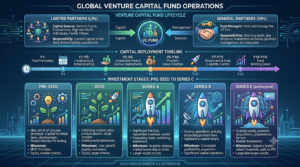
Venture capital firms raise funds from limited partners (LPs) — pension funds, university endowments, sovereign wealth funds, family offices, and high-net-worth individuals. Each fund has a defined lifecycle:
- Fund formation: Typically 3–6 months to close the LP commitments.
- Investment period: Years 1–4, when the majority of new investments are made.
- Follow-on reserves: Years 3–7, reserved capital for follow-on investments in existing portfolio companies.
- Harvest period: Years 5–10+, focused on portfolio exits and LP distributions.

GP, LP, and the Carry Structure
Understanding who makes money and how creates clarity about VC incentives:
- General Partners (GPs): The investment professionals who manage the fund and make investment decisions. They typically commit 1–2% of the fund themselves.
- Limited Partners (LPs): Institutional and individual investors who provide the fund’s capital. They are passive — they do not make investment decisions.
- Management fee: 2% of committed capital annually, used to pay salaries, rent, and operations.
- Carried interest (carry): 20% of the fund’s profits above the hurdle rate, distributed to GPs. This is the primary wealth creation mechanism for VC partners.
The carry structure creates a specific incentive: GPs need outsized winners (10x+ returns) to generate carry. This means top venture capital firms are structurally incentivized to fund companies with the potential to return the entire fund — not merely companies that will be moderately successful.
Investment Stages: What Each Tier Actually Means
| Stage | Typical Check Size | Valuation Range | What Firms Evaluate |
| Pre-seed | $250K–$2M | $2M–$8M post-money | Founder quality, problem thesis, early signals |
| Seed | $1M–$5M | $8M–$25M post-money | Product-market fit signals, team, early traction |
| Series A | $5M–$20M | $20M–$80M post-money | Revenue growth, unit economics, market size |
| Series B | $20M–$60M | $80M–$400M post-money | Scalable GTM, retention, competitive moat |
| Series C+ | $60M–$300M+ | $400M–$5B+ | Path to profitability or IPO, market leadership |
| Growth/Late | $100M–$1B+ | $1B+ (unicorn tier) | Revenue scale, margin improvement, exit readiness |
Sector-Agnostic vs Thesis-Driven Firms
The most important distinction in today’s VC landscape is between sector-agnostic generalist firms and thesis-driven specialists:
- Generalist firms (Sequoia, a16z, Accel): Invest across technology verticals. Bring broad portfolio value but may lack deep domain expertise in niche sectors.
- Thesis-driven specialists (Bessemer for cloud, Founders Fund for deep tech, Union Square Ventures for networks): Have deep conviction in specific investment theses and bring sectoral pattern recognition that generalists cannot match.
- Operator-led firms (a16z, Initialized Capital): Founded by or staffed with former operators who bring hands-on scaling experience, not just capital.
The World’s Top Venture Capital Firms: Profiles and Investment Patterns
The following profiles are based on publicly available investment data, fund announcements, and portfolio analysis. They are designed to help founders understand each firm’s actual investment behavior — not just their brand reputation.
Tier 1: Global Generalist Giants
Sequoia Capital
Founded in 1972, Sequoia is arguably the most powerful venture capital firm in history by portfolio value. Their investments include Apple, Google, Oracle, LinkedIn, Stripe, and Airbnb. Sequoia restructured in 2021 into a single open-ended fund the Sequoia Fund eliminating the traditional 10-year fund cycle and allowing them to hold public company positions indefinitely.
- Investment focus: Early to growth stage across enterprise software, consumer, fintech, healthcare, and deep tech.
- Global structure: Separate Scout, Seed, Venture, and Growth funds by geography (US/Europe, India, Southeast Asia, China through HongShan).
- What they look for: Exceptional founders with missionary zeal, large addressable markets, and defensible differentiation. They prioritize founder character over pure metrics at early stages.
- Partnership access: Partners include Roelof Botha, Alfred Lin, Pat Grady, and Shaun Maguire — all former operators or domain experts. Partner fit is critical; the firm’s culture varies significantly by partner.
Andreessen Horowitz (a16z)
Founded in 2009 by Marc Andreessen and Ben Horowitz, a16z redefined what a VC firm could be by building an internal platform with hundreds of specialists covering recruiting, marketing, executive talent, regulatory affairs, and technical research. They manage over $35 billion in assets under management across multiple funds.
- Investment thesis: Software is eating the world. They invest in companies using software to transform large legacy industries.
- Vertical funds: Bio, crypto (a16z Crypto), games, American Dynamism (defense, space, manufacturing), and infrastructure.
- Platform differentiation: Their talent network and go-to-market support is consistently cited by portfolio founders as the most tangible value-add beyond capital.
- Stage: Seed through growth, with follow-on capacity at every stage.
Accel Partners
Accel is one of the oldest active venture capital firms, founded in 1983. They are best known in enterprise technology their portfolio includes Facebook, Slack, Atlassian, Dropbox, Crowdstrike, and Webflow. Accel operates dedicated funds in the US, Europe, India, and Israel.
- Investment thesis: Early-stage enterprise and infrastructure. They coined the term ‘prepared mind investing’ deep research into sectors before companies approach them.
- Enterprise focus: If you are building B2B SaaS, developer tools, security, or infrastructure, Accel has more relevant pattern recognition than almost any other top-tier firm.
- European presence: Accel London is one of the strongest VC presences in Europe, with investments in Spotify, UiPath, and Deliveroo.
Tier 1: Sector Specialists with Outsized Returns
Bessemer Venture Partners
Bessemer is the oldest active VC firm in the US (founded 1911 as a family office, VC since the 1970s). They are best known for cloud computing investments — Salesforce, LinkedIn, Shopify, Twilio, SendGrid, and Box are all Bessemer portfolio companies.
- Anti-portfolio transparency: Bessemer publishes their famous ‘anti-portfolio’ a list of companies they passed on including Google, Apple, eBay, and Amazon. This intellectual honesty is a strong signal of their culture.
- Cloud index: They maintain the BVP Nasdaq Emerging Cloud Index, a genuine thought leadership product that demonstrates deep sector conviction.
- Ideal fit: If you are building cloud infrastructure, SaaS, or developer tooling, Bessemer’s sector depth is matched by very few.
Founders Fund
Peter Thiel’s Founders Fund was founded in 2005 with an explicit contrarian thesis: invest in companies doing things that seem bold, unconventional, or technologically ambitious not incremental improvements. Their portfolio includes SpaceX, Palantir, Airbnb, Stripe, Lyft, and Neuralink.
- Investment thesis: ‘We wanted flying cars, instead we got 140 characters.’ They seek breakthrough technology companies, not software-as-a-service businesses.
- Ideal fit: Deep tech, biotech, defense technology, space, energy, and AI/ML infrastructure. Not a fit for B2B SaaS or consumer apps without a hard technology component.
- Check size: Known for writing large checks at early stages when they have conviction — they are less concerned with valuation than with ownership in transformational companies.
Union Square Ventures (USV)
Fred Wilson and Brad Burnham founded USV in 2003 around a thesis that has evolved consistently: investing in large networks of engaged users. Their portfolio includes Twitter, Tumblr, Etsy, Duolingo, Coinbase, and MongoDB.
- Investment thesis: Networks, marketplaces, and protocols that create value through user engagement at scale.
- Fund size discipline: USV deliberately keeps funds small ($200M range) relative to their peers. This allows them to focus on early-stage conviction bets rather than deploying capital at scale into later-stage companies.
- Ideal fit: Marketplace businesses, network-effect-driven platforms, open-source companies, and web3/crypto infrastructure.
Tier 2: Essential Sector and Geography-Specific Firms
| Firm | Founded | Focus | Notable Portfolio | AUM (Approx) |
| Benchmark | 1995 | Early-stage, consumer/enterprise | Uber, Twitter, Snap, eBay, Discord | $430M+ per fund |
| Lightspeed | 2000 | Enterprise, consumer, deep tech | Snap, Nutanix, AppDynamics, OYO | $7B+ |
| NEA | 1977 | Enterprise, healthcare, deep tech | Workday, Robinhood, Salesforce | $25B+ |
| Kleiner Perkins | 1972 | Clean energy, consumer, enterprise | Amazon, Google, Twitter, Figma | $6B+ |
| Index Ventures | 1996 | Enterprise SaaS, consumer, fintech | Slack, Figma, Dropbox, Roblox | $2.5B+ |
| General Catalyst | 2000 | Healthcare, fintech, enterprise | Stripe, Airbnb, Snap, Livongo | $6B+ |
| Tiger Global | 2001 | Growth stage, global | Stripe, Bytedance, JD.com, Peloton | $90B+ |
| Coatue Management | 1999 | Growth tech, public and private | Snowflake, DoorDash, Robinhood | $50B+ |
Emerging and Operator-Led Funds Worth Watching
Beyond the established giants, a new generation of operator-led and emerging funds are backing some of the most important early-stage companies:
- Initialized Capital (Garry Tan, Alexis Ohanian): Reddit and Y Combinator alumni backing technical founders at seed stage.
- Lux Capital: Science and deep tech focus with investments in synthetic biology, quantum computing, and defense.
- Obvious Ventures: Impact-focused investing in sustainability, health, and human potential.
- 7percent Ventures: European early-stage with deep technical founder empathy.
- Plural (Taavet Hinrikus, Ian Hogarth): European operator-led fund focused on transformational technology.
What Top Venture Capital Firms Actually Evaluate in a Deal
VC investment decisions are rarely made on spreadsheets. They are made on conviction — conviction about a market, a team, and a product’s ability to dominate that market. Understanding the evaluation frameworks used by top firms helps founders prepare pitches that address the right questions.
The Investment Memo Framework
Most VC firms produce an internal investment memo before a partner vote. The typical memo addresses:
- Team: Why are these specific founders uniquely positioned to win this market? What is their unfair advantage domain expertise, prior experience, network, or technical capability?
- Market: Is this a large and growing market? Are they building a new market or displacing an existing one? Market size analysis goes far beyond TAM slides the best VCs do primary research.
- Product: Does the product work? Does it work better than alternatives? Is the core technology defensible? What is the evidence of product-market fit?
- Business model: How does the company make money? What are the unit economics? What does the path to contribution margin look like?
- Competition: Who are the real competitors (including internal build options for enterprise customers)? What is the differentiated moat?
- Risks: What can kill this company? Regulatory risk, technical risk, market timing risk, key-person risk?
The Metrics That Move Deals at Each Stage
| Stage | Primary Signal | Secondary Signals | Common Rejection Reasons |
| Pre-seed | Founder conviction and insight | Early user validation, prototype quality | No clear unfair advantage; weak problem thesis |
| Seed | Early traction (10-100 users/customers) | Revenue, retention, NPS, referral rate | Slow growth, high churn, weak founder market fit |
| Series A | MoM revenue growth (15-20%+) | CAC/LTV, gross margin, sales cycle length | Growth stalling, poor unit economics, execution gaps |
| Series B | ARR ($5M-30M), NDR > 120% | Payback period, pipeline coverage, expansion revenue | Market saturation signals, competition narrowing moat |
| Series C+ | Clear path to $100M ARR or profitability | Rule of 40, gross margin %, market share data | No clear IPO or M&A path within 3-5 years |
Pattern Recognition: What the Best Firms See That Others Miss
The most valuable capability of top-tier VC firms is pattern recognition built from thousands of deals. This manifests in specific ways during deal evaluation:
- Founder archetypes: Sequoia and Benchmark are known for backing first-time founders with unusual insight over serial entrepreneurs with mediocre execution. They have pattern-matched that the quality of the insight often predicts the outcome more than the track record.
- Market timing signals: The best VCs recognize when infrastructure changes (mobile, cloud, AI) have created a window for a category to be rebuilt from scratch. They back companies that are timed to ride these infrastructure shifts.
- Counter-consensus bets: Founders Fund, USV, and Lux Capital explicitly seek investments where the consensus view is wrong. The highest-return investments are by definition non-consensus at the time of investment.
How to Approach Top Venture Capital Firms: A Systematic Outreach Strategy
Cold outreach to VC firms has an extremely low conversion rate typically below 1%. The founders who successfully raise from top-tier firms do so through a systematic relationship-building strategy that begins 12–18 months before their target raise date.
The Warm Introduction Network
Every top VC firm in the world prioritizes deal flow from trusted sources. The hierarchy of introduction quality:
- Portfolio company CEOs or founders: The highest-quality introduction. If you can get the founder of a successful portfolio company to endorse your deal, most partners will take the meeting.
- Operating partners and advisors at the firm: Many large firms have networks of advisors who can make introductions — building relationships with these individuals is an underutilized path.
- Other VCs who co-invest: If a seed-stage firm that does not compete at Series A has funded you, they will often make warm introductions to Series A firms in their network.
- Angel investors in the firm’s network: Angels who invest alongside a firm frequently and whose judgment is respected carry strong signal.
- Accelerator alumni networks: YC, Techstars, and Entrepreneur First alumni networks provide high-quality warm introduction pathways to virtually every top VC firm.
Building Your Investor Pipeline as a Founder
Treat your fundraise like a sales pipeline:
- Tier A: 5–8 firms where you would be genuinely excited to partner. These are your primary targets.
- Tier B: 10–15 firms that are strong alternatives — good fit but not top preference.
- Tier C: 5–10 firms for competitive dynamics and optionality. You want them in process to create time pressure.
Run all tiers simultaneously. Sequential fundraising approaching one firm at a time and waiting for a decision before moving to the next gives each firm too much leverage and extends your process by months.
The Pitch Deck: What Top Firms Actually Read
The pitch deck you send before a meeting has one job: earn a first meeting. It is not the place to answer every question — it is the place to create enough curiosity that a partner wants 45 minutes with you. Top VC firms consistently look for:
- Problem slide: Is this a real problem experienced by a large number of people/companies? Is it described in the customer’s language, not the founder’s language?
- Solution slide: Is the solution simple to understand? Is it surprising in some way doing something no one thought was possible?
- Traction slide: Any evidence of customer love revenue, growth rate, retention, NPS, case studies goes here. Make the trend line the centerpiece, not the absolute numbers.
- Team slide: Why you? What is the specific unfair advantage this team has that makes them the right people to build this specific company at this specific moment?
- Market slide: Real market sizing using a bottoms-up approach, not top-down TAM from a market research report.
The First Meeting: How to Turn a 45-Minute Slot into a Term Sheet
The first VC meeting is not a presentation — it is a conversation. The founders who advance fastest in VC processes are those who:
- Lead with the problem’s emotional weight before the solution — make the partner feel the pain before you offer the aspirin.
- Have a crisp, confident answer to ‘why now?’ — what has changed in the last 12 months that makes this the right moment for this company?
- Ask the partner about their thesis and prior investments in the space — show you have done your homework and respect their time.
- Close with a specific next step — do not leave a first meeting without agreeing on what happens next and when.
Evaluating a VC Term Sheet: The Terms That Define Your Company’s Future
Receiving a term sheet from a top venture capital firm is exciting. It is also the moment when many founders make expensive mistakes by accepting terms they do not fully understand. The following terms deserve careful scrutiny from every founder.
Valuation and Dilution: The Headline Numbers
Pre-money valuation gets most of the attention, but dilution calculation is what actually matters. A $20M pre-money valuation on a $5M raise = 20% dilution. But the option pool shuffle can dramatically increase real dilution:
- If the term sheet requires a 20% option pool to be created from pre-money shares before the investment, your effective dilution is significantly higher than the headline percentage suggests.
- Negotiate option pool size actively — often the required pool can be reduced to 10–15% with evidence of your current hiring plan.
Liquidation Preferences: The Term That Matters Most at Exit
Liquidation preferences determine how proceeds are distributed at an acquisition or liquidation. The standard market term is 1x non-participating preferred — meaning investors get their money back before common shareholders receive anything, but do not participate further. More aggressive terms include:
- 1x participating preferred: Investors get their money back PLUS participate pro-rata in remaining proceeds. Heavily dilutive to founders at smaller exits.
- 2x or 3x liquidation preference: Investors receive 2x or 3x their investment before any common shares receive proceeds. Rare in today’s market but occasionally seen in down rounds or distressed situations.
- Market standard (2025): 1x non-participating preferred is strongly the norm at Seed and Series A among top-tier firms. Any deviation should be interrogated.
Board Composition and Control
Board rights granted to investors define who controls your company’s strategic direction. Standard board structures at each stage:
| Round | Typical Board Structure | Founder Control | Key Risk |
| Seed | 2 founders, 1 investor, 2 independent | Strong (founders majority) | Investor observer rights can still be onerous |
| Series A | 2 founders, 2 investors, 1 independent | Balanced (50/50 with independent) | Independent seat selection is critical |
| Series B | 2 founders, 2 investors, 1-2 independents | Potentially minority | Investor coalition can outvote founders |
| Series C+ | 2 founders, 3+ investors, independents | Often minority | Drag-along rights become operative |
| Founder advice: The independent board seat is the most underrated leverage point in term sheet negotiation. Founders who proactively propose a respected, domain-relevant independent director before the investor raises the topic signal board governance maturity and maintain more influence over who occupies that critical swing seat. |
Pro-Rata Rights, Anti-Dilution, and Information Rights
Three additional term sheet provisions that founders frequently under-negotiate:
- Pro-rata rights: Give investors the right to participate in future rounds to maintain their ownership percentage. Top-tier VCs demand these aggressively. Granting broad pro-rata to seed investors can create complications at Series A if a lead investor wants maximum ownership.
- Anti-dilution provisions: Weighted-average anti-dilution is market standard and protects investors if you raise a down round. Full ratchet anti-dilution is founder-punishing and should be rejected.
- Information rights: Monthly financials, annual audits, board observer rights. Standard for lead investors but negotiate to limit the number of parties with full information rights — it creates operational overhead and confidentiality risk.
The VC Landscape for Tech Founders in 2025
The venture capital industry has undergone significant structural shifts since the 2021 peak. Understanding the current environment is critical for founders calibrating their fundraising strategy.
The Post-2021 Recalibration
2021 was an anomalous year — near-zero interest rates, remote-work tailwinds, and aggressive growth-at-all-costs strategies led to valuations that were disconnected from business fundamentals. The 2022–2023 correction was severe: valuations compressed 60–80% across stage, and firms that had deployed capital at peak 2021 valuations sat on significant unrealized losses.
The 2024–2025 environment represents a return to fundamentals-based investing:
- Valuations are based on revenue multiples again — typically 8–15x ARR for high-growth SaaS at Series A/B, down from 30–50x in 2021.
- Profitability pathway is no longer optional — investors want to see a credible path to positive unit economics even at early stages.
- Bar for Series A has effectively risen to what Series B required in 2019 — $1–3M ARR with strong growth is increasingly the minimum.
AI and the New Funding Wave
The most significant force reshaping top venture capital firms’ portfolios in 2024–2025 is artificial intelligence. The investment patterns:
- Foundation model layer: Dominated by a small number of well-capitalized players (OpenAI, Anthropic, Google DeepMind, Meta AI, Mistral). The investment opportunity here is largely closed to most founders.
- AI application layer: The most active investment zone. Firms are aggressively funding AI-native applications in legal, healthcare, code generation, customer support, financial analysis, and scientific research.
- AI infrastructure layer: MLOps tooling, vector databases, inference optimization, fine-tuning platforms. High VC activity from technical-focused funds.
- Vertical AI: Domain-specific AI companies with proprietary data moats are attracting premium valuations — legal AI, medical AI, climate AI, and defense AI are all attracting significant interest from specialized funds.
Geographic Expansion: Top VC Firms Beyond Silicon Valley
The geographic concentration of venture capital is diversifying, driven by remote talent, lower cost bases, and maturing startup ecosystems:
| Region | Key Active Firms | Notable Emerging Focus | Funding Stage Strength |
| New York | Bessemer, USV, General Catalyst, Coatue | Fintech, media, climate tech, enterprise | Seed through growth |
| Europe | Index Ventures, Accel London, Atomico, Balderton | Deep tech, climate, B2B SaaS | Seed through Series B |
| India | Sequoia India (Peak XV), Accel India, Lightspeed India | Fintech, SaaS, B2B services | Seed through Series C |
| Southeast Asia | Jungle Ventures, Wavemaker, Golden Gate Ventures | E-commerce, fintech, logistics | Seed through Series B |
| Latin America | Kaszek, Monashees, a16z (LATAM) | Fintech, agritech, health | Seed through Series B |
| Middle East / Pakistan | STV, Wamda, i2i, SOSV | Fintech, logistics, edtech | Seed through Series A |
Alternative Paths to Top-Tier VC: Accelerators, Syndicates, and Rolling Funds
Raising directly from established VC firms at Series A is not the only or always the best path to growth capital. For many founders, especially those pre-product-market fit, alternative structures offer better terms, faster execution, and more relevant support.
Y Combinator: The Gold Standard Accelerator
Y Combinator has funded over 4,000 companies including Airbnb, Stripe, Dropbox, Coinbase, DoorDash, and Instacart. The YC stamp is more than capital — it is a signal that commands respect from virtually every top VC firm.
- Program structure: Two batches per year (winter and summer), 3 months in San Francisco, $500K investment for 7% equity (as of 2024).
- Demo Day: Direct access to hundreds of investors in a single compressed fundraising event. YC companies frequently close seed rounds during or immediately after Demo Day.
- Alumni network: 10,000+ alumni founders who provide warm introductions, co-founder referrals, customer introductions, and follow-on investment.
- Fit: Best for companies with a working prototype and at least one early customer. Not a path for pre-idea stage founders.
AngelList Syndicates and Rolling Funds
AngelList’s syndicates and rolling funds have democratized access to deal flow and created new pathways for founders to raise from operator-angels:
- Syndicates: Lead investors bring deals to their follower network. Founders benefit from access to a distributed investor base in a single close.
- Rolling funds: Operators like Naval Ravikant, Shaan Puri, and other tech figures have raised rolling funds on AngelList that invest continuously. These funds move faster than traditional VCs and often provide more candid founder guidance.
- Strategic value: For technical founders building developer tools, open-source, or API-first businesses, operator-angel syndicates often provide higher-quality early customer introductions than institutional VCs.
Corporate Venture Capital: Strategic Money with Trade-offs
Corporate venture capital (CVC) arms of major technology companies — Google Ventures (GV), Salesforce Ventures, Intel Capital, Microsoft M12, and Qualcomm Ventures — provide an alternative to traditional VC with distinct trade-offs:
| CVC Characteristic | Advantage | Risk / Trade-off |
| Strategic alignment | Access to parent company’s customer base, distribution, technology | Acquisition pressure, exclusivity clauses |
| Patient capital | Less pressure for rapid growth and exits | Slower decision making, committee-driven |
| Technical validation | Parent company engineers can validate your technology | IP sharing concerns if integration is deep |
| M&A signal | Being a CVC portfolio company can accelerate acquisition conversations | Other acquirers may view you as committed to parent company |
Common Mistakes Founders Make When Approaching Top VC Firms
These mistakes cost founders months of time and, in some cases, the chance to raise from firms that were genuinely interested but were turned off by avoidable errors in process or framing.
Mistake 1: Pitching the Wrong Stage Firm
Approaching a growth-stage fund (Tiger Global, Coatue) with a pre-revenue product, or pitching a seed-focused micro-fund (Precursor Ventures, First Round Capital) when you have $10M ARR, wastes both parties’ time. Research the stage fit before outreach — it is visible in every firm’s portfolio.
Mistake 2: Ignoring Fund Lifecycle Position
A VC firm in year 8 of a 10-year fund is unlikely to write new checks into your company. They may take the meeting out of politeness, gather market intelligence about your space, or string you along. Verify fund vintage before investing time in a firm.
Mistake 3: Creating Artificial FOMO Without Real Competition
Founders frequently attempt to manufacture urgency by implying competing term sheets that do not exist. Experienced investors see through this instantly and it damages trust. Real FOMO comes from genuine investor interest — which comes from a well-run process with multiple firms in diligence simultaneously.
Mistake 4: Underpricing or Overpricing the Round
Underpricing creates immediate dilution that compounds across every future round. Overpricing creates down-round risk and can make your company uninvestable if growth slows. The right price is the highest valuation at which you can close a quality lead investor within 60 days of launching the process.
Mistake 5: Neglecting Founder References
Top VC firms conduct deep reference checks — not just on founders, but on former colleagues, customers, and anyone who has worked closely with you. Founders who have unresolved reputation issues from prior companies frequently fail at this stage, even with strong metrics. Proactively identify and address reference risks before they surface.
Conclusion: Choosing the Right Top Venture Capital Firm as a Strategic Decision
The decision of which top venture capital firm to partner with is not merely a funding decision. It is a governance decision, a strategic alignment decision, and in many cases, a decision that will determine the outcome of your company more than your product roadmap.
The founders who navigate the VC landscape most successfully share a common approach: they invest time before the raise to understand each firm’s actual investment thesis, portfolio construction strategy, fund lifecycle position, and the specific partner who would lead their deal. They build relationships before they need capital. They run competitive processes that give them genuine optionality. And they scrutinize term sheets with the same rigor they apply to product decisions.
The top venture capital firms in the world provide more than money — the best partnerships provide pattern-matched advice at critical inflection points, networks that open doors that would otherwise stay closed, and credibility that signals to customers, employees, and future investors that your company has been vetted by the most sophisticated evaluators in the startup ecosystem.
Choose deliberately. The right VC partner at the right stage can compress a decade of building into five years. The wrong one can constrain your vision, misalign your incentives, and turn your cap table into a liability. In venture capital, fit matters as much as funding.