


When evaluating AWS Direct Connect vs Azure ExpressRoute, the core question is simple: which service gives your organization the best private cloud connectivity for performance, control, resiliency, and long-term cost? Both services replace unpredictable public internet paths with dedicated network connectivity into a cloud backbone, but they differ in connection model, routing design, pricing, partner ecosystem, and enterprise fit.
For cloud architects and enterprise IT leaders, this is not just a networking choice. It affects hybrid cloud design, multi-cloud networking strategy, compliance posture, data transfer economics, and how easily you can scale across regions, business units, and providers.
AWS Direct Connect vs Azure ExpressRoute: Quick Answer
If you want the short version, AWS Direct Connect is usually the stronger fit for AWS-centric enterprises that need flexible private connectivity into Amazon VPCs, public AWS services, and AWS Transit Gateway architectures through private, public, and transit virtual interfaces.
Azure ExpressRoute is often the better fit for Microsoft-centric organizations that want private access into Azure and selected Microsoft cloud services through an ExpressRoute circuit with private peering, Microsoft peering, and options like ExpressRoute Direct or Global Reach.
For most enterprises, the winner is not determined by raw bandwidth alone. It comes down to existing cloud alignment, routing model preference, pricing pattern, redundancy design, and whether your broader enterprise networking strategy is AWS-first, Azure-first, or genuinely multi-cloud.
Why Private Cloud Connectivity Matters :
A dedicated network connection matters because public internet routes are shared, variable, and harder to control. Both Direct Connect and ExpressRoute are designed to provide more predictable latency, better traffic isolation, and more reliable hybrid cloud access than internet-based VPN-only architectures. AWS says Direct Connect can reduce network costs, increase bandwidth throughput, and provide a more consistent network experience than internet-based connections. Microsoft says ExpressRoute offers more reliability, consistent latency, faster speeds, and higher security because traffic does not traverse the public internet.
This matters most for enterprises running latency-sensitive apps, regulated workloads, large-scale data transfer, disaster recovery replication, ERP systems, or global hybrid cloud environments. In those cases, private connectivity is not a “nice to have.” It becomes foundational infrastructure.
What Is AWS Direct Connect?
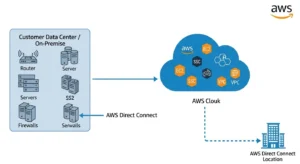
AWS Direct Connect links your internal network to an AWS Direct Connect location over standard Ethernet fiber. From there, you can create virtual interfaces to reach public AWS services or Amazon VPC resources while bypassing internet service providers in the path. AWS supports three VIF types: private virtual interface, public virtual interface, and transit virtual interface.
That architecture is one of Direct Connect’s biggest strengths. A private VIF connects to VPC resources using private IPs, a public VIF gives access to AWS public services, and a transit VIF connects to one or more Transit Gateways through a Direct Connect gateway. AWS also highlights the Direct Connect gateway as a globally available resource that helps connect multiple VPCs or Transit Gateways across Regions and accounts, reducing management complexity for larger enterprise networking designs.
AWS supports both dedicated connections and hosted connections. Dedicated connections are tied to a single customer and are available at larger port capacities. Hosted connections are provisioned through a Direct Connect Partner and can be more practical when you do not have equipment colocated at an AWS location. AWS also supports link aggregation groups (LAGs) to combine multiple dedicated connections into a single managed connection.
What Is Azure ExpressRoute?
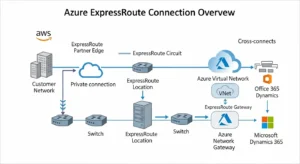
Azure ExpressRoute extends your on-premises network into the Microsoft cloud over a private connection delivered with the help of a connectivity provider. Microsoft says connectivity can come from an any-to-any IP VPN network, a point-to-point Ethernet connection, or a virtual cross-connection through a provider at a colocation facility.
The core building block is the ExpressRoute circuit, which consists of two connections to two Microsoft Enterprise edge routers for built-in redundancy. ExpressRoute supports private peering for Azure virtual network connectivity and Microsoft peering for selected Microsoft cloud services. Microsoft also offers ExpressRoute Direct for customers that want direct connectivity into Microsoft’s global network at very high capacities, and ExpressRoute Global Reach for linking on-premises sites together through the Microsoft backbone.
This circuit-and-peering model makes ExpressRoute especially attractive for enterprises that are deeply invested in Azure, Microsoft 365-related service access patterns, and broader Microsoft ecosystem integration.
AWS Direct Connect vs Azure ExpressRoute: Key Differences
1) Architecture and connection model
The biggest architectural difference is that AWS is organized around connections + virtual interfaces + gateways, while Azure is organized around circuits + peering domains + gateways/provider connectivity. In AWS, the design center is how VIFs and Direct Connect gateways connect into VPC and Transit Gateway topologies. In Azure, the design center is the ExpressRoute circuit and which routing domains, regions, and services it exposes.
2) Routing and peering
Both services rely on BGP, but they expose routing differently. AWS requires support for BGP and BGP MD5 authentication, and uses private, public, and transit virtual interfaces as the main routing construct. Microsoft uses private peering and Microsoft peering as the main routing domains, with route filters and prefix limits shaping how traffic is advertised and controlled. Microsoft notes that standard ExpressRoute circuits support up to 4,000 private peering prefixes and 200 Microsoft peering prefixes, with higher limits available through Premium.
3) Performance and latency
Both services are designed for lower latency and better traffic predictability than public internet paths. AWS emphasizes more consistent network performance and higher bandwidth throughput. Microsoft emphasizes consistent latency, higher reliability, and faster speeds than internet-based connectivity. In real enterprise deployments, latency outcomes depend heavily on provider path quality, colocation geography, gateway placement, and whether you are designing for metro, regional, or global reach.
4) Security and compliance
Neither service should be treated as “automatically encrypted private WAN.” AWS explicitly notes that Direct Connect is not encrypted by default. For 10 Gbps and 100 Gbps dedicated connections, AWS supports MACsec; for lower-speed scenarios, AWS recommends using VPN overlays where needed. Microsoft positions ExpressRoute as private and secure because it does not traverse the public internet, but security design still depends on peering configuration, gateway architecture, and broader enterprise controls.
5) Availability, redundancy, and resiliency
Both platforms provide strong resiliency options, but each vendor is explicit that redundancy must be designed, not assumed. AWS recommends additional Direct Connect connections and offers a Resiliency Toolkit with models for maximum resiliency, high resiliency, and dev/test resiliency across multiple devices and locations. Microsoft states that each ExpressRoute circuit includes a redundant pair of cross-connections, but for maximum resiliency it recommends using two ExpressRoute circuits in two peering locations, ideally with diverse providers and different customer termination points.
6) Global reach and partner ecosystem
AWS gives access to Direct Connect through AWS locations, Direct Connect Partners, or independent providers, and notes that you can access any AWS Region from any Direct Connect location outside China. Microsoft offers provider-based connectivity, cross-connect models, and Global Reach capabilities to link on-premises sites through Microsoft’s network. In practice, the better global reach option depends on where your enterprise sites, providers, and cloud landing zones actually sit.
7) Pricing model and billing logic
This is where the services diverge sharply. AWS Direct Connect pricing is based primarily on port hours and outbound data transfer. Azure ExpressRoute uses a fixed monthly port fee and offers Metered or Unlimited data plans, with additional cost considerations for Premium, Direct, Gateway, and Global Reach features. That means AWS often feels more usage-sensitive, while Azure often feels more plan-based and predictable for consistently high utilization.
AWS Direct Connect vs Azure ExpressRoute: Comparison Table :
| Category | AWS Direct Connect | Azure ExpressRoute |
| Core construct | Connection + VIFs + Direct Connect gateway | ExpressRoute circuit + peering model |
| Main routing model | Private, public, transit virtual interfaces | Private peering, Microsoft peering |
| Cloud integration strength | Best for AWS VPC and Transit Gateway architectures | Best for Azure VNets and Microsoft-centric estates |
| Global expansion model | Direct Connect locations + partners + gateways | Providers + peering locations + Global Reach |
| Encryption | Not encrypted by default; MACsec on some dedicated links | Private connection model; security depends on architecture and controls |
| Pricing style | Port-hour + outbound data transfer | Monthly port fee + metered or unlimited data plans |
| Best fit | AWS-heavy hybrid cloud and large VPC estates | Microsoft-heavy enterprise WAN and Azure integration |
Pricing Comparison in Practical Terms :
AWS Direct Connect pricing
AWS documents two main billing elements: port hours and outbound data transfer. Port-hour pricing varies by capacity and connection type, while outbound transfer charges apply to private and transit interfaces. AWS also notes there is no extra charge for using a multi-account Direct Connect gateway.
Azure ExpressRoute pricing
Microsoft says ExpressRoute pricing includes a monthly port fee, optional metered or unlimited data plan behavior, and possible extra charges for ExpressRoute Gateway, Premium, ExpressRoute Direct, and Global Reach. Under Metered, outbound transfer is charged separately; under Unlimited, inbound and outbound data are included in the fixed monthly fee.
What this means in the real world
If your traffic profile is bursty or hard to predict, AWS Direct Connect can be more flexible but may require closer cost monitoring. If your organization has very steady, high-volume private traffic and prefers fixed billing, Azure ExpressRoute’s unlimited-style model can be easier for finance teams to forecast. The hidden costs on both sides usually show up in provider charges, cross-connect fees, gateway design, redundant circuits, and overbuilt resiliency.
When to Choose AWS Direct Connect
Choose Direct Connect when your environment is overwhelmingly AWS-first and your architecture depends on VPC-centric networking, Transit Gateway connectivity, or direct access to both private and public AWS services through one private connectivity program. It is also a strong choice when you want a flexible mix of dedicated and hosted options, or when your enterprise networking team prefers a VIF-based model over circuit-and-peering abstractions.
It also stands out for organizations moving very large data volumes into AWS, especially where consistent throughput and reduced reliance on public internet paths matter more than fixed-plan simplicity.
When to Choose Azure ExpressRoute
Choose ExpressRoute when your organization is Microsoft-centric, runs major Azure workloads, or needs private connectivity that aligns cleanly with Azure virtual network design and Microsoft service access patterns. It is especially compelling for enterprises that want circuit-based private connectivity with built-in dual connections, strong provider-based deployment options, and features like ExpressRoute Direct or Global Reach.
ExpressRoute is also appealing when predictable monthly spend matters, or when Azure connectivity is closely tied to the broader Microsoft estate.
Best for Hybrid Cloud, Multi-Cloud, and Enterprise Scenarios
For single-cloud enterprise environments, the decision is straightforward: match the private connectivity service to your primary cloud. For multi-cloud organizations, there is no universal winner because neither service is a native cross-cloud fabric. In many real-world enterprise networking designs, companies use both services and stitch them together through colocation providers, SD-WAN platforms, carrier ecosystems, or broader WAN architectures.
For regulated industries, the most important design questions are not just “Direct Connect vs ExpressRoute,” but also where circuits terminate, how routing policies are enforced, what data paths are permitted, how redundancy is isolated, and whether provider choices align with compliance requirements and data residency constraints.
Best Practices Before You Decide :
First, design for resiliency, not just connectivity. AWS recommends multiple connections in multiple locations for critical workloads, and Microsoft recommends geo-redundant ExpressRoute circuits with diverse providers and zone-aware gateway design where appropriate.
Second, validate the partner/provider model early. Colocation access, carrier relationships, and provisioning paths often determine project timelines more than cloud-side configuration does.
Third, build a real routing policy plan. Prefix limits, peering domains, BGP controls, traffic engineering, and gateway placement can become operational pain points if treated as afterthoughts. Microsoft in particular calls out route limits, route filters, ECMP options, and failover controls such as connection weight and AS path prepending.
Fourth, do a full cost model comparison that includes bandwidth, data transfer, redundancy, gateways, provider charges, and growth assumptions over at least 12 to 36 months.
FAQ:
What is the difference between AWS Direct Connect and Azure ExpressRoute?
AWS Direct Connect uses a connection plus virtual interface model for private, public, and transit connectivity into AWS, while Azure ExpressRoute uses a circuit plus peering model for Azure and selected Microsoft cloud services.
Which is better for hybrid cloud networking?
The better choice depends on your primary cloud, WAN design, routing preferences, and provider ecosystem. AWS-heavy enterprises usually benefit more from Direct Connect, while Microsoft-heavy enterprises usually benefit more from ExpressRoute.
Is ExpressRoute faster than Direct Connect?
Not universally. Both are designed for low-latency private connectivity, but actual network performance depends on geography, providers, routing design, and workload pattern.
Is AWS Direct Connect encrypted?
Not by default. AWS says Direct Connect supports MACsec for certain dedicated connections, and VPN overlays can be used for lower-speed encrypted scenarios.
Does Azure ExpressRoute support redundancy?
Yes. Each ExpressRoute circuit includes a redundant pair of cross-connections, and Microsoft recommends multiple circuits across different peering locations for maximum resiliency.
Conclusion: AWS Direct Connect vs Azure ExpressRoute
The best way to think about AWS Direct Connect vs Azure ExpressRoute is not as a generic feature battle, but as a cloud networking architecture decision. AWS Direct Connect is stronger when your priority is AWS-native private connectivity across VPCs, public AWS services, and Transit Gateway-based routing domains. Azure ExpressRoute is stronger when you need Microsoft-aligned private connectivity built around circuits, peering models, and broader Azure or Microsoft cloud integration.
If your organization is AWS-first, choose Direct Connect unless there is a specific commercial or provider reason not to. GoCloud explains in detail how these services compare in this What is Amazon CloudFront guide. If your organization is Azure-first, choose ExpressRoute unless your WAN architecture strongly favors another model. For multi-cloud strategies, the winning design often involves both services with a carefully planned enterprise networking layer to handle resiliency, routing policies, and cost governance across clouds.