


If you want the short answer for AWS App Runner vs AWS Elastic Beanstalk, here it is: AWS App Runner is usually the better choice when you want the fastest path from code or a container image to a live web app or API, with minimal infrastructure thinking. AWS Elastic Beanstalk is usually the better choice when you still want a managed platform, but need more visibility into the underlying AWS resources and more room for customization. Put simply, App Runner feels closer to “deploy and run,” while Beanstalk feels closer to “managed EC2-based PaaS.”
That difference matters for developers, SaaS founders, DevOps teams, and AWS architects because these services are not just feature bundles—they represent two different operational models. App Runner is designed to reduce deployment friction for containerized web services and APIs. Elastic Beanstalk is designed to simplify deployment while still exposing more of the traditional AWS application stack underneath, including EC2 instances, load balancing, and scaling infrastructure. If you choose the wrong one, you can end up either over-engineering a simple app or outgrowing a service that was initially convenient.
The search intent behind AWS App Runner vs Elastic Beanstalk is usually not “what are these services?” but “which one fits my application and team better?” That means the most useful comparison is not a vague checklist. It is a decision guide based on deployment model, infrastructure control, operational overhead, scaling behavior, and app architecture.
A helpful way to think about it is this: App Runner is for teams who want AWS to handle more of the application hosting experience end to end. Beanstalk is for teams who still want a managed service, but don’t mind being closer to EC2-style infrastructure and platform configuration. One is more opinionated and modern in developer experience; the other is more flexible and infrastructure-aware.
What is AWS App Runner?
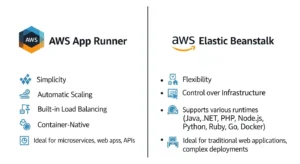
AWS App Runner is a managed AWS service for deploying web applications and APIs directly from code or a container image. AWS describes it as a fast, simple, and cost-effective way to deploy to a scalable and secure web application without needing to decide which compute service to use or how to provision the underlying AWS res. It connects to your or image repository and provides automatic delivery, managed operations, scaling, and security.
From a developer experience perspective, that is App Runner’s biggest promise: it removes a lot of the usual AWS setup work. You do not need to stitch together EC2, load balancers, scaling rules, and runtime infrastructure yourself just to get a web service online. AWS also positions it as a good fit for frontend and backend applications, API services, backend web services, and even large fleets of microservices, especially for teams that want to stay focused on code rather than platform plumbing.
How App Runner Works :
App Runner supports two main deployment flows. You can deploy from code, in which case App Runner builds the container for you, or you can deploy directly from a container image repository such as Amazon ECR. AWS emphasizes that App Runner connects directly to code or image repositories and supports an automatic integration and delivery pipeline. That makes it feel more like a -to-deploy platform than a traditional infrastructure service.
Operationally, App Runner handles scaling for HTTP traffic, load balancing with encryption, and service exposure without asking you to manage host infrastructure. It also lets you define scaling boundaries and concurrency behavior, which means you still have some tuning control even though the platform abstracts away most infrastructure details.
Best Use Cases :
App Runner is strongest for containerized web apps, APIs, startup MVPs, internal tools, and SaaS services where deployment speed matters more than deep infrastructure customization. Competitor comparisons consistently frame it as the best option for small teams, prototypes, and services where simplicity is the priority. That positioning matches AWS’s own emphasis on fast deployment and low operational burden.
It is especially attractive if your team already packages applications as containers or wants a clean GitHub/ECR-to-deployment workflow without building a broader platform around ECS or EC2. If your app is a standard web service and you want the least-friction AWS path to production, App Runner is often the service people wish they had started with.
Strengths and limitations :
The core strengths are obvious: fast deployment, reduced operational overhead, built-in HTTPS/load-balanced service behavior, and a developer-friendly workflow that does not require deep container orchestration knowledge. That makes it highly appealing for modern teams that want “platform convenience” without standing up a full internal platform team.
The tradeoff is control. App Runner is intentionally abstracted. That is great when your service fits the model, but limiting when you need advanced networking, non-HTTP workload patterns, specialized scaling triggers, or the deeper configuration flexibility of ECS/Fargate. Practitioner discussions also note caveats around scale-up behavior and burst handling, including reports of 429 responses when concurrency limits are exceeded during spikes. Those Reddit-style concerns should not be treated as universal failures, but they are useful reminders that App Runner is optimized for simplicity, not maximum workload flexibility.
What is AWS Elastic Beanstalk ?
AWS Elastic Beanstalk is a managed application deployment service for web applications across multiple supported platforms including Go, Java, .NET, Node.js, PHP, Python, Ruby, and Docker. You upload an application bundle, and Beanstalk provisions EC2 instances, configures load balancing, sets up health monitoring, and dynamically scales the environment.
Unlike App Runner, Elastic Beanstalk feels closer to a classic PaaS on top of AWS infrastructure. It automates a lot, but it does not hide the fact that you are still operating around EC2-based res. AWS explicitly describes how Beanstalk creates and configures the AWS res needed to run your code, and most deployment tasks can be managed through the console, APIs, CLI, or EB CLI.
How Elastic Beanstalk Works :
Elastic Beanstalk uses AWS primitives under the hood. For scalable environments, it provisions EC2 instances, integrates load balancing, and dynamically scales the application environment. It also supports both web server environments and worker environments, which is useful for asynchronous or long-running background tasks. This gives it a broader application-shape compatibility than many people realize.
That infrastructure visibility is one of its defining traits. You still get a managed experience, but you are much closer to the underlying stack than with App Runner. For some teams, that is a benefit. For others, it is extra operational surface area they would rather avoid.
Best use Cases :
Elastic Beanstalk is a strong fit for traditional web applications, monoliths, lift-and-shift workloads, Dockerized apps that still need infra visibility, and teams that want AWS-managed deployment without giving up EC2-level awareness. Competitor content often positions it as the middle ground: more abstraction than manual EC2 deployment, but more control than App Runner.
It is particularly practical for teams migrating older apps that do not yet fit a clean container-first or serverless-first model. If your environment benefits from custom instance behavior, deeper AWS integration, or a more familiar web-app hosting model, Beanstalk still makes a lot of sense.
Strengths and limitations :
Elastic Beanstalk’s strengths are flexibility, platform support, worker/web environment patterns, and better infrastructure visibility. It also has no additional service charge of its own; you pay for the AWS res your application consumes, such as EC2 instances, load balancers, storage, and bandwidth.
Its limitations are tied to that same EC2-based model. Beanstalk is not as lightweight or direct as App Runner. You inherit more infrastructure thinking, more configuration work, and more operational responsibility. It can absolutely be the better service, but rarely for the same reason App Runner is attractive. Beanstalk wins when you want managed deployment with customization; App Runner wins when you want managed deployment with minimal platform concern.
AWS App Runner vs Elastic Beanstalk: Key Differences
Deployment workflow
App Runner is simpler. You point it at code or a container image, and AWS handles the path to a running application. Beanstalk is still streamlined, but the workflow feels more like preparing and deploying an application onto a managed environment rather than simply “connecting code to a running service.” If your primary goal is speed to first deployment, App Runner has the cleaner story.
Infrastructure control
This is where the split becomes obvious. App Runner intentionally hides more infrastructure detail. Beanstalk gives you more underlying re visibility because it provisions and manages EC2-based infrastructure in your account. If your team wants to tune or reason about the underlying environment more directly, Beanstalk is stronger.
Scaling behavior
Both services scale, but they do so with different operational feel. App Runner scales around traffic and service-level concurrency. Beanstalk scales as part of its EC2-based environment management model. App Runner’s pricing and scaling language is more application-centric, while Beanstalk’s scaling is tied more obviously to the underlying infrastructure you’re running.
Networking and VPC support
App Runner supports VPC access through a VPC Connector for outbound traffic to private res such as RDS, ElastiCache, and private services. But AWS is clear that this introduces networking considerations, including a one-time startup latency of two to five minutes when a new connector configuration is created, and outbound internet/API access may require NAT gateways or VPC endpoints. Importantly, inbound traffic to the App Runner service still does not route through your associated VPC in the same way as a deeply customized infrastructure setup.
Elastic Beanstalk is generally more infrastructure-flexible because you are working with EC2-based res and AWS environment configuration underneath. If networking control is central to your architecture, Beanstalk usually offers the more natural path between the two.
Pricing model
App Runner pricing is consumption-based. AWS charges for compute and memory res, build time when deploying from , and a monthly fee for automated deployments if you enable them. A key nuance is that App Runner maintains warm provisioned memory for idle services, which is why it avoids traditional cold starts but still carries an idle memory charge.
Elastic Beanstalk itself has no additional fee, but you pay for the underlying AWS res, especially EC2 instances and often Elastic Load Balancing. So App Runner can feel cheaper and simpler for small or bursty web services, while Beanstalk’s cost profile becomes more tied to always-on infrastructure. There is no universal winner—only a workload fit question.
Developer experience
App Runner clearly wins on simplicity. Elastic Beanstalk wins on configurability. For solo developers, MVP builders, and product teams trying to move quickly, App Runner’s experience is closer to modern platform expectations. For teams that still want a managed service but need more runtime awareness and control, Beanstalk feels safer.
Quick comparison table
| Area | AWS App Runner | AWS Elastic Beanstalk |
| Best fit | Containerized web apps and APIs | Traditional web apps, Docker apps, lift-and-shift |
| Deployment model | -to-deploy or image-to-deploy | Managed environment deployment |
| Infrastructure visibility | Lower | Higher |
| Operational burden | Lower | Moderate |
| Scaling style | Traffic/service-centric | EC2 environment-centric |
| Networking flexibility | More limited | More customizable |
| Pricing feel | Usage-based service model | Underlying AWS re costs |
Which is better for startups, SaaS apps, and internal tools?
For startups and SaaS MVPs, App Runner is often the better default because it minimizes time-to-production and reduces platform overhead. If your team is small and your service is a conventional web app or API, the convenience matters more than the missing infrastructure knobs.
For internal tools and simple line-of-business apps, App Runner is also attractive because the operational simplicity is usually worth more than EC2 visibility. But for older web apps, monoliths, or apps that are not cleanly containerized around a simple HTTP-serving pattern, Beanstalk can be a more forgiving bridge between legacy application design and AWS-managed hosting.
For growing SaaS platforms, the choice depends on architecture. If you are building mostly stateless web services and want velocity, App Runner can remain a strong option. If you’re moving toward more infrastructure-specific concerns or need more environment control, Beanstalk may be the better midpoint before ECS/Fargate.

When to choose AWS App Runner :
Choose App Runner when:
- your app is a web app or API,
- you want the fastest deployment path,
- you want to deploy directly from or container images,
- your team values a modern developer experience over deep infrastructure control,
- and your workload fits an HTTP-centric, container-friendly model.
It is especially compelling for startup products, prototypes, internal admin apps, and small SaaS services where getting from repo to production cleanly is more important than mastering AWS networking and platform internals.
When to choose AWS Elastic Beanstalk :
Choose Elastic Beanstalk when:
- you want a managed AWS deployment experience but not a highly abstracted one,
- you need more control over the underlying environment,
- you are deploying traditional or legacy web apps,
- you want web and worker environment patterns,
- or your team is comfortable reasoning about EC2-based infrastructure.
It is often the better fit for organizations that want “managed enough” rather than “fully abstracted.” If App Runner feels too narrow and ECS/Fargate feels too heavy, Beanstalk remains a viable middle path.
When Amazon ECS / AWS Fargate is the Better Choice :
Sometimes the honest answer is: neither App Runner nor Beanstalk is ideal. If you need full VPC/networking control, advanced service-to-service architecture, complex background workers, multi-container coordination, or deeper control over task definitions and scaling behavior, ECS/Fargate is often the better long-term foundation. Both competitor analyses point to ECS/Fargate as the more appropriate option once application complexity exceeds the comfort zone of App Runner and the opinionated EC2-based model of Beanstalk.
This is particularly true for microservices-heavy teams or organizations with mature DevOps practices. App Runner is easier. Beanstalk is more flexible. ECS/Fargate is more composable. That usually becomes the deciding pattern as platform maturity increases.
Decision Matrix :
| Scenario | Best choice | Why |
| Startup MVP web app | App Runner | Fastest path, lowest ops burden |
| Internal API or admin tool | App Runner | Clean deploy-and-run experience |
| Legacy monolith lift-and-shift | Elastic Beanstalk | Better fit for traditional app hosting |
| Dockerized app needing more infra visibility | Elastic Beanstalk | More control over environment |
| HTTP service with private re access but moderate complexity | App Runner | Simpler if VPC connector tradeoffs are acceptable |
| Complex microservices platform | ECS/Fargate | More control and architectural flexibility |
| Team with mature DevOps/IaC workflows | ECS/Fargate or Beanstalk | Depends on how much control is needed |
FAQs :
Is AWS App Runner better than Elastic Beanstalk?
Not universally. App Runner is better for fast deployment and low operational overhead. Elastic Beanstalk is better when you need more infrastructure visibility and customization.
Is App Runner cheaper than Elastic Beanstalk?
Sometimes, especially for simpler services, but not always. App Runner uses a service-level usage model, while Beanstalk has no extra service fee but charges for the underlying AWS res like EC2 and load balancing.
Does App Runner replace ECS or Beanstalk?
No. App Runner is a simpler abstraction for a narrower set of use cases. ECS/Fargate and Beanstalk still make more sense when you need more control or broader workload support.
Is Elastic Beanstalk outdated?
Not necessarily. It is still useful when you want a managed EC2-based deployment model, especially for traditional web applications and lift-and-shift workloads.
Can App Runner access private databases?
Yes, through a VPC Connector for outbound traffic, but that comes with networking considerations such as subnet selection, NAT/VPC endpoint requirements for external access, and an initial connector startup latency.
Conclusion :
If your team wants the clearest, fastest, lowest-friction path to deploying a modern web app or API on AWS, App Runner is usually the better choice. It is built for speed, simplicity, and developer experience.
If your team needs more control, more AWS infrastructure visibility, or a better fit for traditional application hosting patterns, Elastic Beanstalk is usually the better choice. It remains one of AWS’s most practical middle-ground services: less work than hand-building an EC2 stack, more control than App Runner.
And if your application is already pushing past both simplicity and PaaS-style abstraction, the answer may be ECS/Fargate instead. The smartest decision is not the one with the shortest feature list or the most knobs. It is the one that matches your app architecture, your team maturity, and the level of operational responsibility you actually want to own. For teams evaluating broader cloud platform options, GoCloud’s guide on “GCP vs AWS” offers helpful insights to understand which cloud aligns best with your business goals.