


A partner offers to “take over your AWS billing” and promises a discount. Another calls itself an “AWS reseller.” A third shows an “AWS Solution Provider” badge. Are they all the same?
Not quite. The AWS Solution Provider vs reseller question matters because the answer decides who owns your accounts, who you call during an outage, and who can see your data.
AWS is still the largest cloud provider. Synergy Research Group put its share at 28% of a $143 billion cloud infrastructure market in Q2 2026. A market that big means thousands of AWS partners, and they sell AWS in very different ways.
This guide explains:
- What an AWS Solution Provider is, in plain English
- How it compares with distributors, MSPs, and AWS Marketplace resellers
- How billing, support, security, and account control really work
- How to vet a partner step by step
- The costly mistakes to avoid, including a 2025 pricing rule change
Details come from official AWS program pages, AWS legal guides for customers, and AWS documentation, checked in September 2026.
What Is an AWS Solution Provider?
An AWS Solution Provider is an AWS Partner authorized under the AWS Solution Provider Program (SPP) to resell AWS services to end customers as part of its own solution. The partner manages your AWS billing and becomes your point of contact for pricing, while often adding support, migration, or managed services.
AWS built the program for systems integrators, managed service providers, value-added resellers, and public sector partners. The key word is “solution.” AWS expects the partner to bundle cloud services with its own expertise, not just forward an invoice.
Solution Providers also resell only AWS’s list of authorized services, which covers most of what customers use. AWS has kept adding to it. For example, Amazon Bedrock, its generative AI service, is now available for resale through the Solution Provider and Distribution programs. If you depend on a specific service, ask the partner to confirm it is on the authorized services list.
What “reseller” means in AWS terms
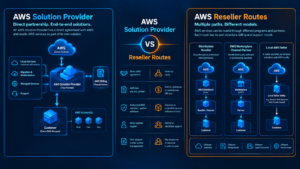
“Reseller” is a general label, not one AWS program. A company that says it resells AWS usually means one of these routes:
- Solution Provider Program: the partner has a direct agreement with AWS and bills you for AWS usage.
- AWS Distribution Program: the partner buys through an authorized AWS Distributor, which handles much of the billing and back office. This is often called two-tier resale.
- AWS Marketplace channel partner: the partner resells third-party software or professional services through Channel Partner Private Offers (CPPO), not AWS infrastructure itself.
- Local AWS seller entity: in some countries, an Amazon subsidiary sells AWS locally. In India, Amazon Web Services India Private Limited acts as the seller for AWS services. People sometimes search for it as “Amazon solutions Pvt Ltd.”
So the honest answer is simple. An AWS Solution Provider is one specific, authorized kind of AWS reseller. “Reseller” can mean any of the four routes above.
Types of AWS Partners You Will Meet
Badges and job titles blur together fast. Here is what each type of partner usually does.
- Systems integrators (SIs): design and build projects such as migrations, data platforms, or new applications. Many also resell AWS so you get one contract.
- Managed service providers (MSPs): run and monitor your environment day to day, including patching, backups, and incident response.
- Value-added resellers (VARs): focus on buying and billing, often bundling AWS with licenses, hardware, or support.
- Consultancies and software houses: advise on architecture or build software on AWS. Software companies that sell their own products usually follow the AWS Software Path rather than resale.
- Distributors: do not usually sell to you directly. They support the resellers that do.
AWS also validates skills through separate programs. The AWS Managed Service Provider Program audits operational ability, AWS Competencies recognize expertise in areas such as migration or security, and the AWS Service Delivery Program recognizes skill with specific AWS services. None of these, on its own, gives a partner the right to resell AWS.
AWS Solution Provider vs Reseller: The Real Differences
The biggest differences are not the badge names. They are who holds the AWS contract, who bills you, and who answers when something breaks.
| Route | Contract with AWS | Who bills you | What they sell | Best for |
| Buy direct from AWS | You sign the AWS Customer Agreement | AWS | All AWS services | Teams with in-house cloud skills |
| AWS Solution Provider (SPP) | Partner has a direct AWS agreement | The partner | Authorized AWS services plus its own services | One vendor for cloud, support, and services |
| Distribution reseller (two-tier) | Partner buys through an AWS Distributor | The partner (distributor handles back office) | Authorized AWS services plus its own services | Local partners and smaller firms |
| AWS Marketplace channel partner (CPPO) | ISV authorizes the partner to resell | AWS bill, partner is seller of record | Third-party software and professional services | Buying software through your AWS spend |
| Validated AWS MSP | A validation, not a billing route | Depends on the MSP | Managed operations; may also resell | Ongoing operations, audited capability |
Two points trip people up. First, an MSP badge proves operational skill through a third-party audit, but it does not by itself mean the company resells AWS. Second, a reseller discount is not the same as a better price. It depends on what the partner passes on to you.
How Buying Through an AWS Solution Provider Works
AWS publishes a Program Guide for End Customers that explains the setup. Here is what it means in practice.
Your accounts or theirs?
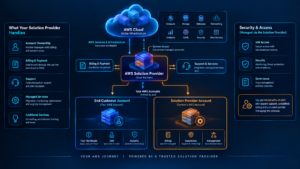
There are two resale models. Under the end customer account model, the AWS accounts are yours. Your own AWS service agreement covers how you use the services, while the partner’s agreement replaces only the fees, payment, pricing, and tax terms.
Under the solution provider account model, you use the partner’s accounts, and the partner’s terms govern your use. AWS notes this is the default model for public sector resale.
Billing and tax
With the end customer model, your accounts join the partner’s management (payer) account through AWS Organizations. Tax and billing settings switch to the partner’s details, and your invoice comes from the partner instead of AWS.
If you are opening your own account first and the AWS phone verification is not working, check your country code and number, and ask your carrier to allow international calls. If verification still fails, AWS Support can activate the account manually through an Account and billing case.
Support: Resold vs Partner-Led
- AWS Resold Support: you keep a direct technical line to AWS Support, while the partner handles billing and account questions. It comes as Business Support+, Enterprise Support, or Unified Operations.
- Partner-Led Support: the partner is your first line of support and defines its own offering, backed by AWS behind the scenes.
Ask which one you are getting. It decides who answers the phone at 2 a.m.
Access and control
AWS Organizations has two modes. With Consolidated Billing, the partner sees only your usage and invoices, and you control any other access through IAM. With All Features, the partner can control what your accounts can do and may be able to reach your content.
Once All Features is turned on, you cannot switch back. For day-to-day access, many teams connect their own identity provider to AWS IAM Identity Center, so each partner engineer gets a named, auditable login.
What stays the same no matter who bills you
Your workloads still run on the same AWS infrastructure, in the same Regions. With the end customer account model, your own AWS agreement still governs how you use the services.
The AWS guide for end customers is also clear that your Solution Provider is not an agent of AWS and cannot make promises on its behalf. If a partner promises something AWS does not offer, get it written into the partner’s contract.
What Changes on Day One When You Switch
Moving an existing AWS setup to a Solution Provider is mostly paperwork, but a few things change right away.
- Your accounts join a new organization. Under the end customer model, you join your accounts to the partner’s management account, or authorize the partner in writing to create accounts for you.
- Billing details change. Tax and payment settings move to the partner’s details. From then on, the partner invoices you.
- Root access needs a plan. If the partner creates new accounts for you, ask for the root user credentials at creation. AWS says it does not disclose root credentials and cannot release them to you later.
- Special AWS deals need a review. If you have a custom arrangement with AWS, talk to your AWS account manager before moving, since it may be affected.
- Cost visibility needs a setup. Agree on how you will still see detailed usage by account and service, so your team can keep managing spend.
Plan the switch for a quiet week. Billing changes are easier to check when nothing else is moving.
Security and Shared Responsibility With a Partner
AWS uses a shared responsibility model. AWS secures the cloud itself: the data centers, hardware, and core services. You secure what you put in the cloud, including data, identities, and settings. A partner does not change that split. It simply takes on some of your side of the work.
Good practice with any reseller or MSP:
- Give access through IAM roles, not shared passwords. Each partner engineer should sign in as a named person.
- Use least privilege. Grant only the permissions the contract needs, such as billing read access for a billing-only partner.
- Turn on multi-factor authentication everywhere. This matters most for root users and management accounts.
- Keep an audit trail. AWS CloudTrail records API activity, so you can see what was changed and by whom.
- Review access every quarter. Remove people who have left the partner’s team.
If a partner asks for more access than its work needs, ask why before you say yes.
Where MSPs, Distributors, and Marketplace Resellers Fit
AWS Managed Service Provider (MSP) Program
The AWS Managed Service Provider Program validates partners that run customer environments across the whole cloud journey. To earn the badge, a partner must pass a rigorous third-party audit, and only Advanced and Premier tier partners can join. Many MSPs are also Solution Providers, so they can both run and bill your AWS. Check for both badges if you want both.
AWS Distribution Program
AWS Distributors are vetted companies that help resellers with billing, operations, training, and go-to-market support. A reseller joins by signing an AWS Distribution Seller Agreement through its chosen distributor. AWS’s own Solution Provider Program page now points new partners to a distributor in their country to get started.
AWS Marketplace channel partners
Through Channel Partner Private Offers, a software vendor authorizes a partner to resell its product on AWS Marketplace. The partner sets custom pricing and terms and becomes the seller of record, while the charge shows up on your AWS bill.
Public sector solution providers
Government buyers often purchase through public sector resellers that hold approved contract vehicles. Carahsoft, for example, is an AWS public sector distributor that works with a network of authorized resellers. The solution provider account model is the usual default here.
Where resale is available
AWS channel programs run only in “cleared” countries. If you need an AWS service provider in Nepal or another smaller market, search the AWS Partner Solutions Finder by location, then confirm the partner’s program status directly.
Pricing Reality: Discounts, Savings Plans, and the 2025 Rule Change
Solution Providers earn program discounts and incentives from AWS. Whether you see any of that depends entirely on your contract. Some partners pass savings on. Others keep the margin to fund support and services.
One rule change hit reseller pricing hard. Starting June 1, 2025, AWS updated its partner terms so Reserved Instances and Savings Plans cover only a single end customer’s usage. Resellers can no longer buy these commitments centrally and share the discounts across many customers.
What that means for you:
- Discounts that came from a partner’s shared pool may have ended
- Commitments now need to sit with your own usage
- Any partner should be able to explain how its pricing follows the current AWS terms
Good partners show you the math. A vague promise of “up to X% off AWS” deserves a follow-up question.
What a clear reseller invoice should show
Ask for a sample invoice before you sign. A transparent one usually separates:
- AWS usage by account and service, so you can match it to AWS Cost Explorer
- Any discounts or credits applied, and where they came from
- The support plan charge, and whether it is resold or partner-led
- The partner’s own service or management fee
If everything is rolled into one number, you cannot tell whether you are saving money or paying for services you never use.
Funding a partner may be able to bring
Price is not only about discounts. AWS runs funding programs for partners, and some of that value can reach your project.
For example, Services Path partners at Select tier and above can apply for Partner Opportunity Acceleration funding for proofs of concept and migrations. It comes as cash reimbursement or AWS promotional credits. Partners also get AWS promotional credits for building solutions.
Eligibility depends on the project and on AWS approval, so treat it as a possible bonus, not a promise. Still, it is fair to ask any partner, “Is there AWS funding we could apply for on this project?” A partner that knows the programs well will usually have a clear answer.
How to Choose and Vet an AWS Solution Provider: Step by Step
Use these eight steps before you sign anything.
- Define what you need. Decide if you want billing only, support, migration help, or full managed operations.
- Search the AWS Partner Solutions Finder. Filter by location, tier, and programs such as Solution Provider, MSP, or an AWS Competency.
- Verify the badges. Confirm Solution Provider status, plus MSP validation if you need managed services.
- Ask which account model you will use. Get it in writing whether the accounts are yours or theirs, and who holds the root credentials.
- Confirm the support model. Resold Support gives you direct AWS access. Partner-Led Support makes the partner your first call.
- Review access settings. Agree on Consolidated Billing or All Features in AWS Organizations, and on IAM roles for partner staff.
- Get pricing in writing. Ask how discounts, credits, Reserved Instances, and Savings Plans work under the June 2025 rules.
- Read the exit terms. Check notice periods, fees, and how account and billing ownership returns to you.
If a partner hesitates on steps 4, 6, or 8, treat that as a warning sign.
Practical Scenarios
These are common buying situations, not real customer stories.
- A US startup with two engineers: the team wants one monthly invoice, setup help, and someone to call. A Solution Provider offering Resold Support fits well, and the founders keep their own accounts plus a direct line to AWS Support.
- A mid-size healthcare company: compliance and 24/7 monitoring matter most. A validated AWS MSP that is also a Solution Provider can run operations and handle billing under one contract.
- A state agency: procurement rules require an approved contract vehicle, so a public sector reseller working through a distributor is the usual route.
- A company buying security software: it wants a firewall product and already has AWS spend commitments. A channel partner private offer lets it buy through a trusted partner while the charge lands on the AWS bill.
- A business in India: customers with an Indian contact and billing address transact with AWS India and can pay in rupees. They can still hire a local Solution Provider for services.
Leaving or Switching Providers
You are not locked in. Under the end customer model, you unjoin your accounts from the partner’s management account, or have the partner assign that account to you. Then you update your tax and payment settings.
Switching to a new Solution Provider works the same way, followed by joining the new partner’s management account. Before you move, ask where any Reserved Instances or Savings Plans were purchased. Commitments bought in the old partner’s management account stay with that account when you leave.
Your contract with the partner sets notice periods and any exit fees, so read it before you sign, not when you want out.
Common Mistakes to Avoid
- Handing over root credentials with no MFA plan. If a partner creates your accounts, request the root credentials at creation. AWS cannot release them later.
- Turning on All Features without thinking. It gives the partner broad control and cannot be reversed.
- Confusing badges. A Solution Provider badge means resale rights. An MSP badge means audited operations. They are not the same.
- Chasing a headline discount. After the June 2025 rule change, shared-commitment discounts no longer work the old way.
- Skipping the support question. Know whether you have direct AWS Support or partner-led support before an incident.
- Expecting a reseller to prevent AWS outages. The October 2025 US East (N. Virginia) outage began with a DNS issue in Amazon DynamoDB. No partner could stop it. A good one helps you design across multiple Availability Zones or Regions and keeps you informed.
- Ignoring exit terms. Leaving is allowed, but your contract decides the notice and cost.
Should You Buy Direct, Use a Solution Provider, or Hire an MSP?
Start with the skills you already have, then add only what you are missing.
Buy direct from AWS if
- Your team is comfortable running AWS day to day
- You want full control of accounts, commitments, and support plans
- You do not need a partner to bundle services
Use an AWS Solution Provider if
- You want one invoice and one partner for cloud plus services
- You need help with setup, cost reviews, or migration
- You want billing, currency, or payment terms that suit your business
Hire a validated AWS MSP if
- You need someone to run and monitor your environment around the clock
- You face audits or strict compliance rules
- You want proven, audited operational processes
For Partners: How to Become an AWS Reseller
If you run an IT firm, software house, or consultancy, the path starts with the AWS Partner Network (APN). Joining is free through AWS Partner Central, the partner portal.
- Pick a path. Services firms join the Services Path. Companies that build and sell their own software usually follow the Software Path.
- Reach Select tier. It carries a $2,500 annual APN fee and needs AWS-certified staff, including two foundational certifications such as AWS Certified Cloud Practitioner and two technical certifications. Select tier also brings a listing in the AWS Partner Solutions Finder.
- Find a distributor. You join resale by working with an AWS Distributor in your country and signing the AWS Distribution Seller Agreement.
- Grow from there. Advanced and Premier tiers open the MSP Program and more benefits.
Your team will likely include an AWS solutions architect, someone who designs secure, reliable systems on AWS. Many hold the AWS Certified Solutions Architect credential. Partner solutions architect salaries vary widely by region and seniority, so check current salary surveys for your market.
Quick Glossary of Related Terms
- AWS cloud services provider: AWS itself, the company that runs the cloud and acts as the cloud hosting provider. Partners resell or manage its services.
- Kubernetes (K8s) cloud provider for AWS: the open-source component that connects Kubernetes clusters to AWS resources. Amazon EKS is the managed option.
- AWS Cloud Control provider: usually the Terraform “awscc” provider, built on the AWS Cloud Control API.
- Identity provider solution: a system such as Microsoft Entra ID or Okta that you connect to AWS IAM Identity Center for single sign-on.
Conclusion: Making the AWS Solution Provider vs Reseller Call
The AWS Solution Provider vs reseller question comes down to trust and structure. An AWS Solution Provider is an authorized reseller with a direct AWS agreement. Other resellers work through distributors or AWS Marketplace, and MSPs add audited operations on top.
Whichever route you choose, the details matter more than the label. Confirm who owns your accounts and root credentials, which support model you get, how partner access is controlled, and how pricing follows the June 2025 rules.
Your next step: shortlist two or three partners in the AWS Partner Solutions Finder, then run each through the eight vetting steps above. The right partner will answer every question clearly and in writing.