


Why Global Content Delivery Is a Business-Critical Decision in 2026
72% of all web traffic crosses a CDN today. The global CDN market is projected to grow from $38.75 billion in 2026 to over $69 billion by 2036 at a CAGR of 15.6%. If you are running a global website without a CDN in 2026, you are already falling behind — in speed, security, search rankings, and revenue.
The root problem is geography. Your origin server sits in one physical location — say, London. A user in Dubai sending a request to that server must travel thousands of miles across multiple network hops, each adding latency. The result? A 3–8 second page load that drives users away before they convert.
The data is unambiguous: a 1-second delay in page load time causes a 7% drop in conversions. For a UK e-commerce brand generating £50,000/month, that single second costs £3,500 — every month, invisibly.
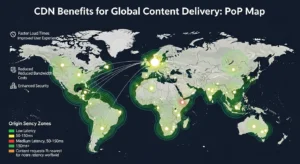
This is where the CDN benefits for global content delivery become a direct business case, not a technical nicety. A Content Delivery Network solves the geography problem by serving your content from edge servers physically close to each user — reducing that London-to-Dubai round trip from 250+ milliseconds to under 30.
In this complete 2026 guide, you will discover all 10 core CDN benefits, real performance statistics, ROI calculations, industry-specific use cases, a CDN vs No CDN comparison, provider comparisons, and a step-by-step implementation guide.
What Is a CDN and How Does It Work?
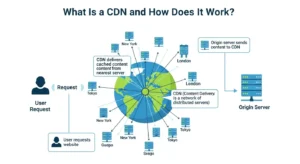
A CDN (Content Delivery Network) is a geographically distributed network of servers that caches and delivers web content from locations physically closer to end users. By serving content from edge servers rather than a single origin server, CDNs reduce latency, improve page load speed, enhance security, and lower bandwidth costs for websites and applications serving global audiences.
In one sentence: A CDN puts copies of your content on servers distributed worldwide, so every user whether in New York, London, or Dubai — receives it from a server close to them, not from your distant origin.
Static Content vs Dynamic Content Delivery
| Content Type | Examples | CDN Handling |
| Static Content | HTML, CSS, JavaScript, images, fonts, videos | Cached at edge servers; served without origin contact on cache hit |
| Dynamic Content | User dashboards, personalised feeds, real-time APIs | Not typically cached; but CDN accelerates routing and maintains persistent origin connections |
Even for dynamic, non-cacheable content, CDNs provide significant benefits through TLS offloading at the edge, persistent keep-alive connections to the origin, and routing traffic via the CDN provider’s private network rather than the unpredictable public internet.
CDN Architecture — PoPs, IXPs, and Edge Servers
| Component | What It Is | Purpose |
| Points of Presence (PoPs) | Physical server clusters in specific cities | Store cached content close to users |
| Internet Exchange Points (IXPs) | Network hubs where ISPs interconnect | Reduce hops between CDN and users’ ISPs |
| Edge Server | Individual cache/proxy server at a PoP | Serves content to users, communicates with origin on cache miss |
| Origin Server | Your web server, S3 bucket, or EC2 instance | Source of truth; only contacted on cache miss |
The 10 Core CDN Benefits for Global Content Delivery
Benefit 1 — Dramatically Reduced Latency and Faster Load Times
This is the headline benefit — and the numbers are compelling.
| Scenario | Without CDN | With CDN |
| UK origin → UAE user | 250–400ms latency | 15–30ms (Dubai edge) |
| USA origin → UK user | 120–200ms latency | 10–25ms (London edge) |
| Singapore origin → UK user | 300–500ms latency | 15–30ms (London edge) |
| Global average page load | 3–8 seconds | 0.5–1.5 seconds |
Edge computing research confirms: CDNs can reduce latency from 150ms+ to below 20ms for users accessing geographically distant services. For a well-optimised CDN, average latency typically ranges from 20–50 milliseconds globally.
The business impact is direct. Amazon’s internal research has quantified that every 100ms of latency costs approximately 1% in revenue. For a global business doing $1 million/year in online revenue, reducing latency by 200ms recovers $20,000 annually — more than covering the cost of any CDN service.
CDNs also directly improve Google Core Web Vitals:
- LCP (Largest Contentful Paint) — CDN-served images and assets load faster → LCP under 2.5 seconds → “Good” Core Vitals rating
- TTFB (Time to First Byte) — Edge-terminated TLS and proxied connections → TTFB under 600ms → positive SEO signal
Benefit 2 — Significant Bandwidth Cost Reduction
Every request your origin server fulfils costs you bandwidth — whether through data centre egress, EC2 data transfer, or hosting provider charges. A CDN’s cache offloads the majority of this traffic.
How it works: After the first user in a region requests a file, the CDN edge caches it. Every subsequent user in that region gets the cached copy — your origin never sees those requests. A well-configured CDN achieves 60–80% cache hit rates for static-content-heavy websites, meaning 60–80% of your traffic never reaches your origin server.
| Monthly Origin Bandwidth | Without CDN | With CDN (70% cache hit) | Monthly Saving |
| $500/month | $500 | ~$150 | $350 |
| $2,000/month | $2,000 | ~$600 | $1,400 |
| $10,000/month | $10,000 | ~$3,000 | $7,000 |
An independent study by Fastly found 189% ROI over 3 years when businesses migrated to a modern CDN — factoring in reduced bandwidth costs, infrastructure savings, and improved conversion rates from faster load times.
Pro Tip:
For AWS users, using Amazon CloudFront with an S3 origin is particularly cost-efficient. Data transfer from S3 to CloudFront edge locations is completely free — you only pay for CloudFront’s delivery to end users, which is priced lower than direct S3 egress.
Benefit 3 — Handling Traffic Spikes Without Downtime
Traffic spikes are unpredictable and devastating without a CDN. A product launch, a viral social media post, a Black Friday flash sale, or a breaking news article can send 10x–100x normal traffic to your origin server in minutes — crashing it entirely.
A CDN handles this through:
| Mechanism | How It Helps During Spikes |
| Distributed load | Traffic distributed across hundreds of PoPs; no single server is overwhelmed |
| Anycast routing | DNS automatically routes users to the nearest available edge node |
| Origin offloading | 60–80% of requests served from cache — origin only handles cache misses |
| Auto-scaling edge | Major CDN providers scale edge capacity automatically — no pre-provisioning needed |
Real-world example: During a Black Friday sale, a UK fashion retailer sees 50,000 concurrent visitors — 10x their normal load. Without a CDN, their single London origin server crashes. With a CDN, 80% of product page requests are served from cached edge copies globally. The origin handles only 10,000 dynamic requests. Zero downtime.
Benefit 4 — DDoS Protection and Edge Security
DDoS attacks increased by 23.26% year-over-year in 2024 — and the trend continues upward in 2026. CDNs provide critical protection because their distributed architecture makes them inherently DDoS-resistant.
How CDN DDoS protection works:
| CDN Security Feature | What It Does |
| Distributed absorption | Attack traffic distributed across 100s of PoPs — no single point overwhelmed |
| Anycast diffusion | Attack routed to nearest 50+ data centres simultaneously, diluting impact |
| Rate limiting at edge | Malicious request patterns blocked before reaching origin |
| WAF integration | OWASP Top 10 attacks filtered at the edge — SQL injection, XSS, bot traffic |
| SSL/TLS termination | All user-to-edge traffic encrypted; DDoS targeting SSL handshakes absorbed at edge |
| TLS False Start | Enables ~15% faster HTTPS performance by reducing round trips |
Amazon CloudFront includes AWS Shield Standard free with every distribution — automatic Layer 3/4 DDoS protection across all 400+ PoPs. AWS Shield Advanced adds Layer 7 protection, cost shielding, and a 24/7 DDoS Response Team. The global CDN security market is projected to reach $72.9 billion by 2036 — reflecting how central CDN security features have become to enterprise infrastructure.
Benefit 5 — Improved SEO Rankings Through Faster Load Times
Google made page experience — including Core Web Vitals — a direct ranking factor, and CDNs are the most impactful single infrastructure change for improving these metrics:
| Core Web Vital | Target | CDN Impact |
| LCP (Largest Contentful Paint) | Under 2.5 seconds | CDN-served images/assets load from nearby edge → LCP improves by 40–70% |
| TTFB (Time to First Byte) | Under 600ms | Edge TLS termination and persistent connections → TTFB drops from 500ms+ to 50–100ms |
| INP (Interaction to Next Paint) | Under 200ms | Faster asset loading → browser processes interactions faster |
| CLS (Cumulative Layout Shift) | Under 0.1 | Faster font/image loading prevents layout shifts during page render |
Data shows pages ranking at position 1 are 10% more likely to pass Core Web Vitals thresholds than lower-ranking pages. For competitive search terms in UK, USA, or UAE markets, CDN-driven Core Vitals improvements can be the difference between page 1 and page 2 — an enormous traffic and revenue gap.
For mobile users — increasingly the majority — faster load times on mobile networks matter even more. Google uses mobile performance data as its primary ranking signal via mobile-first indexing.
Benefit 6 — Enhanced Video Streaming and Media Delivery
Video is the dominant internet traffic type — and CDNs are what make global video streaming possible at scale.
| CDN Video Capability | How It Works | Business Benefit |
| Adaptive Bitrate (ABR) Streaming | Edge detects user connection speed; serves appropriate video quality (HLS/DASH) | No buffering regardless of network conditions |
| VOD delivery | Video files pre-cached at edge PoPs globally | Instant playback, no wait for origin buffering |
| Live streaming distribution | Edge PoPs act as relay nodes distributing live streams | Millions of concurrent viewers with no origin overload |
| Large file distribution | Game patches, software updates distributed from edge | Fast downloads globally without central server bottleneck |
Netflix, YouTube, and every major streaming platform rely on CDN infrastructure for global delivery. An e-learning platform based in the UK serving students in the USA and UAE simultaneously uses CDN edge nodes to deliver the same lecture video from London, New York, and Dubai edges each student experiencing local-speed delivery.
Benefit 7 — Higher Availability and Content Redundancy
A CDN provides geographic redundancy that no single-origin setup can match:
| Availability Scenario | Single Origin | With CDN |
| Origin server hardware failure | Full downtime | CDN serves cached content; stale-while-revalidate keeps site up |
| Data centre network outage | Full downtime | Anycast routing sends users to next nearest PoP automatically |
| Regional internet disruption | Partial/full outage | Other regional PoPs continue serving users in unaffected areas |
| Planned maintenance | Downtime window required | Origin can be taken offline; CDN serves cached content |
| Traffic spike overload | Origin crashes | CDN absorbs load; origin protected |
Most major CDN providers offer 99.9%+ uptime SLAs backed by this distributed redundancy. Amazon CloudFront is backed by a 100% uptime SLA — one of the most robust in the industry because even if edge PoPs are unavailable, Anycast routing fails over to the next nearest location within milliseconds.
Benefit 8 — Reduced Infrastructure and Operational Costs
Building your own multi-region server infrastructure to match what a CDN provides is prohibitively expensive for most businesses:
| Approach | Setup Cost | Monthly Cost | Management Overhead |
| Self-managed multi-region (5 regions) | $50,000–$200,000+ | $5,000–$20,000+ | Dedicated infrastructure team |
| CDN (e.g., Amazon CloudFront) | $0 | $5–$500 (usage-based) | Zero infrastructure management |
| CDN (enterprise, Akamai) | $0 | Custom contract | Minimal |
CDN converts a CapEx infrastructure investment into an OpEx pay-per-use model. A startup launching their SaaS product in the UK gains instant global reach to the USA and UAE without provisioning a single server in those regions. The CDN handles global infrastructure the team focuses on product.
Pro Tip for Startups: Amazon CloudFront’s Always Free tier (1 TB/month, 10 million requests/month) means small businesses and early-stage startups can access global CDN infrastructure at literally zero cost.
Benefit 9 — Real-Time Analytics and Traffic Intelligence
Modern CDNs provide rich analytics that give you visibility into your global user base — data that your origin server alone cannot provide:
| Analytics Capability | What You Learn | Business Use |
| User geographic distribution | Which countries/cities drive your traffic | Prioritise regional marketing, localisation investment |
| Cache hit rate by PoP | Which edge locations are well-optimised | Tune TTL values, identify under-cached content types |
| TTFB and load time by region | Where users experience slowness | Identify performance improvements needed |
| Traffic volume by time | Peak hours across time zones | Plan capacity, schedule deployments in low-traffic windows |
| Error rates by origin | 4xx/5xx patterns at scale | Identify application errors before users report them |
| DDoS and WAF events | Attack patterns and blocked requests | Security posture assessment, compliance evidence |
Amazon CloudFront integrates directly with AWS CloudWatch for real-time dashboards and alerts, and supports Kinesis Data Firehose for streaming logs to analytics platforms — enabling near-real-time traffic intelligence across all 400+ PoPs.
Benefit 10 — Future-Ready: Edge Computing and Edge AI
In 2026, CDN technology has evolved far beyond simple caching. The modern CDN is an edge computing platform — running application logic at the network edge, not just serving cached files.
| Edge Capability | Technology | Use Case |
| Serverless edge functions | Lambda@Edge (AWS), Cloudflare Workers, Fastly Compute | A/B testing, auth, URL rewrites, personalisation — at zero-origin latency |
| Edge AI inference | ML models deployed at PoPs | Real-time content personalisation, image recognition, fraud detection without round-trip latency |
| 5G-optimised delivery | CDN PoPs placed at 5G edge nodes | Ultra-low latency for mobile-first apps (sub-10ms) |
| IoT content delivery | CDN serving firmware, config files, telemetry | Billions of IoT devices updated via edge without origin overload |
| QUIC / HTTP/3 support | Next-gen protocol support at edge | Faster connection establishment, better performance on lossy networks |
Cloud CDN providers are recording the fastest growth segment at 14.7% CAGR through 2034 — driven precisely by this expansion from static caching to full edge compute platforms. Lambda@Edge and CloudFront Functions (AWS) already allow full application logic execution at 400+ PoPs worldwide, with sub-millisecond function execution for lightweight tasks.
CDN vs No CDN — Performance and Business Impact Comparison
| Metric | Without CDN | With CDN |
| Page Load Time (global users) | 3–8 seconds | 0.5–1.5 seconds |
| TTFB | 500–1,500ms | 50–200ms |
| LCP Score | Often “Needs Improvement” / “Poor” | Typically “Good” (under 2.5s) |
| DDoS Vulnerability | High — single origin target | Low — distributed absorption |
| Bandwidth Cost | 100% origin egress cost | 20–40% of origin cost |
| Uptime During Traffic Spikes | Risk of full outage | Handles 10x–100x normal load |
| SEO Core Vitals | Lower scores, weaker rankings | Better LCP/TTFB → stronger rankings |
| Global Reach | Single-region latency for all users | Low latency globally from nearby PoPs |
| Video Streaming Quality | Buffering, high abandonment | Smooth adaptive bitrate playback |
| Setup Complexity | N/A | Minutes with Amazon CloudFront |
| Infrastructure Cost | Origin scales with all traffic | Origin only handles cache misses |
Honest Assessment: A CDN does not help if your content is entirely dynamic and non-cacheable (e.g., a personalised real-time data dashboard with no static assets). In that case, consider AWS Global Accelerator for TCP/UDP path optimisation rather than a CDN. For most websites — which have at least some static assets — CDN benefits are immediate and significant.
Industry-Specific CDN Use Cases for Global Businesses
E-Commerce — Fast Product Pages, Global Checkout
For e-commerce, speed is revenue. Akamai research found a 16% lower customer satisfaction for every 1-second delay in page load. Product images, CSS, JavaScript bundles, and promotional assets are all ideal for CDN caching.
Specific benefits for e-commerce:
- Product catalogue pages load instantly from edge cache
- High-resolution product images delivered from regional PoPs
- Checkout pages served with edge TLS offloading for security and speed
- Black Friday and seasonal sale traffic spikes absorbed automatically
- Real scenario: A UK fashion retailer using Amazon CloudFront serves product images from a Dubai edge PoP to UAE customers 800ms load time instead of 4+ seconds — resulting in measurable uplift in UAE conversion rate
SaaS and Web Applications
SaaS applications benefit from CDN even with dynamic content:
| SaaS Benefit | How CDN Delivers It |
| Cacheable API responses | GET requests for product catalogues, configuration, reference data cached at edge |
| Static asset delivery | JS bundles, CSS, web fonts — cached globally |
| WebSocket acceleration | Some CDN providers proxy WebSocket connections via edge for lower latency |
| Geo-personalisation | Edge functions detect user location → serve region-specific content |
| Global dashboard performance | Users in EU, North America, APAC all experience near-local-speed |
Media Streaming and Entertainment
CDN is the backbone of the global streaming industry:
| Use Case | CDN Role |
| Live sports/events | Edge PoPs relay live HLS/DASH streams to millions of concurrent viewers |
| VOD libraries | Films, episodes pre-cached at regional PoPs based on demand patterns |
| Podcast/audio delivery | Audio files cached at edge; low-latency streaming globally |
| E-learning platforms | Lecture videos, downloadable resources served from regional edges |
| Real scenario | An online education platform in the UK delivers HD lecture videos to students in New York and Dubai via CloudFront — achieving sub-1-second start times globally |
Online Gaming
| Gaming Benefit | CDN Contribution |
| Game update distribution | Multi-GB patches distributed via CDN — download speeds maximised globally |
| Reduced ping | Game server discovery content served from nearby PoPs |
| DDoS protection | Volumetric attacks absorbed at CDN edge — game servers protected |
| Leaderboard/score APIs | Cached API responses for read-heavy game data (rankings, item catalogs) |
Enterprise and Government Portals
| Use Case | CDN Value |
| Internal document delivery | Private CDN distributions for sensitive documents with access controls |
| Compliance | Data sovereignty maintained — UK GDPR (eu-west-2), UAE PDPL (me-south-1) |
| Intranet static assets | CSS, JS, images for internal tools accelerated globally for distributed workforces |
| Government citizen portals | High-traffic service announcements served reliably during peak access |
How to Choose the Right CDN for Global Content Delivery
Key Selection Criteria
| Criterion | What to Evaluate |
| Geographic PoP coverage | Do PoP locations match where your actual users are? (UK, USA, UAE, APAC?) |
| Security features | DDoS protection tier, WAF capability, SSL/TLS certificate management |
| Pricing model | Pay-per-use (flexible) vs flat-rate (predictable); egress pricing per region |
| AWS/stack integration | Native vs connector-based; Alias record support; Lambda@Edge availability |
| SLA and uptime | 99.9% minimum; 100% for mission-critical workloads |
| Analytics and observability | Real-time logs, cache hit rate dashboards, integration with monitoring tools |
| Support quality | 24/7 support availability, documentation depth, developer experience |
Top CDN Providers Compared — 2026
| Provider | PoPs | Free Tier | AWS Native | Best For | Notable Strength |
| Amazon CloudFront | 400+ | ✅ Always Free (1TB/mo) | ✅ Yes | AWS workloads | Native S3/EC2/Lambda integration |
| Cloudflare | 330+ | ✅ Generous free plan | ❌ Via connectors | Multi-cloud | Speed, free DDoS, ease of use |
| Akamai | 4,100+ | ❌ No | ❌ No | Large enterprise | Largest PoP network, longest track record |
| Fastly | 80+ | ❌ No | ❌ No | Developer-centric | Real-time purging, WASM edge compute, 189% ROI study |
Why Amazon CloudFront Is the Best CDN for AWS Workloads
For any application hosted on AWS, Amazon CloudFront is the natural CDN choice:
| Advantage | Detail |
| Zero origin transfer cost | Data from S3, EC2, ELB to CloudFront is completely free |
| Native AWS integration | S3 OAC, Lambda@Edge, Route 53 Alias, WAF, ACM certificates — all native |
| Private network delivery | Traffic travels the AWS backbone — not the public internet — from origin to edge |
| 400+ PoPs | Global coverage including UK (London), USA (multiple), UAE (Dubai) |
| Always Free tier | 1 TB/month + 10 million requests/month at zero cost |
| Flat-rate plans | $0–$1,000/month bundles that include CDN + WAF + DDoS + DNS |
Getting Started with CDN — Quick Implementation Guide
Step 1 — Identify Your Content Types (Static vs Dynamic)
Audit your website assets. Identify: images, CSS, JavaScript, fonts, video files (static — ideal for CDN caching), vs. personalised user data, real-time APIs (dynamic — route via CDN but do not cache).
Step 2 — Choose Your CDN Provider
For AWS workloads: Amazon CloudFront. For multi-cloud or provider-agnostic: Cloudflare. For enterprise with maximum PoP coverage: Akamai. For developer-focused edge compute: Fastly.
Step 3 — Configure Your Origin (S3 Bucket or Web Server)
For CloudFront: specify your S3 bucket URL or EC2/ELB endpoint as the origin. Enable Origin Access Control (OAC) for S3 to ensure only CloudFront can access your bucket directly.
Step 4 — Create CDN Distribution and Configure Cache Rules
Define cache behaviours by URL path:
- /*.jpg, /*.png, /*.css, /*.js → cache for 86,400–604,800 seconds (1–7 days)
- /api/* → cache for 0–300 seconds (or bypass)
- /checkout/* → bypass cache (no caching of personal/payment data)
Step 5 — Update DNS Records to Point to CDN
Update your domain’s CNAME record (or Alias record in Route 53) to point to your CDN distribution’s domain (e.g., d1234abcd.cloudfront.net). Enable HTTPS-only redirect.
Step 6 — Test Performance with PageSpeed / WebPageTest
Run your URL through Google PageSpeed Insights and WebPageTest before and after CDN implementation. Measure TTFB, LCP, and total load time from multiple global test locations.
Step 7 — Monitor Cache Hit Rate and Optimise TTL Values
In your CDN analytics, monitor your cache hit ratio. A healthy ratio is 70%+. If lower, review TTL values, ensure cache-control headers are set correctly on your origin, and check if query strings are preventing caching.
Frequently Asked Questions About CDN Benefits
Q1: What are the main benefits of a CDN for global content delivery?
The main CDN benefits for global content delivery include: reduced latency (40–80% faster load times globally), lower origin bandwidth costs (60–80% reduction), DDoS protection at the edge, higher availability during traffic spikes, improved SEO through better Core Web Vitals scores, and enhanced video streaming quality for worldwide audiences — all without building multi-region server infrastructure.
Q2: How much does a CDN improve website speed?
CDNs typically improve page load times by 40–80% for global users. A UK-origin website serving UAE visitors can see load times drop from 4+ seconds to under 1 second using a CDN edge server in Dubai. Average CDN latency globally is 20–50 milliseconds — versus 150–400ms for a distant origin server.
Q3: Is a CDN necessary for small businesses?
A CDN benefits any business with users in multiple geographic locations. With providers like Amazon CloudFront offering an Always Free tier (1 TB/month, 10 million requests/month), there is minimal barrier to entry. Even a simple static website gains meaningfully from CDN-accelerated load times, improved SEO scores, and free DDoS protection at the edge.
Q4: How does a CDN help with DDoS protection?
CDNs distribute traffic across hundreds of PoPs globally — making it extremely difficult for DDoS attacks to overwhelm any single server. Most CDN providers include automatic DDoS mitigation that absorbs attack traffic at the network edge before it reaches your origin. Amazon CloudFront includes AWS Shield Standard free with every distribution for Layer 3/4 protection.
Q5: Does a CDN improve SEO rankings?
Yes. CDNs improve Google Core Web Vitals metrics — particularly LCP (Largest Contentful Paint) and TTFB (Time to First Byte). Google uses page speed as a direct ranking factor, and research shows position-1 pages are 10% more likely to pass Core Web Vitals thresholds. CDN-accelerated sites consistently outrank slower competitors in both mobile and desktop search results.
Conclusion — Unlocking Global Growth with CDN Benefits
CDNs have become essential for global content delivery in 2026, significantly improving website speed, security, and scalability. By caching content at edge locations around the world, CDNs can reduce load times by 40–80%, making them one of the most impactful infrastructure upgrades for global websites. The CDN market is projected to exceed $69 billion by 2036, highlighting how edge delivery has become the dominant model for internet content.
Modern CDNs also include built-in security features such as DDoS protection, WAF integration, and SSL/TLS encryption at the edge. For AWS-based workloads, Amazon CloudFront stands out with deep integration with services like S3 and EC2 and a global network of 400+ edge locations. As edge computing continues to evolve with technologies like Lambda@Edge and edge AI, CDNs are becoming programmable platforms rather than simple caching layers. Businesses looking to implement and optimize global CDN strategies can accelerate deployment and performance with the support of GoCloud.